

niña y gato
Overview of the Artwork
niña y gato (Chica joven con gato) c1882 is an exquisite example of 19th-century French academic painting, created by Emilio Munier (1840 – 1895), a renowned French painter known for his detailed depictions of children and their emotional depth. Pintado en 1882, this portrait captures a delicate moment of childhood innocence, perfectly encapsulated through the innocent gaze of a young girl who is lovingly interacting with a cat. La meticulosa atención del artista al detalle., his ability to capture human expression, and his expert use of light and color make this piece a standout in the genre of academic realism.
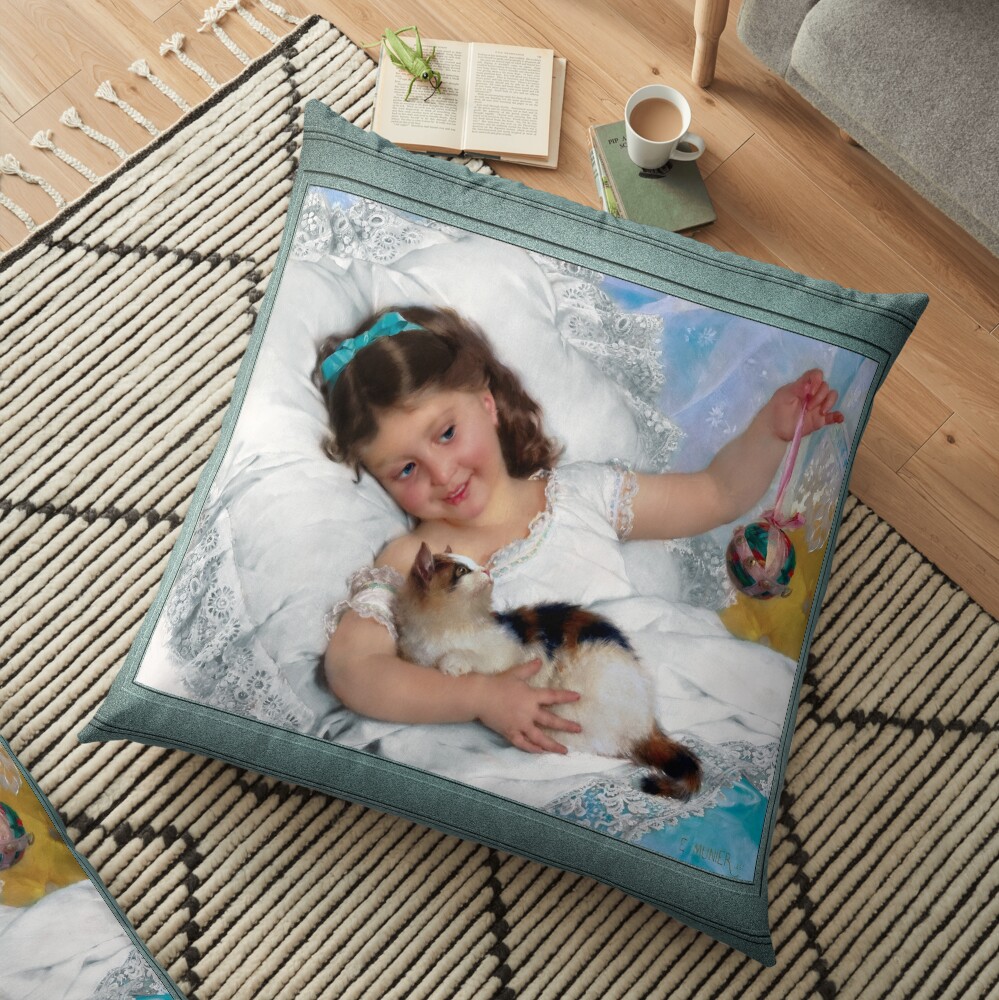
Tabla de contenido
El tema principal: The Young Girl
En el corazón de “niña y gato” is the young girl, whose porcelain-like skin and gentle expression convey both fragility and joy. She is depicted in a moment of quiet delight as she reclines on a cushion, her body slightly turned towards the viewer while her gaze is directed downward at the small cat resting beside her. The girl’s soft brown hair is styled in loose waves, with a bright blue ribbon nestled at the crown of her head, adding a touch of playfulness to her appearance. The pale blue ribbon contrasts beautifully with the softness of her white gown, further emphasizing the purity and simplicity of her childhood.
The fabric of her gown is rendered in soft, flowing folds that suggest a fine, luxurious material. Its delicate lace trims at the neckline and sleeves add an element of refinement, capturing the high level of craftsmanship typical of the period. The girl’s posture and demeanor evoke an image of serene contentment, perfectly in tune with the theme of childhood innocence that the artist sought to portray.
The Cat: A Companion in Innocence
The cat, nestled contentedly beside the girl, plays a pivotal role in the composition. It is rendered with extraordinary attention to detail, particularly in its fur, which exhibits the artist’s characteristic skill in portraying texture. The cat’s distinctive coat of fur—patches of white, naranja, and brown—creates a sense of realism, while its playful yet peaceful demeanor adds to the tranquil atmosphere of the painting. The young girl’s hand rests gently on the cat’s back, a tender gesture that reinforces the bond between the child and her pet, a universal symbol of innocence and companionship.
The cat’s presence in the painting also serves as a subtle contrast to the girl’s softness and elegance. It represents a more spontaneous and untamed element, yet in this context, it becomes a gentle companion, further enhancing the serene mood of the artwork.
Antecedentes y entorno
The background of the painting is as meticulously composed as the figures in the foreground. The setting appears to be an indoor space, possibly a child’s nursery or a drawing room, where the soft textures of a luxurious fabric and a gentle play of light are at the forefront. Behind the young girl and cat, un suave, ethereal blue hue transitions to a creamy pastel yellow, creating a dreamy, almost otherworldly atmosphere. The background is delicately painted, featuring light touches of drapery that hint at the artist’s attention to both the natural light filtering through the space and the textures of the fabrics.
Lace and other delicate elements such as floral patterns also appear in the background, adding complexity and depth to the scene without overwhelming the primary subject. La habitación, filled with these light, tonos suaves, emphasizes the purity of childhood, offering a quiet sanctuary where the girl and her cat are free to indulge in their peaceful moment.
El uso del color y la luz
Munier’s use of light and color is central to the emotional impact of “Petite Fille et Chat.” Lo suave, pastel tones—predominantly blues, ropa blanca, and subtle hints of pink—dominate the composition, creating a serene and almost dreamlike quality. The delicate color palette enhances the theme of innocence, furthering the narrative of childhood purity and happiness.
The interplay of light and shadow on the girl’s face and gown is masterfully handled. Munier uses light to bring out the luminous quality of her skin, contrasting it with the subtle shadowing beneath her chin and along her collarbone, which adds depth to her features. The glow of her cheeks and the soft illumination around her eyes suggest a youthful vitality, yet this is contrasted by the calm serenity of the scene.
Emotional Impact and Theme
“niña y gato” captures a moment of innocence and tranquility. The theme of childhood—its purity, ternura, and closeness to nature—is rendered with delicate precision. The interaction between the girl and her cat is both intimate and gentle, a visual expression of the love and affection that often characterizes the bond between children and their pets.
The emotional atmosphere of the painting is one of warmth and comfort, a sanctuary from the outside world. Lo suave, intimate moment between the girl and her cat seems to freeze time, inviting the viewer into a quiet, peaceful world where the only concerns are love and companionship. Munier’s portrayal of the girl’s sweet expression and the peaceful setting imbue the work with a sense of nostalgia, evoking a longing for simpler times and the beauty of childhood.
Estilo artístico: Academic Realism
Emile Munier was a master of academic realism, a style characterized by its focus on the careful study of light, human anatomy, y el mundo natural. His works often feature children in idyllic settings, exploring themes of innocence, pureza, y profundidad emocional. The precision with which Munier renders the details of the girl’s face, the textures of her gown, and the softness of the cat’s fur speaks to his exceptional technical skill and dedication to realism. His careful attention to detail in both the figures and the background elements reflects the high standards of academic painting in the 19th century.
Conclusión
“niña y gato” is a timeless portrayal of childhood innocence and the beauty of quiet moments shared between a child and her pet. Through his exquisite use of light, color, y textura, Munier creates a scene that resonates with emotional warmth and tenderness. The piece stands as a perfect example of academic realism, blending technical skill with an intimate portrayal of the human experience.
Petite Fille et Chat es una reproducción de maestros antiguos de arte digital remasterizada de una imagen de dominio público que está disponible como Esta es una elegante chica de glamour art deco vintage..
Sobre el artista
Información a continuación derivada de Wikipedia.org
Emilio nació en París, Francia a Pierre François Munier; un artista tapicero en la fábrica de tapices Nationale des Gobelins (en París Francia) y María Luisa Carpentier, una pulidora en una fábrica de telas de cachemira.
También tuvo dos hermanos, François y Florimond.; que junto con él que se formó y trabajó como artista durante un período en el Nationale des Gobelins.
En la fábrica Emile fue formado como dibujante por Abel Lucas, y desarrollaría una estrecha relación con Abel y su familia., lo que llevó a Emile a casarse con Lucas’ hija heriette en 1861.
tristemente en 1867, seis semanas después de que su esposa diera a luz a su hijo Emile Henri, ella contrajo reumatismo severo, y murió prematuramente.
En 1871 Emile dejó la fábrica de tapices para dedicarse a la pintura a tiempo completo., además de brindar clases de pintura a adultos tres noches a la semana.
Entonces en 1872 Emile se casó con Sargine Augrand, estudiante de Abel Lucas y amiga de Emile y Henriette.; la pareja tuvo una hija, Marie-Louise, quien nació en 1874.
En 1884 recibió una comisión del gobernador Leland Stanford de California y su esposa Jane Stanford para crear una pintura de su hijo Leland Stanford, jr., que había fallecido a la edad de 15 años; y tituló la pieza Ángel consolando a su madre afligida; que el niño como ángel que volvió a la tierra para consolar a su madre con su mano puesta sobre su hombro.
Uno de los maestros más influyentes de Emilio fue el pintor francés William-Adolphe Bouguereau. (1825 – 1905), y uno puede ver la influencia que tuvo en Emile en muchas de las piezas que creó y, con el tiempo, los dos también se hicieron amigos cercanos..
Una de sus obras más famosas., que demostró esta influencia es su pieza Trois Amis o Three Friends, que expuso en el Salón de París de 1885; que representaba a una niña gordita jugando en su cama con su gatito y su perro.
Este trabajo fue tan bien querido por el público, que fue reproducido en muchas formas y también fue utilizado para publicidad por la compañía británica de jabón Pears Soap; que se estableció en 1807, producir el primer jabón transparente del mundo.
Esta pintura lo ayudó a establecerse como uno de los principales pintores de niños pequeños y sus mascotas.; y continuaría pintando tales escenas junto con escenas de pesca de animales., paisajes marinos, paisajes, género escenas campesinas, temas mitológicos y religiosos a lo largo de la década de 1890 hasta su prematura muerte en 1895 a la edad de 55.