

Petite Fille et Chat
Aperçu de l'œuvre
Petite Fille et Chat (Jeune fille au chat) c1882 is an exquisite example of 19th-century French academic painting, created by Emile Munier (1840 – 1895), a renowned French painter known for his detailed depictions of children and their emotional depth. Peint 1882, this portrait captures a delicate moment of childhood innocence, perfectly encapsulated through the innocent gaze of a young girl who is lovingly interacting with a cat. L’attention méticuleuse aux détails de l’artiste, his ability to capture human expression, and his expert use of light and color make this piece a standout in the genre of academic realism.
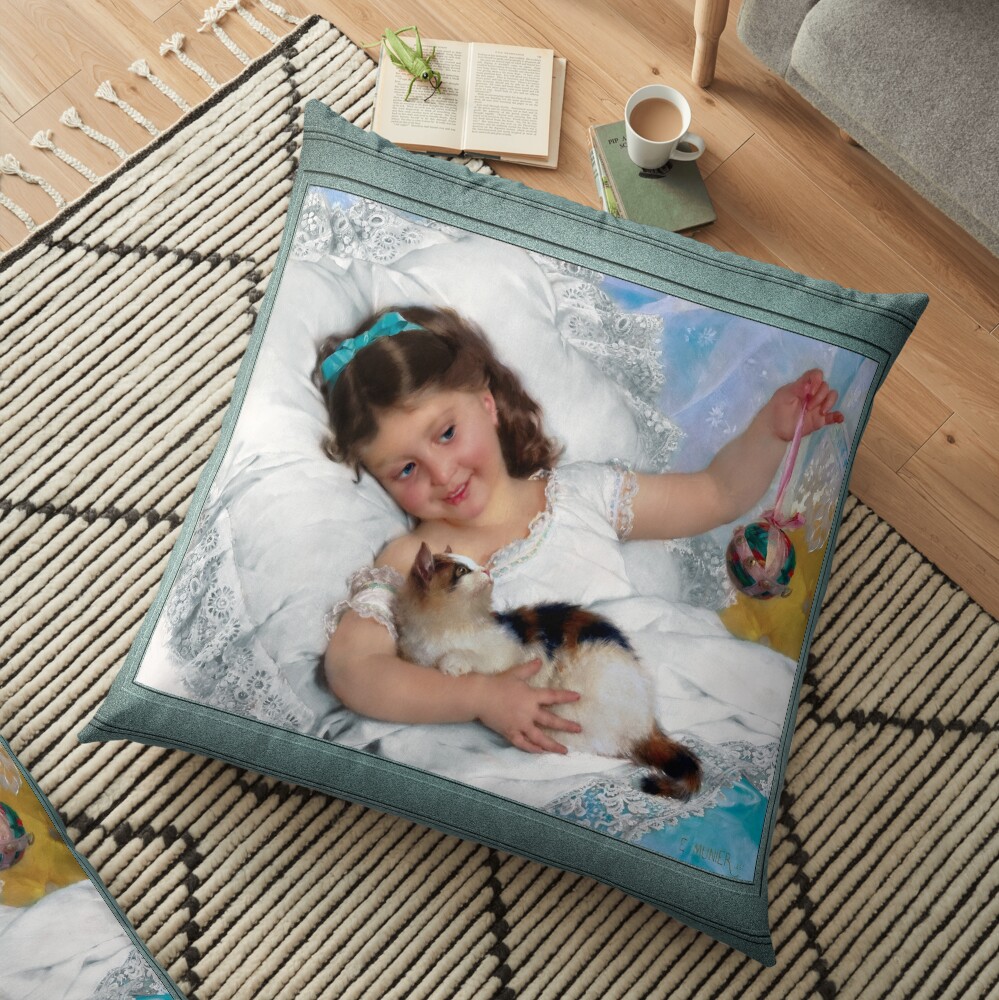
Table des matières
Le sujet principal: La jeune fille
Au coeur de “Petite Fille et Chat” is the young girl, whose porcelain-like skin and gentle expression convey both fragility and joy. She is depicted in a moment of quiet delight as she reclines on a cushion, her body slightly turned towards the viewer while her gaze is directed downward at the small cat resting beside her. The girl’s soft brown hair is styled in loose waves, with a bright blue ribbon nestled at the crown of her head, adding a touch of playfulness to her appearance. The pale blue ribbon contrasts beautifully with the softness of her white gown, further emphasizing the purity and simplicity of her childhood.
The fabric of her gown is rendered in soft, flowing folds that suggest a fine, luxurious material. Its delicate lace trims at the neckline and sleeves add an element of refinement, capturing the high level of craftsmanship typical of the period. The girl’s posture and demeanor evoke an image of serene contentment, perfectly in tune with the theme of childhood innocence that the artist sought to portray.
The Cat: A Companion in Innocence
The cat, nestled contentedly beside the girl, plays a pivotal role in the composition. It is rendered with extraordinary attention to detail, particularly in its fur, which exhibits the artist’s characteristic skill in portraying texture. The cat’s distinctive coat of fur—patches of white, Orange, and brown—creates a sense of realism, while its playful yet peaceful demeanor adds to the tranquil atmosphere of the painting. The young girl’s hand rests gently on the cat’s back, a tender gesture that reinforces the bond between the child and her pet, a universal symbol of innocence and companionship.
The cat’s presence in the painting also serves as a subtle contrast to the girl’s softness and elegance. It represents a more spontaneous and untamed element, yet in this context, it becomes a gentle companion, further enhancing the serene mood of the artwork.
Contexte et cadre
The background of the painting is as meticulously composed as the figures in the foreground. The setting appears to be an indoor space, possibly a child’s nursery or a drawing room, where the soft textures of a luxurious fabric and a gentle play of light are at the forefront. Behind the young girl and cat, un doux, ethereal blue hue transitions to a creamy pastel yellow, creating a dreamy, almost otherworldly atmosphere. The background is delicately painted, featuring light touches of drapery that hint at the artist’s attention to both the natural light filtering through the space and the textures of the fabrics.
Lace and other delicate elements such as floral patterns also appear in the background, adding complexity and depth to the scene without overwhelming the primary subject. La pièce, filled with these light, tons doux, emphasizes the purity of childhood, offering a quiet sanctuary where the girl and her cat are free to indulge in their peaceful moment.
L'utilisation de la couleur et de la lumière
Munier’s use of light and color is central to the emotional impact of “Petite Fille et Chat.” Le doux, pastel tones—predominantly blues, blancs, and subtle hints of pink—dominate the composition, creating a serene and almost dreamlike quality. The delicate color palette enhances the theme of innocence, furthering the narrative of childhood purity and happiness.
The interplay of light and shadow on the girl’s face and gown is masterfully handled. Munier uses light to bring out the luminous quality of her skin, contrasting it with the subtle shadowing beneath her chin and along her collarbone, which adds depth to her features. The glow of her cheeks and the soft illumination around her eyes suggest a youthful vitality, yet this is contrasted by the calm serenity of the scene.
Emotional Impact and Theme
“Petite Fille et Chat” captures a moment of innocence and tranquility. The theme of childhood—its purity, tendresse, and closeness to nature—is rendered with delicate precision. The interaction between the girl and her cat is both intimate and gentle, a visual expression of the love and affection that often characterizes the bond between children and their pets.
The emotional atmosphere of the painting is one of warmth and comfort, a sanctuary from the outside world. Le doux, intimate moment between the girl and her cat seems to freeze time, inviting the viewer into a quiet, peaceful world where the only concerns are love and companionship. Munier’s portrayal of the girl’s sweet expression and the peaceful setting imbue the work with a sense of nostalgia, evoking a longing for simpler times and the beauty of childhood.
Style artistique: Réalisme académique
Emile Munier was a master of academic realism, a style characterized by its focus on the careful study of light, human anatomy, et le monde naturel. His works often feature children in idyllic settings, exploring themes of innocence, pureté, et profondeur émotionnelle. The precision with which Munier renders the details of the girl’s face, the textures of her gown, and the softness of the cat’s fur speaks to his exceptional technical skill and dedication to realism. His careful attention to detail in both the figures and the background elements reflects the high standards of academic painting in the 19th century.
Conclusion
“Petite Fille et Chat” is a timeless portrayal of childhood innocence and the beauty of quiet moments shared between a child and her pet. Through his exquisite use of light, Couleur, et texture, Munier creates a scene that resonates with emotional warmth and tenderness. The piece stands as a perfect example of academic realism, blending technical skill with an intimate portrayal of the human experience.
Petite Fille et Chat est une reproduction remasterisée de maîtres anciens d'art numérique d'une image du domaine public disponible sous forme de impression sur toile.
À propos de l'artiste
Informations ci-dessous dérivées de Wikipedia.org
Émile est né à Paris, France to Pierre François Munier; un artiste tapissier à la manufacture de tapisserie Nationale des Gobelins (à Paris France) et Marie-Louise Carpentier, un polisseur dans une usine de tissu de cachemire.
Il avait également deux frères François et Florimond; celui avec lui qui s'est formé et a travaillé un temps comme artiste à la Nationale des Gobelins.
A l'usine Emile fut formé comme dessinateur par Abel Lucas, et développerait une relation étroite avec Abel et sa famille, ce qui a conduit Emile à épouser Lucas’ fille Hériette dans 1861.
Malheureusement dans 1867, six semaines après que sa femme a donné naissance à leur fils Emile Henri, elle a contracté de graves rhumatismes, et est mort prématurément.
Dans 1871 Emile quitte la fabrique de tapisserie pour se consacrer à la peinture à plein temps, ainsi que des cours de peinture aux adultes trois soirs par semaine.
Puis dans 1872 Emile a épousé Sargine Augrand, élève d'Abel Lucas et amie d'Emile et Henriette; le couple a eu une fille Marie-Louise, qui est né en 1874.
Dans 1884 il a reçu une commande du gouverneur Leland Stanford de Californie et de son épouse Jane Stanford pour créer une peinture de leur fils Leland Stanford., Jr., décédé à l'âge de 15 années; ahd il a intitulé la pièce Angel Comforting His Grieving Mother; que le garçon comme ange qui est revenu sur terre pour réconforter sa mère avec sa main posée sur son épaule.
L'un des professeurs les plus influents d'Émile était le peintre français William-Adolphe Bouguereau. (1825 – 1905), et on peut voir l'influence qu'il a eu sur Emile dans de nombreuses pièces qu'il a créées et au fil du temps, les deux sont également devenus des amis proches..
Une de ses œuvres les plus célèbres, qui a démontré cette influence est sa pièce Trois Amis ou Three Friends, qu'il a exposé au Salon de Paris en 1885; qui représentait une petite fille potelée jouant sur son lit avec son chaton et son chien.
Cette œuvre a été tellement appréciée du public, qu'il a été reproduit sous de nombreuses formes et a également été utilisé à des fins publicitaires par la société britannique de savon Pears Soap; qui a été établi en 1807, produire le premier savon transparent au monde.
Cette peinture l'a aidé à s'imposer comme l'un des principaux peintres de jeunes enfants et de leurs animaux de compagnie.; et il continuerait à peindre de telles scènes ainsi que des scènes de pêche aux animaux, paysages marins, paysages, scènes paysannes de genre, sujets mythologiques et religieux tout au long du début des années 1890 jusqu'à sa mort prématurée en 1895 à l'âge de 55.