

Phryne vor dem Areopag enthüllt: A Study in Classical Drama
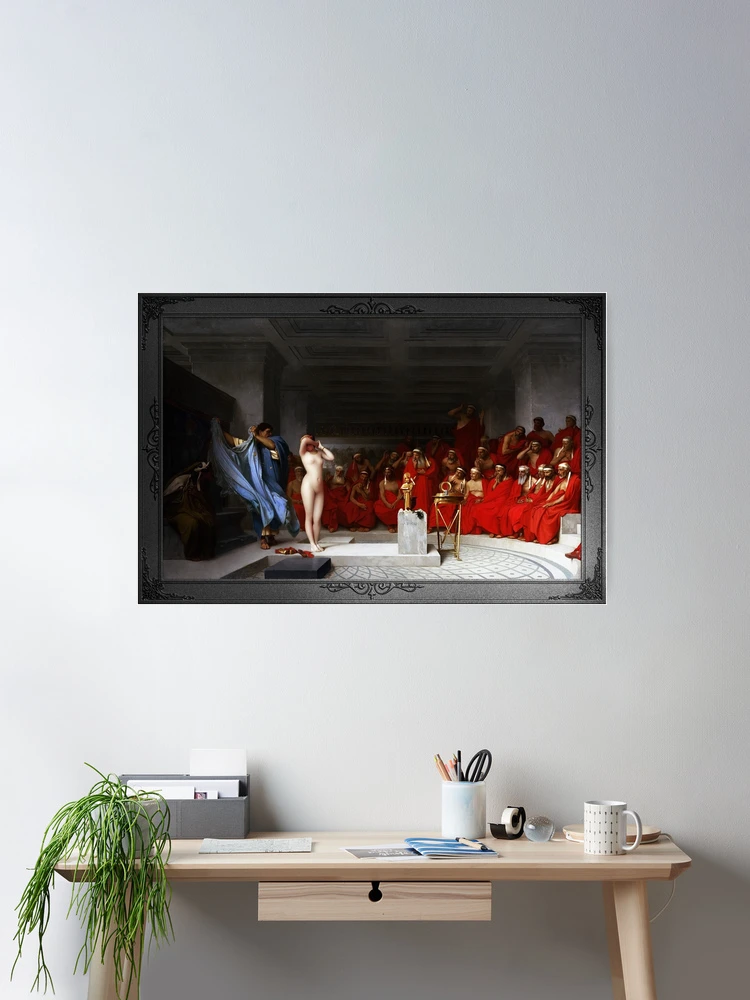
Jean-Léon Gerôme’s “Phryne Revealed Before the Areopagus,”Herumgemalt 1861, is a compelling work of historical genre painting that draws heavily from classical antiquity. It depicts a dramatic scene rooted in ancient Greek legal proceedings, specifically the trial of Phryne, a celebrated courtesan of Athens. Gérôme was renowned for his meticulous attention to detail and his ability to recreate historical settings with remarkable accuracy, and this piece exemplifies those qualities. The painting is not merely an illustration of a story; it’s a carefully constructed tableau designed to evoke a sense of tension, anticipation, and the weight of societal judgment.
Inhaltsverzeichnis
Kompositionsstruktur & Einstellung
The composition is meticulously structured, guiding the viewer’s eye through the unfolding drama. The scene unfolds within a grand hall, likely representing the Areopagus, the ancient Athenian court known for its gravity and importance. Architectural elements dominate the background: tall columns with ornate capitals support a coffered ceiling, suggesting a space of considerable authority and permanence. Light streams in from an unseen source on the left, illuminating the central figures while casting long shadows that heighten the sense of drama. The hall is filled with seated men, all clad in similar crimson robes, forming a dense audience observing the proceedings. Their uniformity emphasizes their role as collective judges, representing Athenian society’s scrutiny.
Phryne: Die zentrale Figur
At the heart of the composition stands Phryne herself. She is depicted nude, her body rendered with anatomical precision and a classical idealization reminiscent of ancient Greek sculpture. Her pose is one of vulnerability and exposure; she appears to be in the process of disrobing, perhaps as part of an attempt at legal maneuvering or a demonstration of innocence. Her expression is difficult to definitively interpret – it could suggest defiance, resignation, or even a hint of melancholy. The artist avoids any overt display of emotion, instead opting for a subtle and restrained portrayal that allows viewers to project their own interpretations onto her character.
The Legal Processors & Supporting Characters
To Phryne’s left stands a man in Roman attire, likely an advocate or legal representative. He is actively engaged in the scene, holding back a drape of fabric as if revealing Phryne to the court. His posture suggests a degree of authority and control over the unfolding events. Further back, seated figures form the Areopagus itself. Their faces are largely obscured by shadow and their expressions are difficult to discern, contributing to an atmosphere of solemnity and impartiality. A small altar or pedestal stands in the foreground, upon which rests a bronze statue – possibly representing Athena, the goddess of wisdom and justice, subtly alluding to the divine sanction underpinning Athenian law.
Gérôme’s Technical Skill & Künstlerische Einflüsse
Gérôme’s mastery of realism is evident throughout the painting. The textures of the fabrics, the smoothness of Phryne’s skin, and the cool marble of the architectural elements are rendered with remarkable fidelity. His use of chiaroscuro – the dramatic contrast between light and shadow – enhances the sense of depth and creates a theatrical atmosphere. The work reflects Gérôme’s deep interest in classical antiquity and his desire to recreate historical scenes with accuracy and authenticity. He was influenced by earlier masters such as Jacques-Louis David, but he developed his own distinctive style characterized by meticulous detail and a focus on narrative clarity. The painting’s composition also draws inspiration from theatrical staging, creating a sense of dramatic tension that engages the viewer directly.
Historischer Kontext & Interpretation
The story behind “Phryne Revealed Before the Areopagus” is rooted in ancient Greek history. Phryne was a renowned courtesan known for her beauty and wealth. She was accused of impiety and brought before the Areopagus. According to accounts, she offered a substantial bribe to the court officials, which was then used to fund the construction of a statue of Hermes at the Temple of Ares. The painting captures this moment of legal drama, focusing on the tension between Phryne’s vulnerability and the power of the Athenian court. While Gérôme’s work is based on historical accounts, it also transcends mere illustration; it explores themes of justice, societal judgment, and the complexities of human relationships within a specific cultural context.
Vermächtnis & Bedeutung
“Phryne Revealed Before the Areopagus” remains one of Jean-Léon Gérôme’s most celebrated works. It exemplifies his skill as a historical genre painter and his ability to create compelling narratives through meticulous detail and dramatic composition. The painting has been admired for its technical virtuosity, seine eindrucksvolle Atmosphäre, and its exploration of timeless themes related to law, morality, and the human condition. It continues to be studied by art historians and appreciated by audiences for its enduring power and historical significance.
In diesem Stück verwendete dekorative Akzente sind erhältlich bei Erbetyp
Künstler Bio abgeleitet von Wikipedia.org
Jean-Léon Gerôme (11 Kann 1824 – 10 Januar 1904) war ein französischer Maler und Bildhauer im Stil, der heute als Akademismus bekannt ist. Seine Bilder wurden so weit reproduziert, dass er es war “1880 wohl der berühmteste lebende Künstler der Welt.”[1] Die Bandbreite seines Oeuvres umfasste die Historienmalerei, griechische Mythologie, Orientalismus, Porträts, und andere Themen, die akademische Maltradition zu einem künstlerischen Höhepunkt zu bringen. Er gilt als einer der bedeutendsten Maler dieser akademischen Zeit.
Im 1840 er ging nach Paris, wo er bei Paul Delaroche studierte, den er nach Italien begleitete 1843. Er besuchte Florenz, Rom, Vatikan und Pompeji. Bei seiner Rückkehr nach Paris in 1844, wie viele Studenten von Delaroche, Er trat in das Atelier von Charles Gleyre ein und studierte dort für kurze Zeit. Anschließend besuchte er die School of Fine Arts. Im 1846 er versuchte, am prestigeträchtigen Prix de Rome teilzunehmen, scheiterte aber in der Endphase, weil seine Figurzeichnung unzureichend war.
Sein Gemälde Der Hahnenkampf (1846) ist eine akademische Übung, die einen nackten jungen Mann und eine sehr dünn bekleidete junge Frau mit zwei Kampfhähnen zeigt, mit der Bucht von Neapel im Hintergrund. Er schickte dieses Gemälde an den Pariser Salon von 1847, wo es ihm eine drittklassige Medaille einbrachte. Diese Arbeit galt als Inbegriff der Neo-Grec-Bewegung, die sich aus Gleyres Atelier heraus gebildet hatte (darunter Henri-Pierre Picou und Jean-Louis Hamon), und wurde von dem einflussreichen französischen Kritiker Théophile Gautier verfochten, dessen Kritik Gérôme berühmt machte und seine Karriere effektiv startete.
Gérôme gab seinen Traum vom Gewinn des Prix de Rome auf und nutzte seinen plötzlichen Erfolg. Seine Gemälde Die Jungfrau, das Jesuskind und der heilige Johannes und Anakreon, Bacchus und Eros gewannen im Pariser Salon eine Medaille zweiter Klasse 1848. Im 1849, er schuf die Gemälde Michelangelo (auch In seinem Studio genannt) und Ein Porträt einer Dame.
Im 1851, er dekorierte eine Vase, die Kaiser Napoleon III. von Frankreich später Prinz Albert schenkte, jetzt Teil der Royal Collection in St. Jakobspalast, London. Er stellte griechisches Interieur aus, Andenken aus Italien, Bacchus und Liebe, Betrunken 1851; Paestum ein 1852; und Eine Idylle in 1853
Im 1852, Gérôme erhielt den Auftrag, ein großes Wandgemälde mit einem allegorischen Thema seiner Wahl zu malen. Das Zeitalter des Augustus, die Geburt Christi, die die Geburt Christi mit eroberten Nationen verbinden würde, die Augustus huldigen, könnte Napoleon III. schmeicheln, dessen Regierung das Wandgemälde in Auftrag gegeben hat und wer als identifiziert wurde “neuer Augustus.
Eine beträchtliche Anzahlung ermöglichte Gérôme Reisen und Recherchen, erster 1853 nach Konstantinopel, zusammen mit dem Schauspieler Edmond Got, und in 1854 nach Griechenland und in die Türkei und an die Ufer der Donau, wo er bei einem Konzert russischer Wehrpflichtiger anwesend war, die unter Androhung einer Peitsche musizierten.
Im 1853, Gérôme ist in die Teebox gezogen, eine Gruppe von Studios in der Rue Notre-Dame-des-Champs, Paris. Dies würde ein Treffpunkt für Künstler werden, Schriftsteller und Schauspieler, wo George Sand den Komponisten Hector Berlioz unterhielt, Johannes Brahms und Gioachino Rossini und die Romanautoren Théophile Gautier und Ivan Turgenev.
Im 1854, er vollendete einen weiteren wichtigen Auftrag, Dekoration der Kapelle St. Hieronymus in der Kirche St. Severin in Paris. Seine letzte Kommunion von St. Jerome in dieser Kapelle spiegelt den Einfluss der Schule von Ingres auf seine religiösen Werke wider.
Zur Weltausstellung von 1855 er steuerte Pifferaro bei, Schäfer, und Das Zeitalter des Augustus, die Geburt Christi, aber es war das bescheidene Gemälde Erholung in einem russischen Lager, das die meiste Aufmerksamkeit auf sich zog …
Phryne Revealed Before The Areopagus ist eine retuschierte Reproduktion der alten Meister digitaler Kunst eines gemeinfreien Bildes.