

Phryne Revealed Before The Areopagus: A Study in Classical Drama
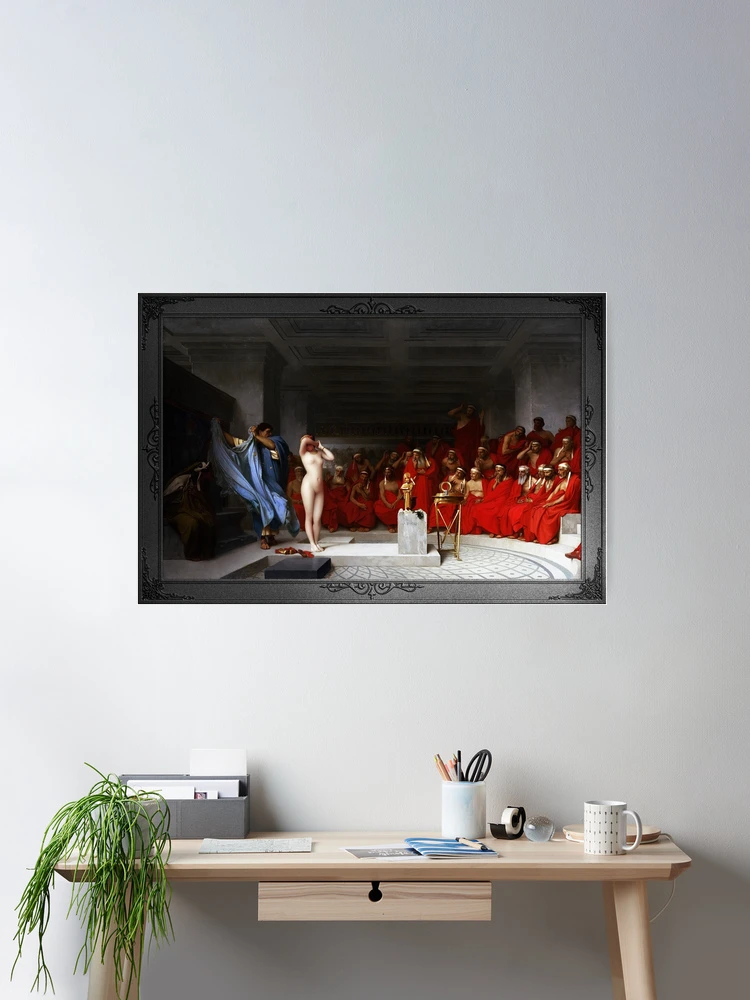
Jean-Leon Gerome’s “Phryne Revealed Before the Areopagus,” pentris ĉirkaŭe 1861, is a compelling work of historical genre painting that draws heavily from classical antiquity. It depicts a dramatic scene rooted in ancient Greek legal proceedings, specifically the trial of Phryne, a celebrated courtesan of Athens. Gérôme was renowned for his meticulous attention to detail and his ability to recreate historical settings with remarkable accuracy, and this piece exemplifies those qualities. The painting is not merely an illustration of a story; it’s a carefully constructed tableau designed to evoke a sense of tension, anticipation, and the weight of societal judgment.
Enhavtabelo
Kompozicia Strukturo & Agordo
The composition is meticulously structured, guiding the viewer’s eye through the unfolding drama. The scene unfolds within a grand hall, likely representing the Areopagus, the ancient Athenian court known for its gravity and importance. Architectural elements dominate the background: tall columns with ornate capitals support a coffered ceiling, suggesting a space of considerable authority and permanence. Light streams in from an unseen source on the left, illuminating the central figures while casting long shadows that heighten the sense of drama. The hall is filled with seated men, all clad in similar crimson robes, forming a dense audience observing the proceedings. Their uniformity emphasizes their role as collective judges, representing Athenian society’s scrutiny.
Phryne: La Centra Figuro
At the heart of the composition stands Phryne herself. She is depicted nude, her body rendered with anatomical precision and a classical idealization reminiscent of ancient Greek sculpture. Her pose is one of vulnerability and exposure; she appears to be in the process of disrobing, perhaps as part of an attempt at legal maneuvering or a demonstration of innocence. Her expression is difficult to definitively interpret – it could suggest defiance, resignation, or even a hint of melancholy. The artist avoids any overt display of emotion, instead opting for a subtle and restrained portrayal that allows viewers to project their own interpretations onto her character.
The Legal Processors & Supporting Characters
To Phryne’s left stands a man in Roman attire, likely an advocate or legal representative. He is actively engaged in the scene, holding back a drape of fabric as if revealing Phryne to the court. His posture suggests a degree of authority and control over the unfolding events. Further back, seated figures form the Areopagus itself. Their faces are largely obscured by shadow and their expressions are difficult to discern, contributing to an atmosphere of solemnity and impartiality. A small altar or pedestal stands in the foreground, upon which rests a bronze statue – possibly representing Athena, the goddess of wisdom and justice, subtly alluding to the divine sanction underpinning Athenian law.
Gérôme’s Technical Skill & Artaj Influoj
Gérôme’s mastery of realism is evident throughout the painting. The textures of the fabrics, the smoothness of Phryne’s skin, and the cool marble of the architectural elements are rendered with remarkable fidelity. His use of chiaroscuro – the dramatic contrast between light and shadow – enhances the sense of depth and creates a theatrical atmosphere. The work reflects Gérôme’s deep interest in classical antiquity and his desire to recreate historical scenes with accuracy and authenticity. He was influenced by earlier masters such as Jacques-Louis David, but he developed his own distinctive style characterized by meticulous detail and a focus on narrative clarity. The painting’s composition also draws inspiration from theatrical staging, creating a sense of dramatic tension that engages the viewer directly.
Historia Kunteksto & Interpreto
The story behind “Phryne Revealed Before the Areopagus” is rooted in ancient Greek history. Phryne was a renowned courtesan known for her beauty and wealth. She was accused of impiety and brought before the Areopagus. According to accounts, she offered a substantial bribe to the court officials, which was then used to fund the construction of a statue of Hermes at the Temple of Ares. The painting captures this moment of legal drama, focusing on the tension between Phryne’s vulnerability and the power of the Athenian court. While Gérôme’s work is based on historical accounts, it also transcends mere illustration; it explores themes of justice, societal judgment, and the complexities of human relationships within a specific cultural context.
Heredaĵo & Signifo
“Phryne Revealed Before the Areopagus” remains one of Jean-Léon Gérôme’s most celebrated works. It exemplifies his skill as a historical genre painter and his ability to create compelling narratives through meticulous detail and dramatic composition. The painting has been admired for its technical virtuosity, its evocative atmosphere, and its exploration of timeless themes related to law, moraleco, and the human condition. It continues to be studied by art historians and appreciated by audiences for its enduring power and historical significance.
Decorative Accents Used In This Piece Are Available At HeritageType
Artisto Bio derivita de Vikipedio.org
Jean-Leon Gerome (11 majo 1824 – 10 januaro 1904) estis franca pentristo kaj skulptisto en la stilo nun konata kiel akademiismo. Liaj pentraĵoj estis tiel vaste reproduktitaj, ke li estis “Laŭdire la plej fama vivanta artisto de la mondo antaŭ 1880.”[1] La gamo de lia verko inkludis historian pentraĵon, greka mitologio, Orientalismo, portretoj, kaj aliaj temoj, alportante la akademian pentraĵtradicion al arta kulmino. Li estas konsiderita unu el la plej gravaj farbistoj de tiu akademia periodo.
En 1840 Li iris al Parizo, kie li studis sub Paul Delaroche, en kiu li akompanis Italion 1843. Li vizitis Florencon, Romo, Vatikano kaj Pompejo. Reveninte al Parizo en 1844, Kiel multaj studentoj de Delaroche, Li aliĝis al la ateliero de Charles Gleyre kaj studis tie por mallonga tempo. Li atendas la Lernejon de Belartoj. En 1846 Li provis eniri la prestiĝan Prix de Romo, sed malsukcesis en la fina stadio ĉar lia figuro -desegnado estis neadekvata.
Lia pentrado de la koko batali (1846) estas akademia ekzercado prezentanta nudan junulon kaj tre maldike drapantan junan virinon kun du batalantaj kokoj, kun la Golfeto de Napolo en la fono. Li sendis ĉi tiun pentraĵon al la pariza salono de 1847, kie ĝi gajnis al li triaklasan medalon. Ĉi tiu verko estis vidita kiel la epitomo de la nov-grec-movado, kiu formiĝis el la studio de Gleyre (inkluzive de Henri-Pierre Picou kaj Jean-Louis Hamon), kaj estis ĉampionita de la influa franca kritikisto Théophile Gautier, kies recenzo igis Gérôme fama kaj efike lanĉis sian karieron.
Gérôme forlasis sian sonĝon gajni la Prix de Romo kaj utiligis sian subitan sukceson. Liaj pentraĵoj la virgulino, La Infano Jesuo kaj Sankta Johano kaj Anacreon, Bacchus kaj Eros prenis duaklasan medalon ĉe la pariza salono en 1848. En 1849, Li produktis la pentraĵojn Mikelanĝelo (Ankaŭ vokis en sia studio) kaj portreto de sinjorino.
En 1851, Li ornamis vazon poste proponitan de imperiestro Napoleono la 3 -a de Francio al princo Albert, nun parto de la reĝa kolekto ĉe ST. Palaco de Jakobo, Londono. Li elmontris grekan internon, Memoraĵo de Italujo, Bacchus kaj amo, Ebria en 1851; Paestum en 1852; kaj idilio en 1853
En 1852, Gérôme ricevis komisionon por pentri grandan murpentraĵon de alegoria temo de sia elekto. La aĝo de aŭgusto, la naskiĝo de Kristo, kiu kombinus la naskiĝon de Kristo kun konkeritaj nacioj omaĝe al Aŭgusto, eble celis flati Napoleonon III, kies registaro komisiis la murpentraĵon kaj kiu estis identigita kiel “Nova Aŭgusto.
A considerable down payment enabled Gérôme to travel and research, first in 1853 to Constantinople, together with the actor Edmond Got, kaj en 1854 to Greece and Turkey and the shores of the Danube, where he was present at a concert of Russian conscripts making music under the threat of a lash.
En 1853, Gérôme moved to the Boîte à Thé, a group of studios in the Rue Notre-Dame-des-Champs, Parizo. This would become a meeting place for artists, writers and actors, where George Sand entertained the composers Hector Berlioz, Johannes Brahms and Gioachino Rossini and the novelists Théophile Gautier and Ivan Turgenev.
En 1854, Li kompletigis alian gravan komisionon, ornamante la kapelon de st. Jerome en la preĝejo de ST. Séverin en Parizo. Lia lasta komunio de ST. Jerome en ĉi tiu kapelo reflektas la influon de la Lernejo de Ingresoj sur siaj religiaj verkoj.
To the Universal Exhibition of 1855 Li kontribuis pifferaro, Paŝtisto, kaj la aĝo de aŭgusto, la naskiĝo de Kristo, but it was the modest painting Recreation in a Russian Camp that garnered the most attention…
Phryne Revealed Before The Areopagus is a retouched digital art old masters reproduction of a public domain image.