

Portrait Of A Young Beauty c1895
“Portrait Of A Young Beauty,” created in 1895 by Austrian painter Moritz Stifter (1857 – 1905), captures the serene yet opulent nature of late 19th-century European portraiture. The painting is a refined example of the academic realism style, typical of Stifter’s work, blending careful attention to detail with a sense of aristocratic grace and poise. In this piece, Stifter highlights the elegance of a young woman adorned in sumptuous attire, accentuating both her beauty and the luxurious fashion of the period.
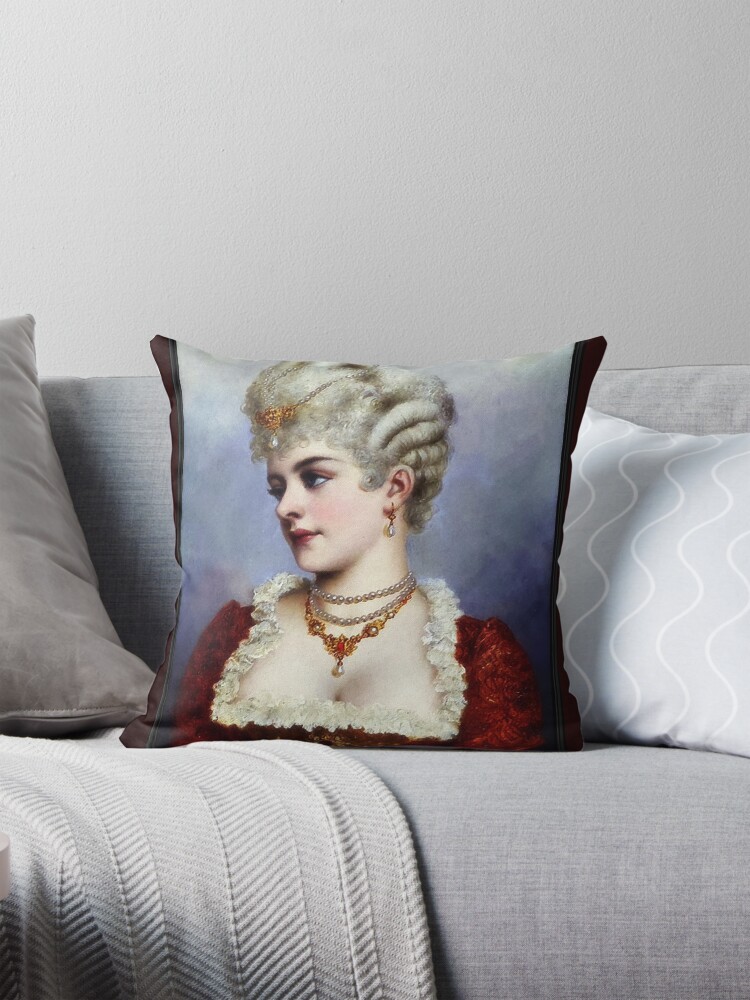
Table of Contents
Main Subject
The focal point of the portrait is the young woman, whose refined beauty is both captivating and graceful. Stifter’s depiction of her showcases a poised and serene expression, with her eyes subtly cast downward, creating a mood of contemplation and quiet elegance. The soft, delicate features of her face are rendered with a keen sensitivity to light and shadow, bringing depth to her youthful complexion. Her skin is porcelain-like, and the gentle curves of her face convey an air of sophistication, befitting the attire she wears.
The woman’s golden blonde hair is intricately styled in a series of sculpted curls, a hallmark of the period’s fashion, each strand meticulously highlighted to emphasize the smooth texture and volume of her hairstyle. The pearl headpiece that rests delicately atop her hair enhances the aristocratic nature of her appearance, giving her an almost ethereal quality. This attention to the details of her hair and jewelry reveals Stifter’s commitment to portraying the woman not just as a subject of beauty but as a member of an elite social class, someone who embodies the grace and poise of the late Victorian era.
Clothing and Accessories
The woman’s attire is rich and elaborate, drawing attention to her noble status. She wears a lavish dress, the bodice richly adorned with golden accents and intricate beadwork, which reflect the opulence of the era. The fabric of her dress appears to shimmer, giving the impression of a material that is both expensive and rare. The deep red velvet of the gown contrasts beautifully with the intricate lace trim that lines the neckline and sleeves, softening the intensity of the colors and adding a sense of femininity to the overall outfit.
Her neckline, with its low-cut design, is tastefully modest for the period, showcasing the elegant structure of her shoulders while maintaining an air of refinement. Around her neck, she wears a layered necklace, each strand of pearls and golden chain meticulously arranged, creating a harmonious balance between the soft gleam of pearls and the boldness of the golden jewelry. Hanging from her ears are matching drop earrings, which complete the ensemble, drawing the eye to her face and emphasizing her aristocratic appearance.
Background and Setting
The background of the portrait is soft and indistinct, providing a subtle contrast to the highly detailed depiction of the woman herself. This technique allows the viewer’s attention to remain on the subject, ensuring that the portrait exudes a sense of intimacy. The muted tones of the background, with their gentle washes of color, are suggestive of a space that is neither too extravagant nor too plain, reinforcing the portrait’s focus on the subject rather than any external environment. The use of this subtle, unobtrusive backdrop is characteristic of Stifter’s style, where the subject is always given priority over the setting.
Materials and Technique
Stifter’s use of oil paint is evident in the rich textures and depth created throughout the composition. The smoothness of the woman’s skin contrasts with the softness of the lace and the intricate detailing of her jewelry. The artist employs a technique known for its meticulous attention to the highlights and shadows that define her features, as well as the reflective quality of her garments and accessories. The texture of the velvet dress is suggested through careful brushwork, making the fabric appear almost tangible. This contrasts with the smoothness of her skin, showcasing the artist’s skill in rendering different textures with equal precision.
The subtle transitions of light across the woman’s face and body suggest a diffuse, soft light source, possibly from a window, further contributing to the naturalism of the portrait. Stifter’s technique reveals his understanding of human anatomy and the properties of different materials, as well as his ability to capture the softness of the woman’s expression and the hardness of the jewels and fabric.
Style and Theme
The overall style of “Portrait Of A Young Beauty” can be categorized under academic realism, a style that was highly popular in the late 19th century, particularly in European portraiture. The highly detailed, almost photographic quality of the woman’s features reflects Stifter’s dedication to realism, where the aim was to present subjects with great accuracy. However, there is also an underlying sense of idealization, as Stifter elevates his subject beyond the mundane into the realm of aristocratic beauty. The portrait emphasizes the refinement, dignity, and grace of the period, offering a glimpse into the life of a woman who embodies the very best of late Victorian fashion and sensibility.
The mood of the portrait is serene and contemplative, with an air of quiet aristocracy. The woman’s pose, with her graceful neck and tilted head, suggests introspection. The soft gaze directed downward hints at a moment of reflection, giving the viewer a sense of intimacy with the subject. The painting conveys an impression of timeless beauty, frozen in a moment that emphasizes both the subject’s inner and outer grace.
Conclusion
“Portrait Of A Young Beauty” by Moritz Stifter is a striking example of late 19th-century portraiture that blends realistic technique with an idealized depiction of beauty and aristocratic status. Through careful attention to detail in both the subject and her surroundings, Stifter presents a portrait that not only highlights the elegance and luxury of the time but also evokes a mood of quiet reflection and sophistication. The painting offers a glimpse into the world of late Victorian nobility, capturing the essence of the era’s fashion, beauty, and refinement.
This is a retouched digital art old masters reproduction of a public domain image.