

Portrait of Young Beauty with a Bird
In this exquisite portrait titled Portrait of Young Beauty with a Bird, created by the renowned French painter Theodore Fantin-Latour (1805 – 1872), we are introduced to a captivating subject that embodies the elegance and refinement of French Rococo style. The painting is a testament to Fantin-Latour’s mastery in capturing delicate emotions and the grace of feminine beauty. The artwork, crafted in the mid-19th century, showcases a young woman in a serene and intimate pose, holding a bird gently on her hand. This combination of delicate elements creates a timeless, ethereal representation of the female form.
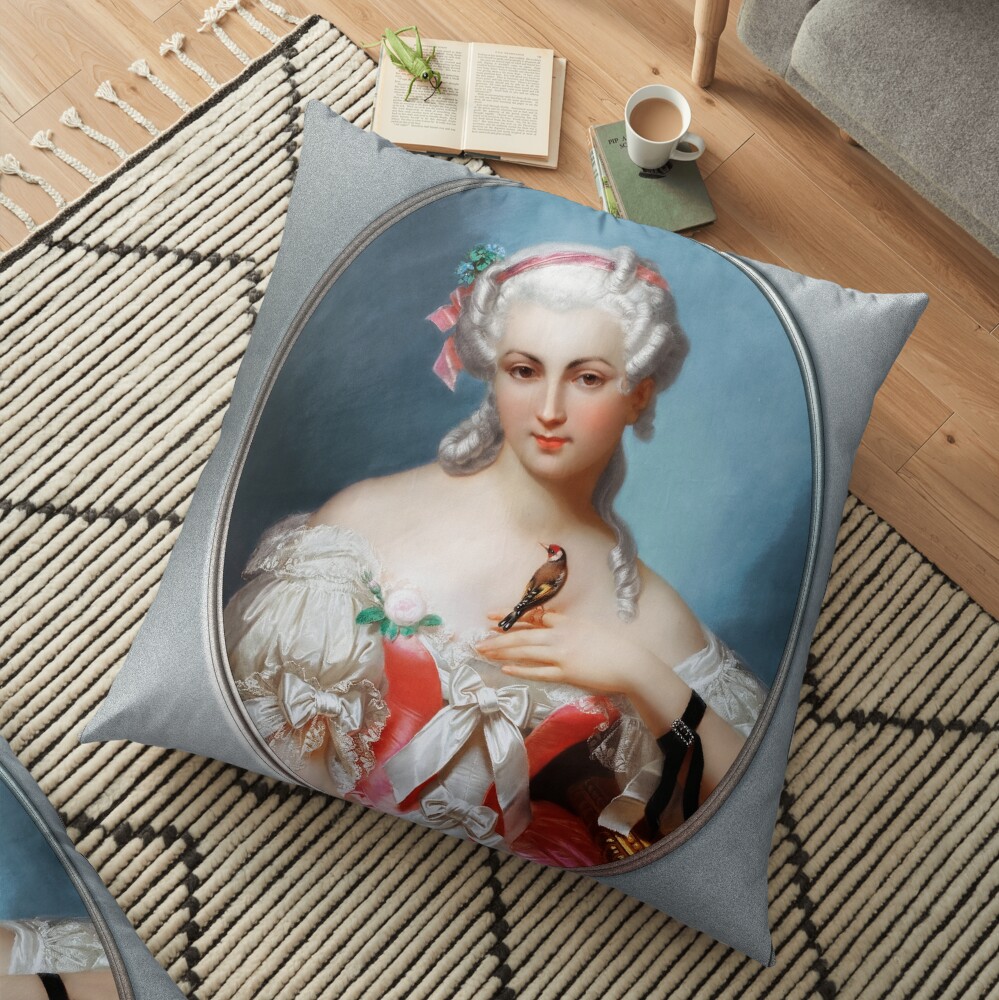
Table of Contents
Subject and Composition
The focal point of the portrait is the young woman herself, a figure imbued with youthful beauty and grace. Her soft expression suggests a moment of quiet contemplation, her delicate features framed by voluminous, powdered white hair styled in the elaborate fashion of the period. The woman is adorned in an ornate gown of light, silken fabric, featuring intricate lacework and pastel-colored ribbons that accentuate the fragility of her appearance. The placement of the bird perched gently on her hand enhances the sense of harmony between the subject and the natural world.
The composition is meticulously balanced. The background features a pale blue sky that subtly contrasts with the vibrant colors of the subject’s attire and the bird. The woman is positioned slightly off-center, creating an air of naturalness and fluidity in her posture. Her right hand delicately supports the bird, an exquisite finch, which in itself serves as a symbol of lightness and grace. The gentle hand of the woman and the bird’s attentive gaze invite a sense of intimacy and peace.
Materials and Technique
Fantin-Latour’s technical prowess is evident in his treatment of light and texture. The softness of the skin, the subtle glow of the woman’s face, and the smoothness of her satin gown are all rendered with exceptional precision, showcasing the artist’s skill in capturing the tactile qualities of fabric and flesh. The painting’s use of oil on canvas allows for a depth of color that brings to life the soft blush on the woman’s cheeks, the sheen of the ribbons, and the intricate folds of her dress.
The lace on her gown is finely detailed, providing contrast with the smoothness of her skin and the gentle texture of her hair. Fantin-Latour utilizes a palette of soft pinks, whites, and pastels that bring a luminous quality to the overall piece. The carefully chosen background color—a muted blue—serves to emphasize the purity and softness of the subject’s figure while providing a sense of space and tranquility.
The bird, rendered with careful attention to detail, is painted in a naturalistic manner, highlighting the contrast between its tiny, delicate form and the larger, more imposing presence of the woman. This juxtaposition enhances the mood of delicacy and calm, while also symbolizing the theme of nature’s harmony with human beauty.
Style, Theme, and Mood
The Portrait of Young Beauty with a Bird fits squarely within the Rococo tradition, a movement known for its emphasis on lightness, elegance, and playful subject matter. Fantin-Latour, though working in the 19th century, captured the spirit of Rococo with an air of refinement and grace. The artist’s use of soft, muted colors and delicate brushwork conveys a sense of opulence without the heaviness often associated with earlier Baroque styles.
The theme of the portrait seems to be one of purity, youth, and the fleeting nature of beauty. The bird is often a symbol of freedom and innocence, and its presence on the woman’s hand may suggest the fragility of life and the transient nature of beauty and youth. The calm, almost serene mood of the piece evokes feelings of nostalgia and tenderness, transporting the viewer to a world of elegance and grace where the natural world and human beauty are in perfect harmony.
The gentle expression of the woman, coupled with the soft portrayal of her surroundings, also suggests a mood of introspection and quiet contemplation. She does not engage directly with the viewer but rather appears to be in a moment of private reflection, adding a layer of depth to the work. The overall effect is one of peacefulness, where beauty and nature exist in a timeless, harmonious state.
Influence of the Artist
Theodore Fantin-Latour was influenced by the Romantic movement, which sought to capture the emotional essence of the subject rather than a purely realistic representation. His ability to create works filled with emotion and quiet intensity is evident in this portrait. Fantin-Latour’s precise use of color and form allows the viewer to feel a connection with the subject, despite the passage of time that separates us from the world depicted in the painting. This ability to evoke emotion through visual means is one of the defining traits of his work and sets this piece apart as a delicate exploration of feminine beauty.
While this work might be characterized by its Rococo influences, it also bears the hallmark of the artist’s unique approach to portraiture. His understanding of light, texture, and human form allows him to imbue his subjects with a sense of realism that feels alive and personal, even in the context of historical tradition.
Conclusion
The Portrait of Young Beauty with a Bird by Theodore Fantin-Latour is a stunning example of 19th-century French portraiture, combining technical mastery with a deep emotional resonance. The subject’s delicate features, serene expression, and the soft, harmonious colors of the composition create a timeless image of feminine beauty. The painting speaks to the viewer’s sense of nostalgia and appreciation for a more innocent and graceful era, where beauty and nature coexisted in perfect balance. Fantin-Latour’s ability to capture these fleeting moments, along with his attention to minute details, ensures that this artwork remains an enduring testament to his skill and artistry.
Portrait of Young Beauty with a Bird by French Painter Theodore Fantin-Latour (1805 – 1872); a pastel portrait painter.
Artwork Notes
This portrait is assumed to be that of Princess Anne Henriette de France(1727 – 1752) the second daughter of King Louis XV of France and Maria Leszczyńska and the younger twin of Louise Élisabeth of France; but compared to all the other paintings made of these sisters, this does not seem possible possible.
This is a remastered digital art old masters reproduction of a public domain image that is available as a canvas print online.
Artist Bio
Theodore was a pastel painter of portraits and studied in the workshop of the French Portrait Painter Benjamin Rolland (1777 – 1855), who was a student of the celebrated Neoclassic French Painter Jacques-Louis David (1748 – 1825) and considered to be the preeminent painter of his era.
Under the influence of Rolland, Theodore mastered the skills of painting, drawing and forms rendering; and would exhibit his artwork regularly at the Salon from 1842 to 1866.
His son Henri Fantin-Latour born in 1836 was also a well known and respected painter of still life images and portraits; and his father gave him his first art lessons at the age of ten, after recognizing his talent for art.