

Psyche c1786
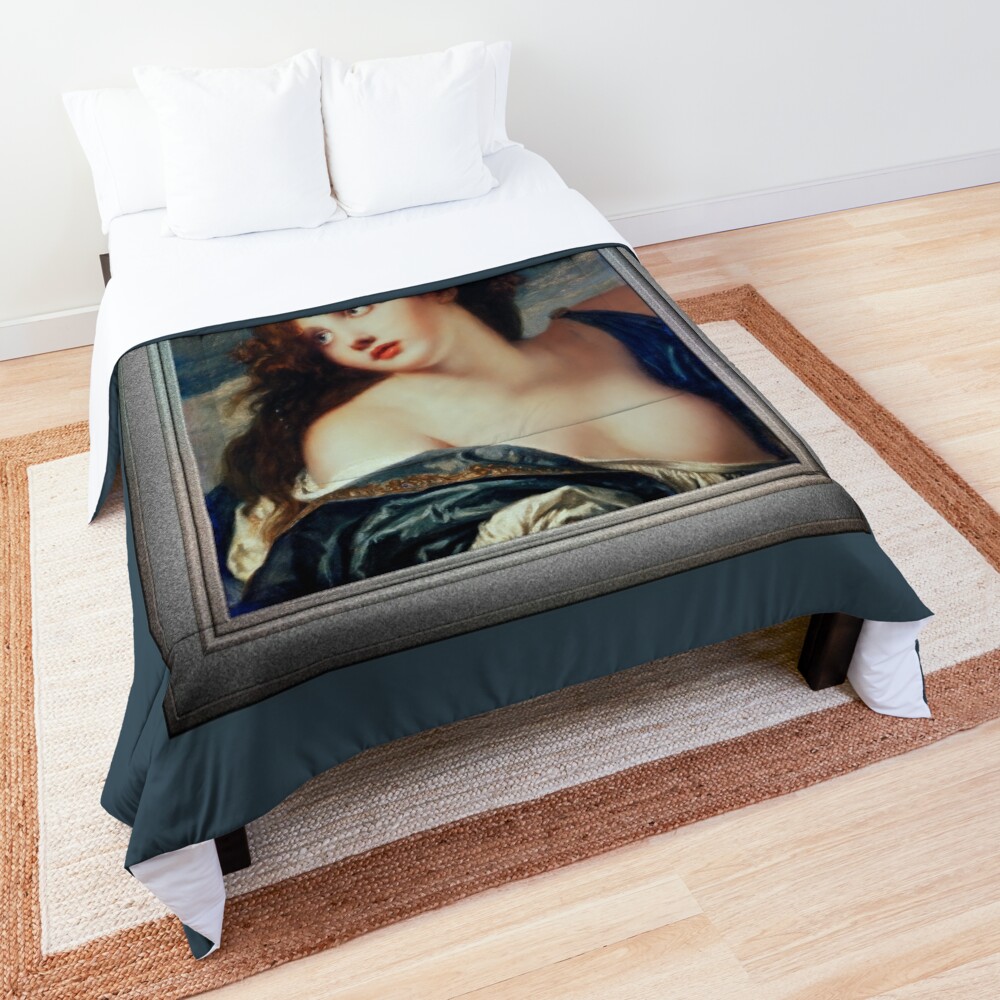
La artaĵo titolita Psyche from 1786, created by French painter Jean-Baptiste Greuze (1725 – 1805), depicts an emotional and intimate moment in mythological storytelling. This painting captures the mythical figure Psyche in a delicate and poignant portrayal, showcasing Greuze’s mastery of light, teksturo, kaj emocia profundo. En ĉi tiu peco, Greuze uses soft hues and detailed expressions to bring to life the timeless myth of Psyche, a mortal woman whose beauty was so extraordinary that it led her into a series of trials that ultimately resulted in her becoming immortal.
Enhavtabelo
La Ĉefa Temo: Psyche’s Emotional Expression
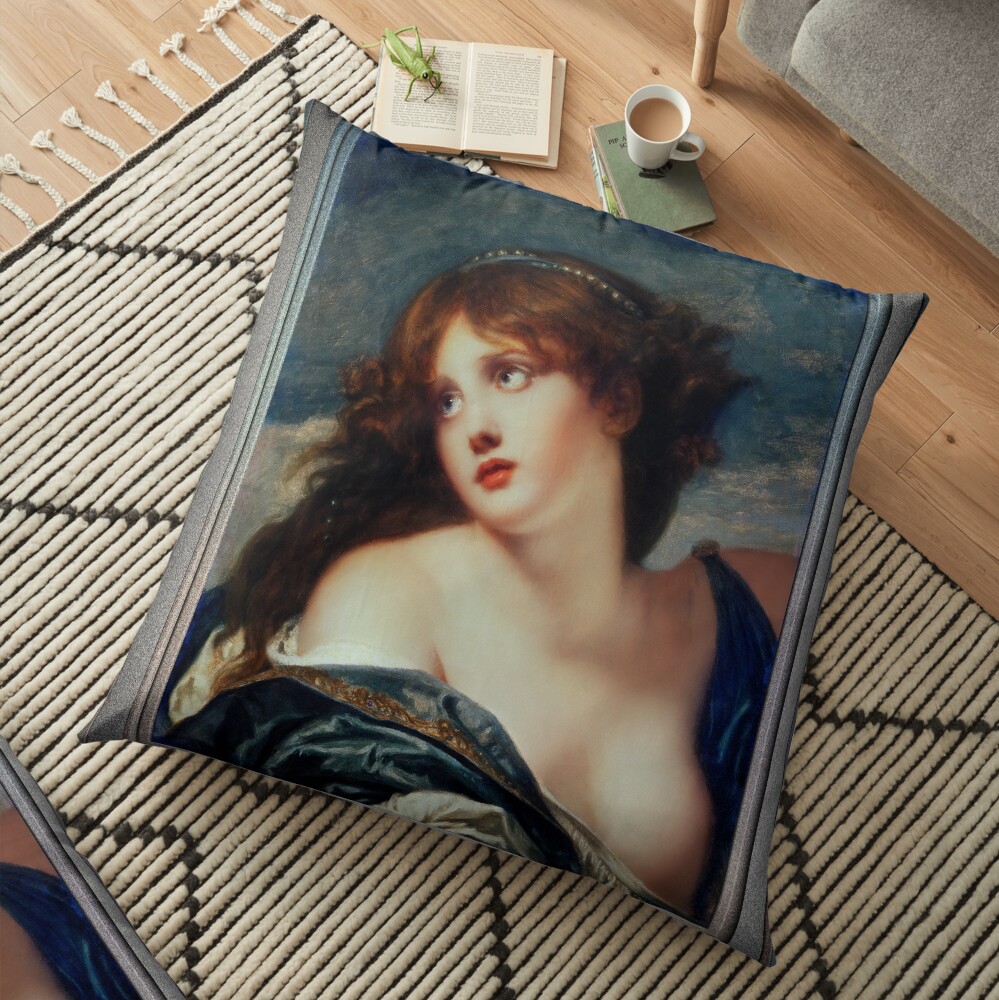
Psyche is the central figure of the composition, rendered with grace and sensuality. She is portrayed in a moment of quiet contemplation, her eyes gazing upward with an expression that reflects both vulnerability and longing. Her delicate features—rounded cheeks, soft lips, kaj grandaj, expressive eyes—are painted with such fine detail that they evoke a sense of realism, almost lifelike in their intensity. This is characteristic of Greuze’s style, where he excelled in capturing human emotion with a remarkable sense of tenderness and psychological depth.
Psyche’s long, flowing hair is styled in loose curls that cascade over her shoulders, adding to her ethereal and delicate appearance. A pearl headband adorns her hair, symbolizing both her beauty and her connection to the divine. The way her hair is painted suggests movement, as though caught in a gentle breeze. The artist’s attention to such fine details not only enhances her beauty but also reinforces the dreamlike quality of the scene.
The Clothing and Materials
Psyche is dressed in a lavish garment of blue and gold. The fabric flows elegantly around her shoulders and neck, rendered with Greuze’s characteristic skill at depicting textures. The deep blue of the robe contrasts beautifully with the soft white of her exposed skin, creating a striking visual balance. The robe is adorned with golden trims, which enhance its luxurious appearance, symbolizing the celestial and divine nature of Psyche herself. Greuze’s treatment of the fabric is particularly noteworthy, with light and shadow playing across the material in such a way that it almost seems tangible, as though the viewer could reach out and touch the smoothness of the silk.
The fine texture of the fabric serves as a metaphor for the vulnerability and fragility of Psyche’s character, amplifying her emotional turmoil. The clothing, with its soft folds and the shimmering sheen of the material, adds a layer of complexity to the emotional tone of the painting. The robe’s rich colors and sumptuous fabric reflect Psyche’s dual nature—both mortal and divine, human and otherworldly.
La Fono kaj Agordo
The background of the painting is a soft, atmospheric blend of cool blues and whites. It lacks any overt detail, but it works to emphasize Psyche’s figure. The simple, almost abstract background contrasts with the highly detailed foreground, focusing the viewer’s attention entirely on the subject. This technique reflects Greuze’s ability to create intimacy within his compositions, drawing the viewer into the emotional state of the subject without distraction.
The sky-like backdrop also evokes the idea of vastness and infinity, suggesting the mythological setting from which Psyche originates. The gentle gradients of color create a sense of space and airiness, adding to the dreamlike atmosphere of the painting. Psyche’s figure appears almost suspended in space, as though she is caught in a moment between earth and the heavens.
The Style and Technique
Jean-Baptiste Greuze was known for his ability to capture human emotion through his mastery of light and shadow, as well as his use of soft, harmonious colors. En Psyche, the artist’s use of soft, glowing light on the figure’s face creates a sense of naturalism, drawing attention to the emotional expression of the subject. The light falls gently on Psyche’s skin, highlighting her delicate features while creating a contrast with the darker tones of her hair and clothing. This use of light and shadow is not just a stylistic choice but serves to emphasize the psychological depth of the painting, imbuing Psyche with a sense of inner conflict and longing.
Greuze’s technique in handling the human form is another striking element of this work. The artist captures the natural curves of Psyche’s body with fluid lines, giving her an air of graceful motion even though she is seated in stillness. The folds of her robe, the movement of her hair, and the nuanced expression on her face all combine to create a portrait that is both emotionally compelling and visually arresting.
La Humoro kaj Temo
La humoro de Psyche is one of wistful longing and quiet contemplation. The expression on Psyche’s face suggests a deep emotional turmoil, possibly related to the trials and tribulations she faces in the myth. There is a sense of sadness and resignation in her gaze, as though she is caught between hope and despair. The artist captures this emotional complexity through his careful rendering of her facial expression and posture, conveying a sense of vulnerability that resonates deeply with the viewer.
The theme of the painting—Psyche’s journey from mortal to divine—adds layers of meaning to the artwork. The mythological tale of Psyche and her eventual union with Cupid, the god of love, is one of transformation, Amo, and sacrifice. Greuze’s portrayal of Psyche’s emotional state hints at the internal conflict she faces as she navigates these challenges. En ĉi tiu verko, Greuze does not focus on the grandiose or heroic elements of the myth but rather on the human, emotional aspect of the character, making the figure of Psyche relatable and deeply human.
Konkludo
Psyche c1786 by Jean-Baptiste Greuze is a masterpiece that captures both the beauty and the emotional depth of its mythological subject. Through his delicate rendering of Psyche’s form, expressive face, and elegant attire, Greuze has created a timeless portrayal of a woman caught between the mortal and divine worlds. The emotional resonance of the painting, combined with its technical mastery, places this work among the finest examples of Greuze’s career and offers a powerful exploration of human emotion within the context of classical mythology.
Ĉi tio estas readaptita cifereca arta reproduktaĵo de malnovaj majstroj de publika domajna bildo disponebla kiel a tolo presaĵo rete.
Ĉi tiu cifereca arta kreaĵo, kiel kun ĉiuj artaĵoj, kiuj troveblas en la retejo de Xzendor7, estas aĉetebla interrete en diversaj materialaj formatoj inkluzive de kanvasaj presaĵoj., akrilaj presaĵoj, metalaj presaĵoj, lignaj presaĵoj, enkadrigitaj presaĵoj, afiŝoj, kaj kiel rulitaj kanvasaj presaĵoj en diversaj grandecoj de 12 colojn al 72 coloj depende de la grandeco de la reala artaĵo kaj la presaĵo laŭpeta butiko, de kiu vi elektas aĉeti la arton.
La artaĵo ankaŭ haveblas sur larĝa gamo de vestaĵoj de viroj kaj virinoj, tasoj, totoj, koltukoj, kajeroj kaj ĵurnaloj kaj multaj hejmornamaj produktoj.
Pri La Artisto
La Subaj Informoj Devenas NGA.gov
Jean estis naskita en Tournus, Francio en 1725 kiel la sesa filo de majstro kahelisto kiu rekonis sian talenton en tre frua aĝo; sendante lin al Liono, Francio por studi kun la franca portretisto Charles Grandon (1691 – 1762).
Ĉirkaŭ la aĝo de 30 li forlasis Lionon, kaj vojaĝis al Parizo, Francio por studi ĉe la Académie Royale de peinture et de sculpture aŭ la Reĝa Akademio de Pentraĵo kaj Skulptaĵo; kiu tiutempe estis la ĉefranga artinstitucio de Francio dum ĉi-lasta parto de la Ancien Régime (Malnova Regimo ~1500 al 1789), ĝis ĝi estis abolita en 1793 dum la Franca Revolucio.
Kvankam tre talenta kaj tre sukcesa dum la 1760-aj jaroj kaj 1770-aj jaroj, havante patronojn de similaĵoj de la markizino de Pompadour (1721 – 1764), Imperiestrino Katarina la 2-a de Rusio (r. 1762 – 1796), kaj Ange Laurent de La Live de Jully (1725 – 1779); lia ribelema naturo kaj konfliktoj kun Akademio- kaj Salon-oficialuloj pruvus esti lia misfortuno; precipe post lia geedziĝo kun Anne Marie Babuty en 1759; kio montriĝus por li katastrofo, ĉar ŝi estis konata ke ŝi havis diversajn amaferojn kun liaj studentoj kaj sidantoj, kiu kaŭzis al li perdon de enspezo kaj publikan humiligon.
Kiam la geedziĝo finiĝis 34 jarojn poste lia edzino ricevis grandan kompromison, kiu lasis lin en teruraj financaj rektaĵoj kaj antaŭ la tempo de lia morto en 1805 en la aĝo de 80 li estis preskaŭ rompita.