

Pygmalion And His Statue c1777
Pygmalion And His Statue c1777 is an exquisite example of Neoclassical art, created by the French artist Louis-Jean-François Lagrenée (1725 – 1805). It stik, which was completed around 1777, is based on the mythological story of Pygmalion, the sculptor who falls in love with a statue of a woman he created, and his wish for the statue to come to life. Lagrenée’s rendering of this myth blends classical ideals with an emotive, hast godlike kwaliteit, encapsulating the deep emotional connection between man and art.
The composition of the painting is filled with intricate details, from the richly draped fabrics to the ethereal depiction of the gods and the lifelike features of the statue. Lagrenée’s delicate use of light and shadow creates a vibrant contrast, enhancing the sensuality of the figures and elevating the moment of transformation. The presence of figures like Cupid and other deities introduces a sense of divine intervention, as if to witness the miraculous event unfolding.
Ynhâldsopjefte
The Main Subject and Figures
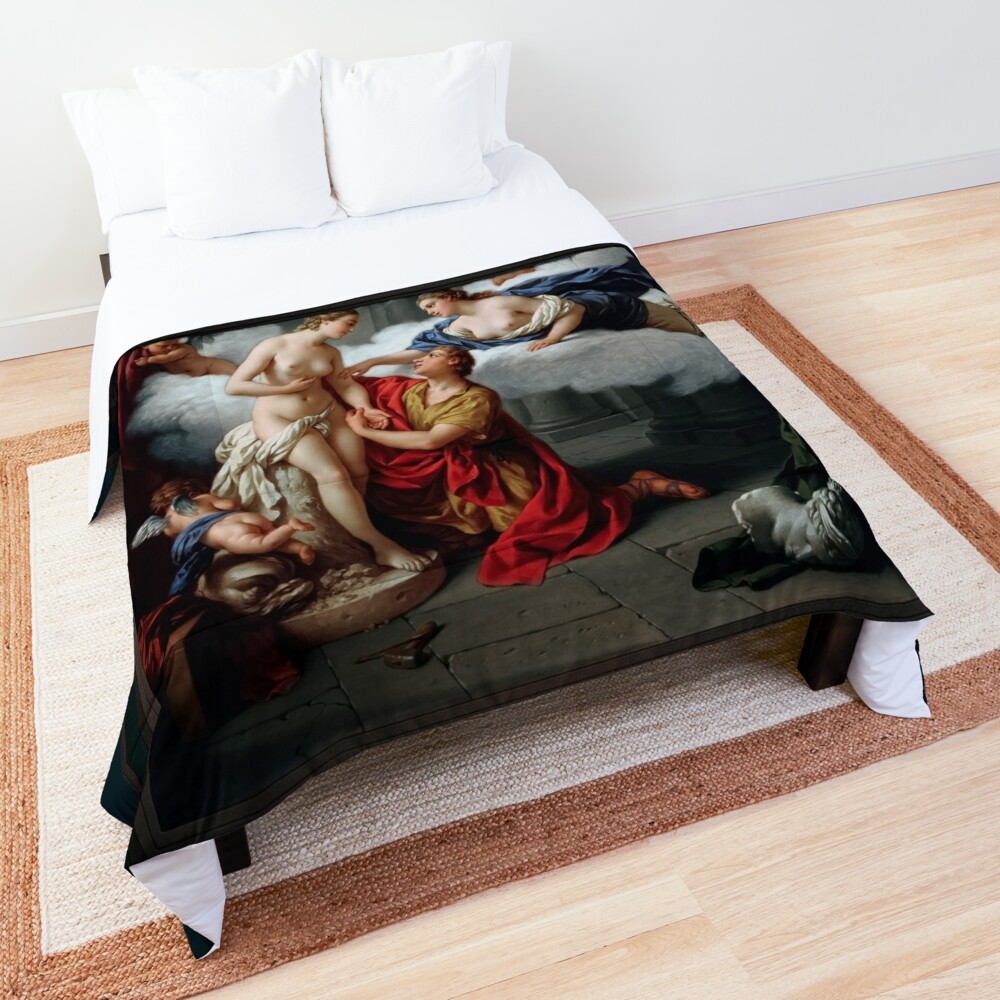
The focal point of the painting is the statue of a woman, sculpted by Pygmalion, who is positioned at the center of the composition. She is depicted with grace and beauty, her form idealized according to classical standards. Her body, crafted from stone, exudes a sense of life-like stillness, as if she is about to come to life. Surrounding her are gods and cherubs, including a prominent angel-like figure with wings. This celestial being appears to gently touch the statue’s face, imbuing it with divine life.
Pygmalion, portrayed as a man of classic beauty, kneels beside his creation, his expression one of awe and adoration. His posture suggests both reverence and longing, as he gazes at the statue, perhaps waiting for the moment when his wish will be granted. His drapery is depicted with naturalistic folds, emphasizing his connection to the classical world and the nobility of his craft.
In the upper-left corner of the painting, a group of angels and gods, including Cupid with a bow, can be seen playing their roles as divine messengers. These figures serve as symbols of love and transformation, emphasizing the mythological theme of the piece. The surrounding clouds are symbolic of the ethereal realm, and their soft billowing forms contrast with the rigidity of the human figures below.
Objekten en terrein
The setting is an idealized classical ruin. The architecture in the background includes crumbling columns and stonework, giving a sense of antiquity to the scene. This placement in ruins suggests the decline of earthly things and the transcendence of love and artistry to the divine. The ground is rough and weathered, further enhancing the contrast between the physical and the metaphysical. These architectural elements allude to classical temples and the world of ancient Greece and Rome, grounding the narrative in a timeless and mythic space.
The objects in the foreground, including a marble pedestal and draped cloth, reinforce the theme of artistry and creation. Pygmalion’s tools, perhaps a chisel or brush, are suggested by the scattered objects near his feet, symbolizing the artist’s devotion to his craft and his ability to mold life from inanimate matter. The rich textures of the cloth draped around the figures, with its flowing and billowing folds, further highlight the sensuality and grace of the scene.
Materialen en techniken
Lagrenée’s technique in Pygmalion And His Statue reveals a mastery of oil painting, showcasing a precise yet fluid application of paint. The skin tones of both Pygmalion and his statue are rendered with remarkable subtlety, each figure’s form modeled with chiaroscuro, which enhances the three-dimensionality of the figures. The use of light and shadow contrasts beautifully, especially on the statue, whose smooth, polished surface is illuminated in a way that accentuates its lifelike appearance.
The artist’s careful attention to texture is evident in the treatment of the fabrics. The soft drapery is contrasted against the harder surfaces of stone and marble, giving the scene a sense of depth and tactile richness. Lagrenée’s use of color is also noteworthy, with the pale hues of the statue and the soft pinks and blues of the surrounding figures bringing a serene yet dramatic vibrancy to the overall composition.
The figures themselves are modeled in a classical style, embodying the elegance and grace of Greek and Roman statuary. Pygmalion’s muscular form and the curvaceous, idealized features of the statue reflect the artistic values of the time. The softer, dreamlike qualities of the surrounding clouds and heavenly figures, combined with the more grounded elements of the human figures and architectural ruins, create a harmony between the earthly and the divine.
Styl, Tema, en Mood
Pygmalion And His Statue is undeniably influenced by the ideals of the Neoclassical period. The return to classical themes, combined with a reverence for Greek and Roman antiquity, is evident in the portrayal of Pygmalion as a hero of myth. The theme of transformation, both physical and spiritual, stiet sintraal yn it ferhaal, highlighting the power of art and love to transcend the human condition. Lagrenée imbues the scene with a mood of reverence and awe, as the gods bestow their blessing upon the artist and his creation. The romantic and sensual undertones are tempered by a sense of divine intervention, suggesting that true love and creation can only be fully realized with the touch of the divine.
The overall mood of the painting is one of quiet contemplation and wonder. Pygmalion’s longing gaze and the tender, almost sacred interaction between the statue and the celestial beings create a sense of divine love, reminding the viewer of the intersection between human artistry and the gods’ intervention in mortal affairs. This work speaks to the enduring power of myth, leafde, en skepping.
Artwork Backstory
This is another eye catching and beautiful painting of the Greek Mythological tale of Pygmalion and Galatea; in which the stone sculpture created by Pygmalion is possessed with life by the Goddess of Love, Aphrodite, in an response to a prayer made by him.
In this scene we see Pygmalion on his left knee, with his right arm around the back of Galatea and his left hand holding her left hand as she is transitioning from a beautiful woman of stone into a beautiful woman of flesh and blood.
By Galatea to her right and near to her leg is a cherub floating above the head of a sculpted fish which makes up part of the sculpture from which Galatea has been created, adjusting part of a robe that is affixed to her waist and between her legs.
Behind her is another cherub floating on a large white cloud that is also supporting the Goddess of Love, Aphrodite and another cherub above her; this cherub is pushing a deep wine red drape to the side and looking at the marvel that is taking place.
Pygmalion And His Statue Before and After Remastering Video View
Behind and to the right of Pygmalion is Aphrodite, laying down on the cloud and touch Galatea so that the sculpture can turn into a human being; and above her on the other part of the cloud is the third cherub that is holding a gold torch that is ablaze, with smoke flowing in the direction of Galatea.
All this is occurring in the sculptors studio of Pygmalion, away from prying eyes and the open courtyard that is comprised of large stone columns, stone walls, and stone beams.
In his work area we can see a wooden stool to the right of sculpture, as well as a hammer and chisel on the floor in front of the sculpture; and to the right front of the scene is a wooden bench with a red cushion top with a green cloak draped over it and on the floor that as a partially broken stone bust of the Goddess Aphrodite resting on it.
Pygmalion And His Statue is a remastered digital art old masters reproduction of a public domain image that is available as canvas, acrylic wood and metal prints online.
Artist Bio
Ynformaasje hjirûnder ôflaat fan Wikipedia.org
Louis waard berne yn Parys, Frankryk yn 1724, en wie de âldste fan twa bruorren, beide bestimd om bekende Frânske skilders te wurden; en fan jongs ôf in oanleg toand foar tekenjen en skilderjen.
Louis begon syn artistike troch de Royal School of Protected Pupils of Royal School for Protected Pupils, dat waard oprjochte yn 1748 ûnder lieding fan Charles Antoine Coypel (1694 – 1752) troch de kening fan Frankryk Loadewyk XV.
De masterskilders fan 'e Frânske Keninklike Akademy biede artistike kursus oan it publyk foar in nominale fergoeding yn tekenjen en de prinsipes en techniken fan keunst; dit soe de masters tastean om te selektearjen út dyjingen dy't har ynskreaun hawwe foar de kursus, seis fan 'e meast bejeftige yndividuen op jierbasis dy't trije jier fergees les en in lyts stipendium wurde oanbean; en tariede de learlingen op de Prix de Rome-kompetysjes.
Neidat hy waard selektearre foar it programma, Louis begûn syn oplieding ûnder lieding fan Carle van Loo (1705 – 1765); en op syn earste poging yn 1749 wûn de Prix de Rome mei syn bibelske skilderij “Jozef ynterpretearret de dreamen fan Farao”.
Yn syn tiid oan 'e Frânske Akademy yn Rome soe Louis syn tiid wije oan 'e barokke skilderstyl; dat waard ynspirearre troch de Bolognese Skoalle en it wurk fan Italjaanske skilders Francesco Albani (1578 – 1660) en Guido Reni (1575–1642).
Fjouwer jier letter soe er weromkomme nei Frankryk, en begon te wurkjen oan The Abduction of Dejaneira troch de Centaur Nessus; by it ôfmeitsjen fan it stik 2 jierren letter yn 1755, it fertsjinne him mei in unanym stimming, lidmaatskip oan de Akademy foar Skilder- en Skulptuer; fêstigje him as in foaroansteand skilder.
Fan dizze tiid ôf soe Loadewyk in protte opdrachten krije fan foaroansteande beskermhearen, leden fan 'e groeiende finansjele mienskip, likegoed as royalty; doe't hy de oandacht fan Elizabeth Petrovna fong, Keizerinne fan Ruslân, WSO, yn 1760, beneamde him hofskilder en direkteur fan de Akademy te St. Petersburg.