

Galatea
Galatea, created by the French painter Anne Louis Girodet-Trioson (1767 – 1824), who was a student of Jacques-Louis David; is an exemplary painting from the Neoclassical period, showcasing the artist’s mastery in capturing both the grace and intensity of mythological subjects. It stik, painted in the late 18th century, offers a powerful and nuanced representation of the Greek mythological figure Galatea, known for her beauty. This work is an exploration of divine femininity and the tension between myth and emotion. The mood conveyed is one of serene grace, tinged with a subtle melancholy that reflects the complex nature of Galatea’s mythological existence.
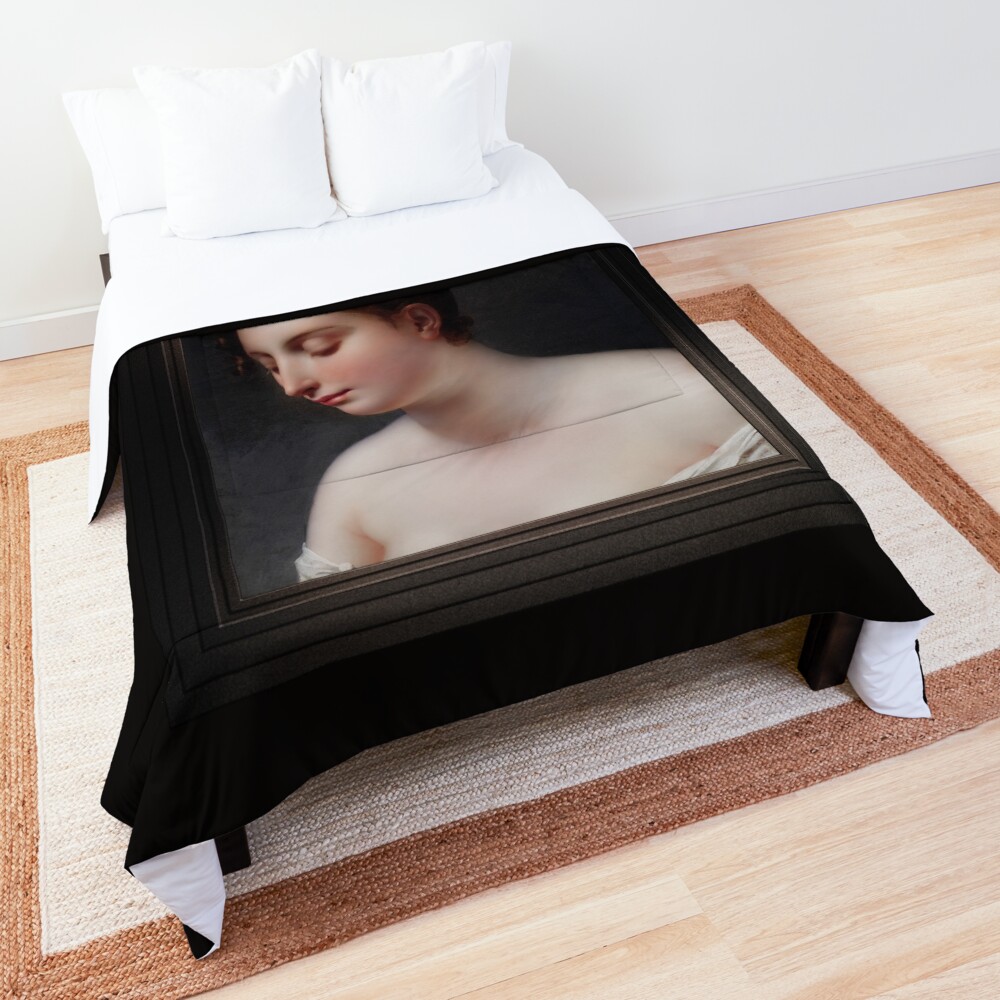
He show her in the same form and position as he did in the full dramatic piece Pygmalion et Galatee that he did in 1819, with her head slanted toward the ground and her eyes just beginning to open; with her wearing an off shoulder white dress.
Ynhâldsopjefte
It ûnderwerp: Galatea
At the heart of the composition is the figure of Galatea, depicted as an ethereal beauty draped in soft, flowing fabrics that cascade around her form. She is shown in a moment of contemplation, her head slightly tilted and eyes cast downward, as though lost in thought or rapture. This pose is characteristic of the romantic and classical sensibilities of the time, allowing the artist to express both Galatea’s divine beauty and her inner turmoil. Har gesicht, delicate and serene, is softly illuminated, capturing her timeless youth and otherworldly allure.
Har fel, rendered with exquisite delicacy, gloeit mei in sêfte porslein-like kwaliteit, in skaaimerk fan Girodet syn oandacht foar detail. De sierlike kromme fan har nekke en de glêdens fan har foarm jouwe in gefoel fan kwetsberens en suverens oer, de klam op it kontrast tusken har himelske aard en de emosjonele djipte dy't troch har blik suggerearre. It streamende drapery om har hinne, bleek en hast trochsichtich, draacht by oan it etheryske gefoel fan it stik, suggerearret dat Galatea is fongen tusken de riken fan 'e ierde en de himel.
De ynstelling en eftergrûn
De setting fan it skilderij is in klassyk lânskip, ropt de romantisearre natuerlike wrâld op dy't typysk is foar de neoklassisistyske perioade. Achter Galatea, wy sjogge hints fan in kustsêne mei sêft rôljende weagen dy't har ferbining mei de see symbolisearje. The muted blues and greens of the background contrast with the warm tones of her skin, creating a visual harmony between the figure and the environment. This soft, distant backdrop enhances the sense of isolation and calm, making Galatea appear as if she is floating in a dreamlike realm, detached from the concerns of the earthly world.
The painter’s use of light, particularly in the way it illuminates her face and shoulders, adds a divine quality to her figure, implying that she exists within a world of her own, untouched by earthly woes.
Styl en technyk
Girodet-Trioson’s painting style blends the classical with the romantic, employing techniques that emphasize idealized beauty, sêfte tekstueren, and harmonious color palettes. The softness of the brushwork in the portrayal of Galatea’s skin and hair contrasts with the more defined strokes in the background, it meitsjen fan in gefoel fan djipte en dimensjonaliteit. The contrast between light and shadow is skillfully executed, especially on Galatea’s delicate form, which appears to glow against the darker, more subdued tones of the background. This contrast enhances the divine, almost supernatural quality of her character.
The painter’s technique of rendering skin tones is especially notable for its smoothness and luminosity. The use of subtle glazes gives her skin an almost translucent appearance, drawing attention to her vulnerability and femininity. This technique is indicative of Girodet’s meticulous attention to detail and his ability to render the human form in a way that feels both realistic and idealized.
The drapery around her, with its fine folds and soft texture, highlights the artist’s ability to depict materiality. The fabric flows elegantly, almost as if it were a natural extension of Galatea’s form, further emphasizing her connection to the world of the gods.
De stimming en tema's
The mood of the painting is one of tranquility tinged with melancholy. There is an ethereal stillness to Galatea, as if she is suspended in time, reflecting on her own beauty or perhaps on the complex emotional landscape of her mythological tale. The softness of her expression, combined with her detached pose, suggests that she is both physically present and yet emotionally distant, caught between her divine nature and the emotional pull of her myth.
The theme of beauty and transformation is central to the work, as it explores the idea of divine femininity as both a gift and a burden. Galatea’s beauty is not only her most defining characteristic but also the source of her emotional and mythical struggles. Her contemplative expression hints at an inner world that is not often associated with mythological figures, who are typically portrayed as powerful and triumphant. Girodet-Trioson’s interpretation of Galatea suggests that beauty, while divine, can also be isolating and filled with sorrow.
Konklúzje
Galatea troch Anne Louis Girodet-Trioson (1767 – 1824) stands as a stunning example of Neoclassical art, blending mythological narrative with deep emotional resonance. De útsûnderlike technyk fan de keunstner, the delicate portrayal of the figure, and the subtle interplay between light and shadow create a painting that is both visually captivating and thematically rich. Through his depiction of Galatea, Girodet-Trioson invites the viewer to consider not only the beauty of the subject but also the emotional complexity beneath that beauty, making this work a timeless exploration of the mythological and human condition.
Dit is in remastered digitale keunst âlde masters reproduksje fan in byld yn it iepenbier domein dat is beskikber as in canvas print online.