

La fille des potiers
“La fille des potiers”, créé par l'artiste britannique Abbey Abraham Altson (1866 – 1949), est une pièce captivante de la fin du 19e au début du 20e siècle, reflétant les influences stylistiques de l'époque. Altson, connu pour ses portraits raffinés et son utilisation de la lumière et de l'ombre, a capturé un moment intemporel de la vie d'une jeune femme, alliant réalisme et touche de romantisme. Ce travail, rendu à l'huile sur toile, représente une femme tenant une cruche de poterie, drapé de riche, tons chauds. La scène résonne avec l'esthétique de l'époque victorienne, tout en poussant subtilement vers l'exploration du naturalisme et de l'émotion au XXe siècle.
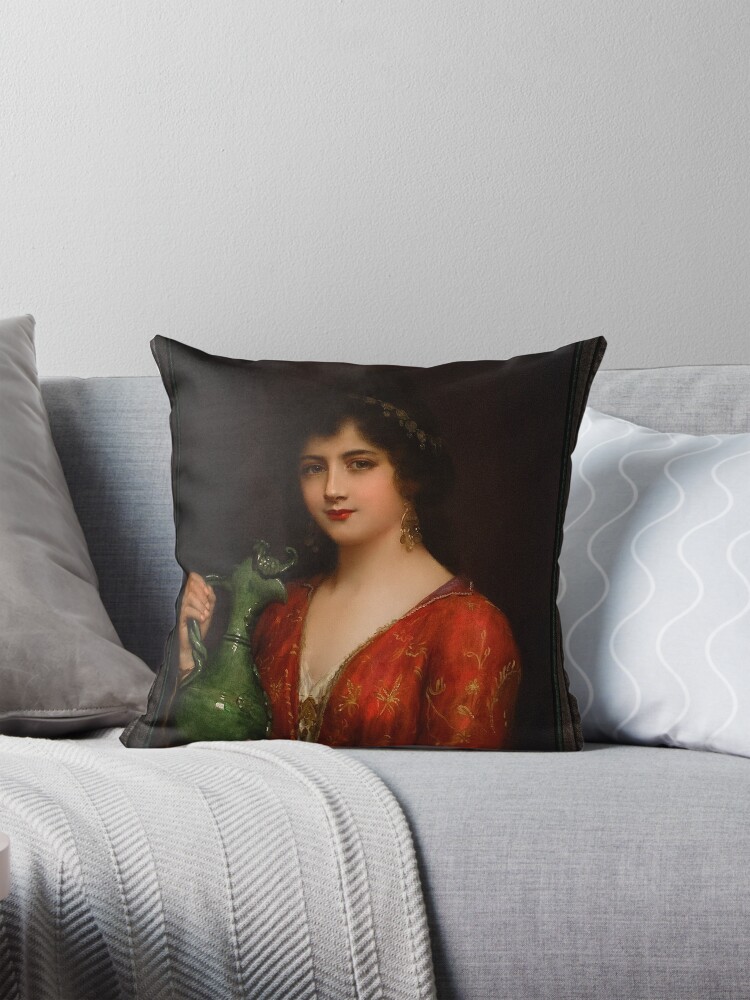
Table des matières
Sujet et humeur
Au cœur du tableau se trouve le beau portrait d'une figure sereine et digne d'une jeune femme, traditionnellement appelé “La fille du potier.” Elle regarde directement le spectateur avec une expression douce mais assurée, sa posture gracieuse et posée, comme pris dans un moment de réflexion. La jeunesse et la beauté du sujet sont évidentes, mais il y a aussi un air de force tranquille en elle, alors qu'elle tient la cruche en poterie, un objet symbolique qui la relie au passé, son héritage, et peut-être au travail quotidien qui aurait été courant pour les femmes en milieu rural ou artisanal.
L'expression de la femme, serein mais légèrement énigmatique, invite le spectateur dans un récit personnel, celui qui n'est ni trop dramatique ni clairement neutre. La subtile courbe ascendante de ses lèvres suggère une confiance intérieure, une connaissance de sa place dans le monde. Cet élément de tranquillité, almost untouched by time, is a central theme in Altson’s depiction, and it evokes a sense of nostalgia for a simpler, pre-industrial era. Her dark hair is elegantly styled, encadrant ses traits délicats, and her jewelry, grand, boucles d'oreilles pendantes, adds an air of modest elegance.
Les objets et leur signification
The pottery jug held by the woman is the most significant object in the composition, both as a symbol and as an element of the narrative. Pottery, often associated with both artistry and utility, signifies the balance between domestic work and creative craft. The vessel is a carefully crafted piece of art itself, rendered with intricate detailing, showing Altson’s careful attention to the textures and shapes of everyday items. The artist’s choice to include the jug in the portrait likely suggests the importance of craftsmanship in this woman’s life, possibly alluding to a heritage or legacy passed down through generations of potters.
aditionellement, the deep red of the woman’s robe stands out against the dark, arrière-plan sourd. The fabric’s rich texture and color imply both warmth and luxury, suggesting that she may not be a mere worker but someone from a family of artisans, perhaps even one whose father’s pottery has achieved some acclaim. This connection between the woman and her father is central to understanding the painting’s underlying narrative: she is not just a daughter, but a representative of a lineage, poised to carry on the traditions of her forebears.
Paysage et arrière-plan
The backdrop of the painting is dark, almost enveloping the subject, creating a striking contrast that focuses the viewer’s attention entirely on the woman and her object. There is no obvious landscape or bustling environment; plutôt, the focus remains inward, on the subject herself. The neutral, deep tones of the background enhance the vividness of the subject, giving her a timeless, almost otherworldly presence. This technique is characteristic of Altson’s portrait style, where the lack of distracting elements elevates the individual and their relationship with the viewer.
This stark contrast between the woman and her environment also suggests an intentional detachment from the world around her. The simplicity of the background can be interpreted as symbolic of the quietude of rural life or artisanal existence, where the internal world of the subject becomes paramount. The absence of any significant landscape or setting may also imply that the subject’s identity is not defined by her surroundings, but by her inner world and the quiet dignity she carries with her.
Style et technique
Altson’s artistic style in “The Potter’s Daughter” blends elements of realism with a slightly romanticized portrayal. L’utilisation du soft par l’artiste, almost ethereal lighting enhances the sense of refinement and grace surrounding the subject.
The technique of sfumato, blending colors and tones to create a soft, smoky transition between colors, gives the woman’s face a lifelike quality, while the rich textures of her robe and the pottery jug invite the viewer to appreciate the artist’s detailed brushwork. The blending of warm and dark tones, contrasted with the intricate details of the subject’s attire and the pottery, is characteristic of Altson’s ability to balance form and texture, bringing out the tactile qualities of both the human figure and the objects she interacts with.
Conclusion
“The Potter’s Daughter” by Abbey Abraham Altson is an exemplary piece of late 19th-century portraiture that captures both the elegance and quiet strength of its subject. Grâce à une attention particulière aux détails, texture, Et léger, Altson transforms a simple moment, holding a pottery jug, into a reflection on heritage, identité, and the role of women in a pre-industrial society.
The muted background, the symbolism of the pottery, and the serene expression of the young woman all work in harmony to create an artwork that speaks not only of personal grace but also of an era that valued craftsmanship and familial legacies. Altson’s masterful rendering of this intimate, timeless scene remains a testament to his ability to capture the essence of both the human spirit and the world it inhabits.
Il s'agit d'une reproduction de maîtres anciens d'art numérique retouchée d'une image du domaine public qui est disponible à l'achat en ligne en tant que impression sur toile roulée.
Biographie de l'artiste
Informations ci-dessous dérivées de Wikipedia.org
Abbey Abraham Altson est né à Middlesbororough-on-Tees, Yorkshire dans l'année 1864. En septembre de 1883 lui et son frère Barnett Hayman Altson sont allés en Australie ; et commençant dans 1885 Abraham a commencé à étudier le dessin deux soirs par semaine à la National Gallery School of Design, situé à Melbourne.
je 1886 il s'inscrit ensuite comme étudiant à temps plein à l'école de peinture; étudier avec un autre artiste bien connu, comme Fred McCubbin, John Longstaff, Emmanuel Phillips Fox, David Davies, Rue Tudor. George Tucker et Fred Williams.
Abraham a remporté des prix chaque année où il était à l'école, et les critiques le présentent comme l'élève le plus prometteur du futur.