

Ripplin-Rhythmus
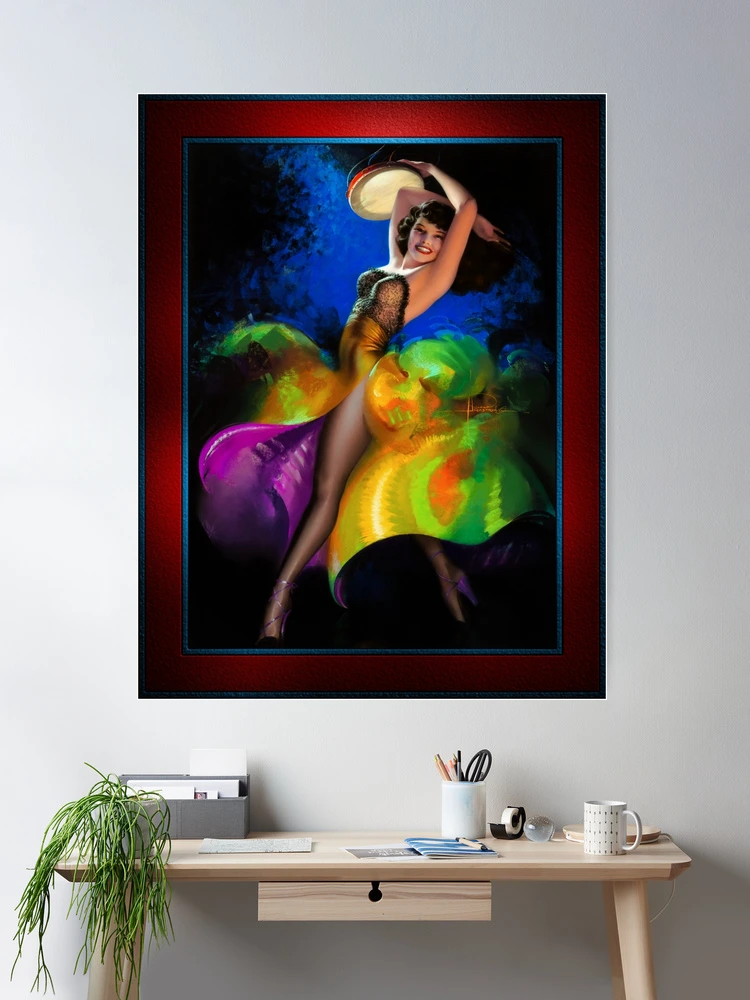
“Ripplin-Rhythmus,” geschaffen vom renommierten amerikanischen Künstler Rolf Armstrong (1889 – 1960), ist ein Beweis für die lebendige Schönheit der Pin-up-Kunst in der Mitte des 20. Jahrhunderts. Armstrong, eine herausragende Figur im goldenen Zeitalter der amerikanischen Werbekunst, vereint gekonnt Bewegung, Farbe, und Emotion in diesem Stück, bietet einen Einblick in den Glamour und die Sinnlichkeit, die diese Ära prägten.
Geboren in 1889, Armstrongs Werk zeichnete sich durch die Beherrschung von Licht und Farbe aus, Seine Bilder waren in der Werbung sehr gefragt, Illustrationen, und bildende Kunst. Er nutzte eine einzigartige Mischung von Techniken, die seinen Motiven Dynamik verlieh, und “Ripplin-Rhythmus” bringt dies mit seiner flüssigen und energischen Darstellung einer Frau in Bewegung auf den Punkt.
Inhaltsverzeichnis
Hauptthema: Der lebendige Tänzer
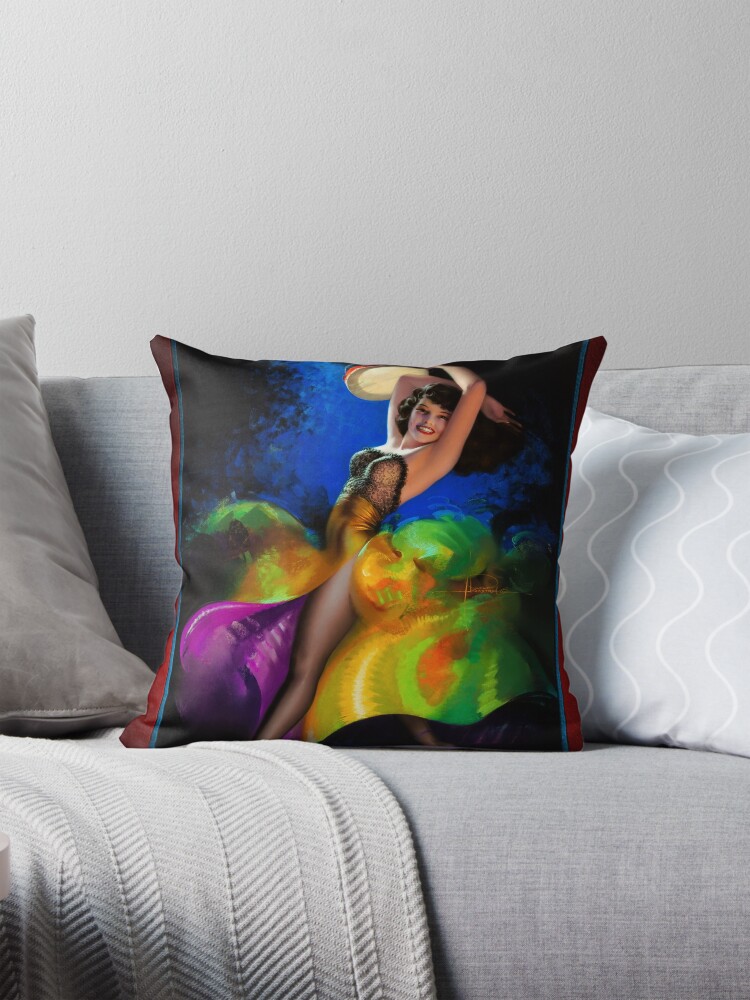
Im Herzen von “Ripplin-Rhythmus” ist eine fesselnde Darstellung einer Tänzerin mitten in der Aufführung. Das Thema, eine Frau, strahlt Selbstvertrauen und Freude aus, während sie sich anmutig dreht, Ihr fließendes Kleid umspielte ihren Körper wie die Wellen eines Ozeans. Die Kleidung des Tänzers ist ein Farbtupfer, mit wirbelnden Grüntönen, Gelb, und Lila bilden einen auffälligen Kontrast zum tiefblauen Hintergrund.
Die Haltung der Frau ist elegant und dennoch überschwänglich, Ihre Arme sind in einer feierlichen Geste erhoben, während sie ein Tamburin über ihrem Kopf hält. Ihr Gesicht strahlt Glück aus, ein breites Lächeln, das ihren verspielten Geist offenbart. Armstrong hat nicht nur ihre Bewegung, sondern auch ihr Wesen eingefangen, Sie wirkt so, als ob sie voller Energie und Rhythmus wäre.
The woman’s vibrant costume, designed to reflect the rhythm of her movements, is a fusion of bold colors. The soft metallic sheen of her golden bodice catches the light, enhancing the dynamic flow of her skirt. Armstrong’s use of color in this piece is masterful, with each hue seemingly chosen to emphasize the woman’s graceful spinning and the lively atmosphere of her performance. Der Rock, which flares out around her like an explosive flower, ripples with energy, suggesting the dancer’s movement and the pulse of the music she is engaged with.
Die Objekte: Tamburin und fließende Kleidungsstücke
The tambourine held by the dancer is a key object in the painting, not only because it symbolizes the musical rhythm she embodies but also because it ties the composition together. The tambourine’s small yet intricate form contrasts the large, swirling mass of the dancer’s gown, yet it maintains a presence that complements the overall movement within the scene.
The circular shape of the tambourine subtly mirrors the curves and flow of her garments, creating a visual harmony between the two. This object, obwohl scheinbar einfach, amplifies the sense of rhythm and dance in the composition.
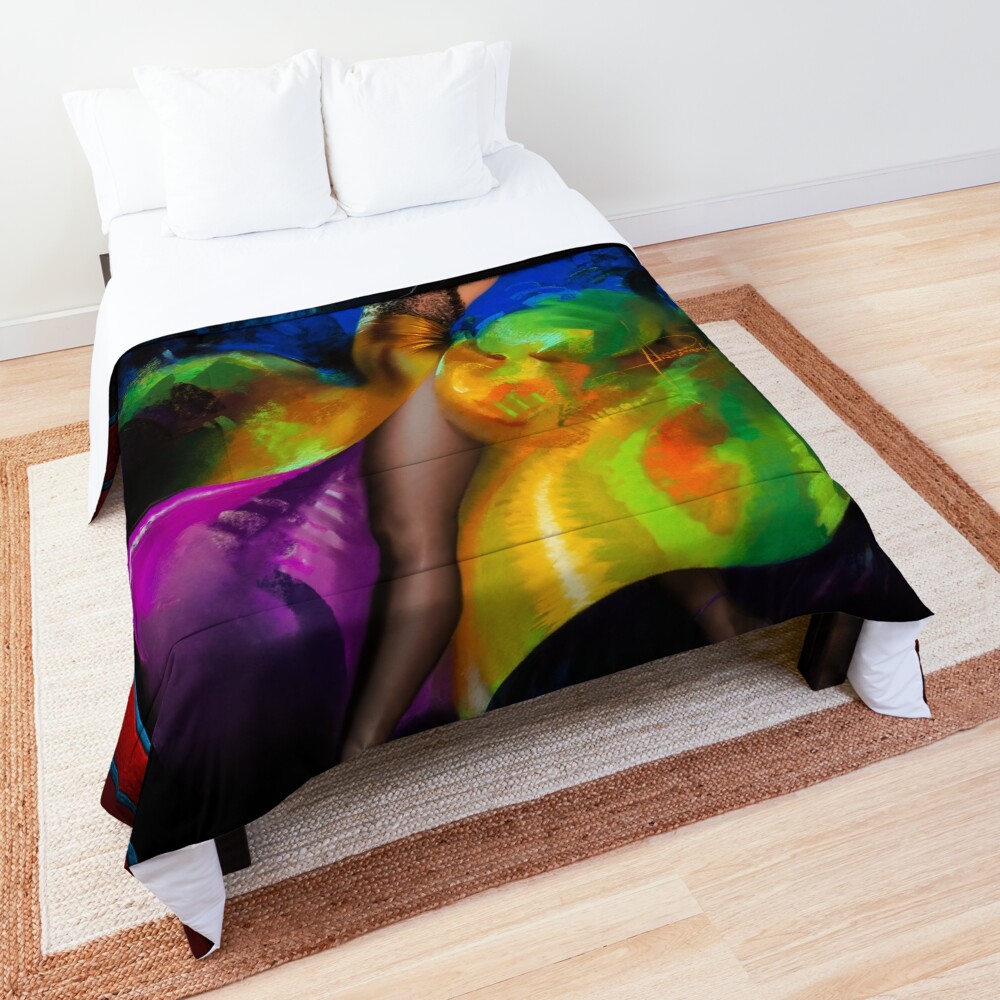
The cascading layers of the dancer’s gown are another vital aspect of the work. Armstrong’s skillful handling of fabric and texture brings the dress to life, with each fold and curve appearing as if it is caught mid-movement. Das Kleid, with its vibrant, rippling folds, seems to echo the fluidity of the dancer’s form. The luxurious colors and glossy textures of the skirt create a feeling of both elegance and freedom, enhancing the theme of lively celebration.
Terrain: Der bunte Hintergrund
Der Hintergrund von “Ripplin-Rhythmus” is one of the key elements that contribute to the piece’s overall mood. A deep blue hue forms the backdrop, providing a striking contrast to the warm colors of the dancer’s attire. This color choice highlights the subject and makes her appear as if she is emerging from a dreamlike or fantastical environment.
Armstrong uses the swirling shapes and dark tones in the background to evoke movement and rhythm, as if the air itself is alive with the same energy that drives the dancer. The fluidity of the colors in the background suggests motion, blending with the dancer’s own movements, creating a seamless connection between subject and environment.
Stil: Art Deco und Glamour
“Ripplin-Rhythmus” is a quintessential example of Armstrong’s signature style, which draws heavily from Art Deco influences. The streamlined elegance of the figure, the dynamic compositions, and the use of bold, contrasting colors all reflect the Art Deco movement, which was characterized by its celebration of modernity, Luxus, und Glamour.
Der glatte, graceful lines of the dancer’s body and the geometric shapes within the composition convey a sense of sophistication and energy that are central to the Art Deco aesthetic. Gleichzeitig, the work also embodies the exuberance and glamour of the pin-up style, which Armstrong helped define. Seine Darstellung von Frauen war nicht nur sinnlich, sondern auch feierlich, und “Ripplin-Rhythmus” ist ein perfektes Beispiel dafür, denn es fängt einen Moment freudigen Selbstausdrucks ein.
Das strahlende Lächeln und die energiegeladene Pose der Tänzerin zeugen von der optimistischen und unbeschwerten Stimmung dieser Zeit. Armstrongs Werk ist von jugendlicher Vitalität durchdrungen, und dieses Gemälde veranschaulicht die lebendige Energie der amerikanischen Kultur in den 1940er Jahren. Es spiegelt eine Zeit des Vertrauens und der Freude wider, vor dem Hintergrund einer Welt, die an der Schwelle zu dramatischen Veränderungen steht.
Thema und Stimmung: Feier der Bewegung und Musik
Das Thema von “Ripplin-Rhythmus” Im Mittelpunkt steht die Feier der Bewegung, Musik-, und Weiblichkeit. Armstrong fängt die Essenz des Tanzes als Ausdruck von Freude und Befreiung ein, Hervorhebung der Dynamik und Schönheit der menschlichen Form in Bewegung.
The artist has skillfully conveyed the idea that rhythm is not just a sound but a force that can be seen and felt in the movements of the body. The dancer’s bright smile and the lively swirl of her dress communicate a sense of freedom, playfulness, and enthusiasm, making the painting feel like an invitation to partake in the celebration.
The overall mood of the artwork is one of joy and excitement. Armstrong’s use of color and form conveys a sense of lightness and exuberance, and the dancer herself appears to be in the midst of a joyous performance, lost in the music and her own movement. The piece encapsulates a spirit of happiness, optimism, and youthful vitality, evoking a time when life seemed to be filled with endless possibilities.
Abschluss
“Ripplin-Rhythmus” by Rolf Armstrong is more than just a beautiful portrait of a woman in motion; it is a vibrant celebration of life, Farbe, und Musik. The dynamic composition, Fettfarbene Verwendung von Farbe, and joyful expression of the dancer all contribute to a sense of energy and rhythm that makes the painting come alive. Armstrong’s mastery of movement and his ability to capture the spirit of an era make this work a timeless example of American art. Through the use of elegant forms, flowing garments, and vibrant hues, Armstrong successfully conveys the joy of dance, the celebration of femininity, and the power of music to inspire movement and expression.
Die Zauberin ist eine retuschierte Reproduktion der digitalen Kunst alter Meister eines gemeinfreien Bildes.
Künstler Bio von Wikipedia.org
Rolf Armstrong wurde als John Scott Armstrong in Bay City geboren, Michigan im April 21, 1889, an Richard und Harriet (Scott) Armstrong. Sein Vater besaß die Boy-Line Fire Boat Company, darunter eine Reihe von Passagierschiffen. Einige wurden in Chicago für den Einsatz auf der dortigen Weltausstellung in Chicago eingesetzt 1893.
jedoch, das Geschäft des Vaters und die Familie hatten zu kämpfen, und das Gehöft der Familie ging durch Zwangsvollstreckung verloren. Im 1899, die Familie zog nach Detroit, Michigan. Rolfs Vater starb in 1903, und ein Jahr später zogen er und seine Mutter nach Seattle, Washington, auf den Spuren seines ältesten Bruders, Wilhelm, der ein Jahr zuvor dorthin gezogen war. Rolfs künstlerisches Interesse entwickelte sich mittlerweile zu mehr als einem Nebenvergnügen.
Er zog nach Chicago in 1908, wo er später am Art Institute studierte. Dann ging es weiter nach New York, wo er bei Robert Henri . studierte. Nach einer Reise nach Paris in 1919 an der Académie Julian . studieren, er kehrte nach New York zurück und gründete ein Studio. Im 1921 er ging nach Minneapolis, um an der Brown Kalenderproduktion zu studieren & Bigelow.
In den 1920er und 1930er Jahren, seine Arbeit erschien auf vielen Musiknoten, sowie auf den Titelseiten vieler Zeitschriften, am bekanntesten für Filmfanmagazine wie Photoplay und Screenland. Seine Arbeit besteht hauptsächlich aus Frauen; Mary Pickford, Bebe Daniels, und Greta Garbo sind nur einige der zahlreichen, die er gemalt hat.
Armstrongs Arbeit für die Pictorial Review war maßgeblich dafür verantwortlich, dass diese Zeitschrift eine Auflage von mehr als zwei Millionen erreichte 1926. Ein Jahr später, er war der meistverkaufte Kalenderkünstler bei Brown & Bigelow. Im 1930, RCA hat ihn angeheuert, um Pin-ups zu malen, um für ihre Produkte zu werben, und in 1933 der Thomas D. Murphy Calendar Company verpflichtete ihn, eine Reihe von Gemälden für ihre Linie zu produzieren.
März 1940, Juwel Blumen, ein Mädchen aus Lumberton, North Carolina, schickte Armstrong ein Bild von sich als Reaktion auf eine Anzeige, die er in der New York Times geschaltet hatte. Armstrong, 50 damals, war seither im Hotel des Artistes in der West 67th Street in Manhattan ansässig 1939, und war auf der suche nach neuen modellen.
Er hat Flowers zu einem Interview eingeladen. Im März 25, 1940, Flowers begann für Armstrong zu modeln. Ihre professionelle Zusammenarbeit und Freundschaft dauerte zwei Jahrzehnte. Das erste Gemälde, betitelt “Wie mache ich mich?”, angeblich weil Blumen, ungewohnt zu modeln, fragte Armstrong immer wieder “Wie mache ich mich?” während der Modellierungssitzung, wurde erstmals nach Beginn des Zweiten Weltkriegs veröffentlicht.
Es war Braun & Bigelows meistverkaufter Kalender für 1942 zu einer Zeit, als das Unternehmen in Amerika Millionen von Kalendern verkaufte, und es wurde eines der am häufigsten reproduzierten Bilder von Armstrong. Flowers war während des Zweiten Weltkriegs bei amerikanischen Soldaten beliebt, einige von ihnen schickten ihr Briefe mit Heiratsanträgen. Armstrongs Kalender und Silhouetten von Blumen wurden als Nasenkunst auf Bomber und andere Flugzeuge kopiert und auf Panzertürme gemalt.
Sie wurde während des Krieges so bekannt, allerdings eher als berühmtes gesicht denn namentlich, dass ein Brief eines Soldaten einfach adressiert als “Juwel Blumen, New York City” wurde korrekt geliefert. Für viele amerikanische Soldaten im Ausland, sie repräsentierte die “Warum wir kämpfen” Geist. UNS. Präsident Franklin D. Roosevelts Regierung hat sie angeworben, um bei der Förderung von Kriegsanleihen zu helfen.
Der Januar 1, 1945 Ausgabe des TIME-Magazins enthalten Armstrongs “Toast der Stadt” Blumenmalerei in einem Artikel über Kalenderkunst. Der Artikel stellte fest, dass Kalender mit “Mädchenbilder” war “stark gekauft von Gießereien, Maschinenwerkstätten, Auto-Versorgungshändler.”
Blumen verheiratet in 1946. Sie und ihr Mann lebten an mehreren Orten, während er eine Reihe von geschäftlichen Unternehmungen versuchte, einschließlich Laguna Beach, Kalifornien, Greenville, South Carolina, Reno, Nevada, wo sie angeblich eine Zeit lang als Kartenhändlerin gearbeitet hat, und New York City. Laut Michael Wooldridge, Co-Autor von Pin up Dreams: Die Glamour-Kunst von Rolf Armstrong, Armstrong rief sie während der Zeit, in der sie ihrem Mann von Ort zu Ort folgte, mehrmals an, um sie zu überreden, nach New York zurückzukehren und für ihn zu modeln.
Ihre Modelkarriere endete mit Armstrongs Tod in 1960. Einen großen Teil seines persönlichen Vermögens hinterließ er Flowers. Insgesamt, Armstrong schuf etwa fünfzig bis sechzig Werke nach dem Vorbild von Flowers.
Rolf Armstrong ist gestorben 1960 auf der Insel Oahu, Hawaii als eines der besten “Aufstecken” Künstler der ersten Hälfte des 20. Jahrhunderts.