

Rough Sea with Ships c1834
Rough Sea with Ships c1834″ by Théodore Gudin (1802 – 1880)
Il dipinto Rough Sea with Ships, creato in 1834 dall'artista francese Théodore Gudin, captures the raw, tumultuous nature of the sea as it crashes against ships caught in its powerful swells. Théodore Gudin, known for his marine landscapes, brings his deep understanding of seafaring life and nautical environments to life in this dramatic portrayal. The work, painted during the early part of his career, demonstrates his mastery of capturing both the violent and serene aspects of the ocean, as well as the lives of those who navigate its unpredictable waters.
Sommario
Argomento principale: The Struggle Between Man and Nature
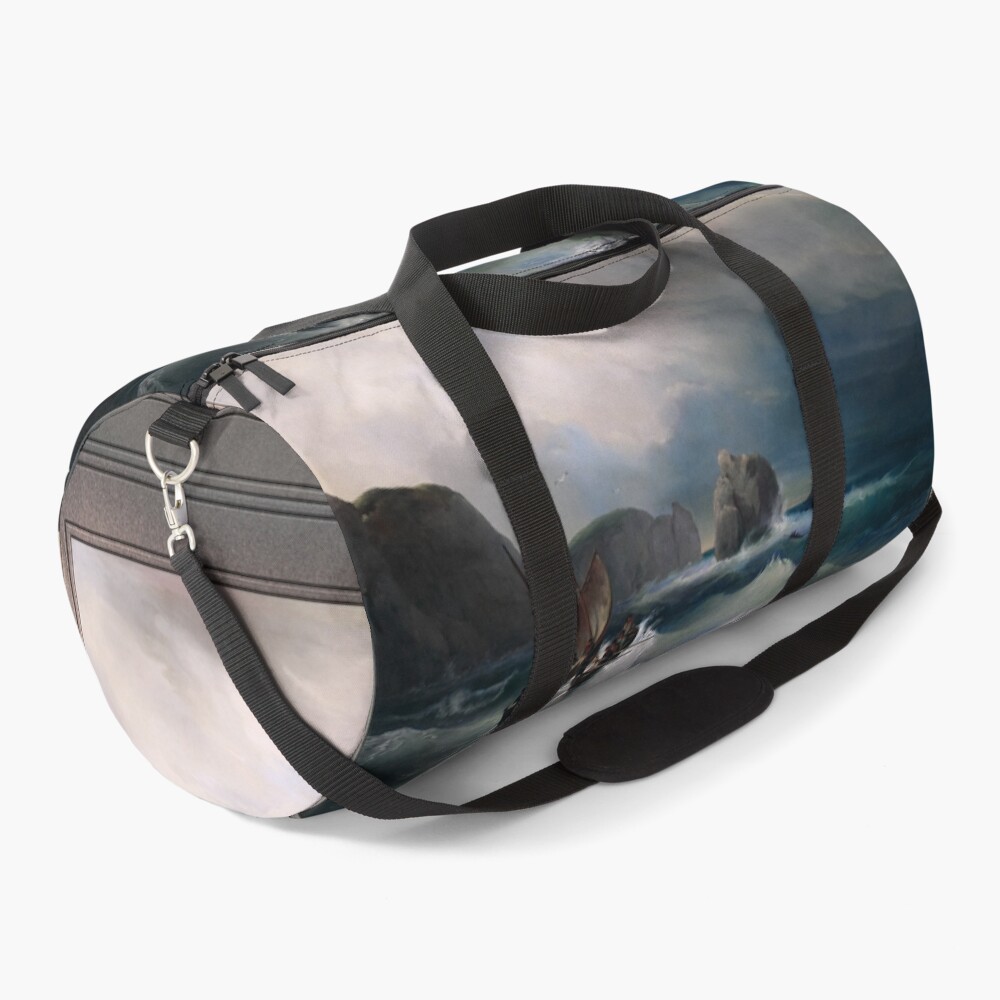
Al centro di Rough Sea with Ships is the battle between human endeavor and the untamable force of nature. A small group of sailors is depicted in a boat, braving the crashing waves with determination. Their vessel, a sturdy wooden ship, is helmed by several figures whose taut expressions and focused actions suggest the dire situation they are facing. The sailors, positioned toward the foreground, labor tirelessly to control their ship amidst the violent tides, with some of the figures rowing while others brace themselves against the ocean’s relentless pull.
The ship they are struggling to steer is not fully depicted, but the viewer can sense its looming presence as the sailors face the mighty forces of the sea. The stark contrast between the smallness of the boat and the vastness of the ocean serves as a reminder of human vulnerability in the face of nature’s immense power. In lontananza, another ship lies wrecked, its broken hull visible in the turbulent waters—a tragic casualty of the storm, illustrating the perils of seafaring life.
Terrain and Background Elements: A Churning Ocean and Rugged Coastline
The background is dominated by a vast and churning sea. Gudin’s use of swirling waves, painted in shades of green and blue, evokes the strength and energy of the water. The sea appears to stretch endlessly into the horizon, where the sky and water merge in a seamless, stormy union. The waves are thick with motion, capturing the raw power of nature as they crest and crash down. The high waves are painted with dynamic brushwork that gives them a three-dimensional quality, as though they might leap off the canvas and engulf the viewer.
In lontananza, jagged cliffs rise sharply from the ocean, serving as an imposing reminder of the rugged coastlines that often challenge sailors. The rocky outcrops, painted with muted grays and browns, loom large in the composition. The cliffs are not only symbolic of the perilous environment sailors must navigate but also act as a dramatic contrast to the violently churning sea. The sea and sky appear restless, their tension palpable, as they communicate the chaos and danger of the scene.
The sky above the sea is dominated by heavy, dark clouds, painted in a mixture of grays and whites. The atmosphere is thick and oppressive, with the storm seeming to grow ever more powerful as it rages on. A few birds can be seen flying through the storm clouds, their fragile existence an almost poetic counterpoint to the overwhelming power of the waves below.
Materiali e Tecnica: Gudin’s Skillful Brushwork and Use of Light
Gudin employs a variety of techniques to bring this dramatic scene to life. His brushwork is bold and confident, especially in the rendering of the waves. The swirling movement of the water is captured with thick, swirling strokes that give the ocean a sense of dynamic motion. The texture of the waves feels palpable, almost as if the viewer could feel the spray of saltwater from the canvas.
The light in the painting plays a crucial role in heightening the mood. The painting is lit from a source beyond the horizon, with the light breaking through the dark clouds in places, lanciare un morbido, almost ethereal glow on the surface of the water. This light serves to accentuate the contrast between the darkness of the storm and the fleeting moments of clarity that emerge during the tempest. The interplay of light and shadow on the sailors and their boat adds depth and drama, illuminating the tension of their struggle against the storm.
The material qualities of the painting are rich, with Gudin using oils to achieve a highly detailed, textured surface that allows for dramatic contrasts between light and dark. The smoothness of the sky contrasts with the rough, thick texture of the ocean’s waves. This juxtaposition adds to the sense of conflict and chaos in the scene, intensifying the mood.
Tema e umore: A Struggle for Survival
The overriding theme of Rough Sea with Ships is one of struggle and survival. Gudin’s depiction of the sailors’ efforts against the raging sea emphasizes the fragility of life and the strength of the human will. The shipwreck in the distance acts as a grim reminder of the consequences of failing to overcome nature’s power. Ancora, the sailors in the boat press on, rowing with determination, their perseverance symbolizing resilience in the face of overwhelming odds.
The mood of the painting is intense and fraught with tension. The violent, turbulent ocean and the oppressive sky create an atmosphere of imminent danger. Il buio, heavy clouds above the water seem to mirror the uncertainty and peril that the sailors face. Allo stesso tempo, the small, human figures in the boat evoke a sense of quiet defiance. Their struggle, though seemingly hopeless in the face of such overwhelming odds, is imbued with dignity and purpose. Gudin’s work is not merely a depiction of nature’s power but also a tribute to human endurance and the will to survive.
Rough Sea with Ships is a remastered digital art old masters reproduction of a public domain image that is available as a canvas print online.
Biografia dell'artista derivata da Wikipedia.org
Théodore è nato a Parigi, in Francia, insieme a suo fratello maggiore Jean-Louis (1799 – 1823), sono stati allevati da sua madre che era una vedova.
Sebbene fosse iscritto a una scuola navale in Francia, abbandonò gli studi e intraprese un viaggio a New York City negli Stati Uniti dove si mescolò con i bonapartisti (persona che ha partecipato attivamente o sostenuto per il conservatore, monarchico) in esilio.
Nel 1819 Gudin decise di arruolarsi nella Marina degli Stati Uniti ed entrò a far parte dell'equipaggio del Manchester Packet, UN 250 il tuo brigantino (un veliero con due alberi a vele quadre).
poi in 1822 tornò a Parigi e ispirato da suo fratello che era diventato uno studente del pittore francese Horace Vernet (1789 – 1863); ha deciso di intraprendere una carriera nell'arte, e fu in grado di prendere posizione negli studi del pittore francese Anne-Louis Girodet (1767 – 1824).
Nello stesso anno debutta al Salon; ma proprio l'anno dopo 1823 le cose avrebbero preso una piega tragica, poiché lui e suo fratello furono coinvolti in un naufragio sulla Senna in Francia, dove suo fratello è annegato. Questo evento avrebbe avuto un profondo impatto su di lui per il resto della sua vita.
Nel 1824 espose al Salon un dipinto di navi che lo aveva portato in visita negli Stati Uniti e ottenne l'appoggio del futuro re Luigi Filippo I (1773 – 1850).
Nel 1828 fu incaricato dal re Carlo X (1754 – 1836) per dipingere una rappresentazione del guardiamarina Hippolyte Bisson (1796 – 1827) Chi, l'anno prima, aveva fatto saltare in aria la sua nave piuttosto che consegnarla ai pirati.
Poco dopo aver completato la sua commissione, Gudin è andato con il suo amico ufficiale della marina francese Abel Aubert du Petit-Thouars, partecipare alla spedizione algerina (1830 – 1903), dove ha realizzato numerosi schizzi della sua avventura.
Dopo il ritorno dalla spedizione algerina, gli è stato conferito il titolo di “Pittore della Marina” alla corte di Luigi Filippo; e negli anni successivi fece viaggi di pittura in Italia, Svizzera e Russia.
Fu quindi nominato barone dal re, ed è stato incaricato di produrre novanta dipinti sulla storia navale francese per il Palazzo di Versailles; un compito monumentale che apparentemente ha minato la sua salute.
Nel 1841 fu nominato ufficiale della Legion d'Onore e in seguito ad un'esibizione a Berlino nel 1845 ha ricevuto la Cross Pour le Mérite.