

Satin Rose
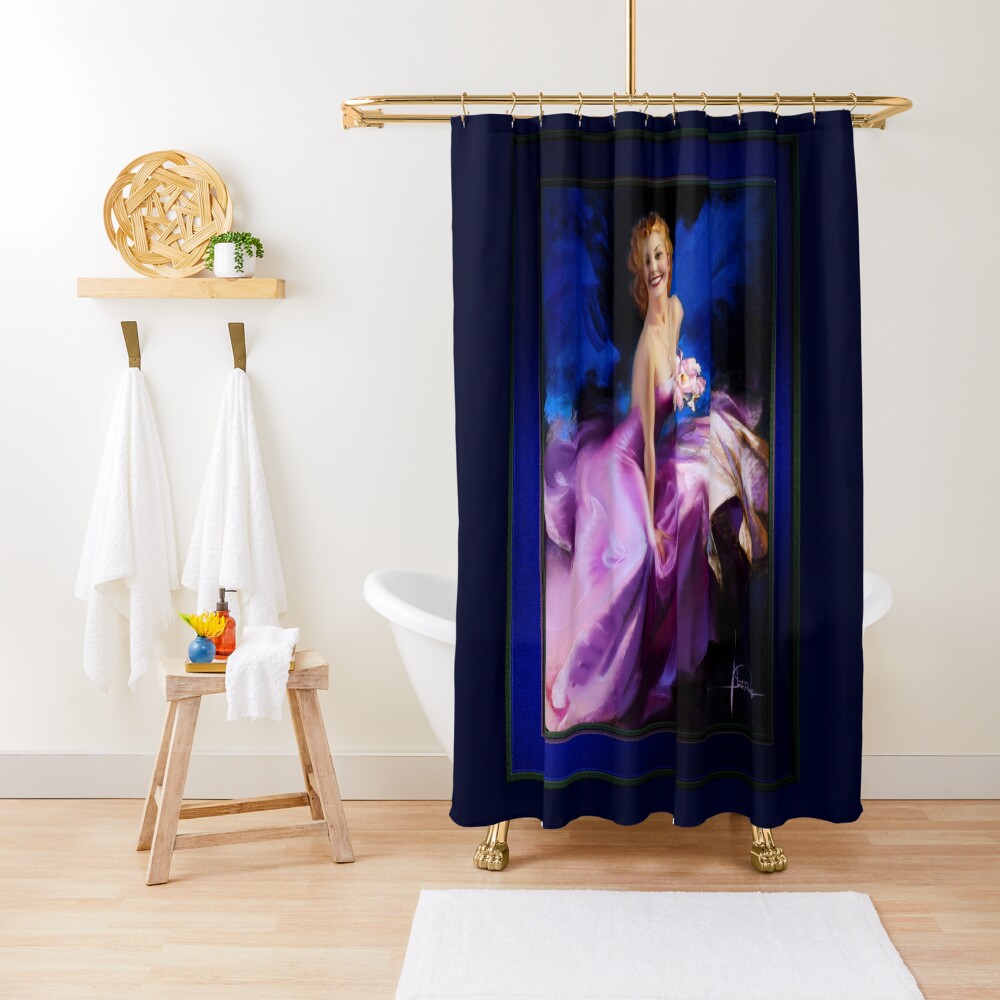
“Satin Rose” (1930), painted by the renowned American artist Rolf Armstrong (1889-1960), is an exemplary piece of early 20th-century American portraiture. Known for his luminous depictions of women in fashionable attire, Armstrong’s work captures a sense of beauty and elegance that resonates with the spirit of the Jazz Age and the Art Deco period. In this particular piece, Armstrong presents an image of femininity and grace, illustrating the intricate details of a woman in a soft, satin gown.
Enhavtabelo
La Ĉefa Temo
“Satin Rose” is a young woman poised gracefully, her figure rendered with a delicate balance of light and shadow. She is the embodiment of youthful beauty, wearing a gown that flows and ripples around her in soft waves. La robo, primarily a lavender satin, gleams in the light, its smooth fabric accentuated by folds and creases that give it a rich, almost tactile quality. Armstrong’s mastery of texture is evident in his treatment of the satin fabric, which shimmers with the soft sheen that is characteristic of this luxurious material.
Stilo, Tekniko, and Medium
The woman’s face is full of vitality, exuding joy and warmth. Her smile is subtle but confident, and her eyes are directed toward the viewer, establishing a sense of direct engagement. Ŝia mola, wavy blonde hair frames her face in an effortless, yet elegant manner. The roses she holds in her right hand, delicately grasped, add a touch of romance and softness to the composition, their pale pink petals mirroring the delicate hues of the gown. Armstrong’s use of flowers is not just ornamental; they symbolize beauty, Femineco, kaj graco, further emphasizing the overall theme of the painting.
The background of the piece is richly colored with abstract brushstrokes that suggest a dreamy, Preskaŭ etera kvalito. The deep blue tones of the background contrast with the soft, lighter shades of the woman’s gown, helping her figure to stand out as the central focus. This contrast between the warm lavender tones of the figure and the cool blues of the background creates a sense of depth and dimension, which enhances the realism of the portrait. The soft gradations of color contribute to the overall serene atmosphere of the work, where the light seems to caress the surface of the satin fabric, further enhancing the mood of elegance.
Objects and Composition
The composition is tightly focused on the figure, capturing her in a moment of serene joy. Armstrong’s decision to leave the background somewhat abstract and blurred directs the viewer’s attention entirely to the subject. This emphasis on the figure over the surroundings is a characteristic feature of many of Armstrong’s works, where the human form is celebrated in its natural beauty.
Armstrong’s style in “Satin Rose” exemplifies his signature technique of blending realism with a certain idealized quality. The portraiture is not merely a representation of a woman but rather an exploration of beauty, Eleganteco, kaj graco. The artist’s use of light and shadow is subtle yet effective, highlighting the contours of the woman’s face and the folds of her gown in a way that gives the painting a sense of dimensionality. Armstrong’s skill in capturing fabric, precipe, is unparalleled, and the way the satin gown appears to catch and reflect the light gives it a fluid, almost living quality.
Temo kaj Humoro
La temo de “Satin Rose” is deeply rooted in the early 20th century’s appreciation for beauty and fashion, reflecting the cultural preoccupations of the time. The 1930s was an era that celebrated glamour, sofistikeco, and modern femininity, and Armstrong’s work is an embodiment of these ideals. The use of satin fabric, the emphasis on luxurious textures, and the delicate portrayal of a young woman’s radiant beauty all speak to the high regard for elegance that permeated the social and artistic landscapes of the time.
The mood of the painting is one of warmth and serenity. The woman’s gentle smile, the soft folds of her gown, and the serene blue backdrop create an atmosphere of calm elegance. There is a sense of intimacy in the work, as if the viewer is being invited into a private moment with the subject, who stands before us in a poised yet approachable manner. The artist does not present her as an unattainable ideal but as a woman of grace and dignity, who radiates an inner beauty as much as the external qualities the painting depicts.
Konkludo
Koncerne materialojn, Armstrong employed traditional oil paints, using the medium to build up layers of color that add depth and texture to the scene. The painting’s surface, rich in color and form, highlights Armstrong’s ability to create smooth, almost luminescent textures, particularly in the depiction of fabric and skin. The piece is framed in a classical style, with a rich blue border that complements the tones of the background and further enhances the visual impact of the work.
Satin Rose is a remastered digital art old masters reproduction of a public domain image that is available as a canvas, akrila kaj metala presaĵo interrete.
Artisto Bio derivita de Vikipedio.org
Rolf Armstrong estis naskita John Scott Armstrong en Bay City, Miĉigano en aprilo 21, 1889, al Rikardo kaj Harriet (Scott) Armstrong. Lia patro posedis la Boy-Line Fire Boat Company, kiu inkludis vicon de pasaĝerŝipoj. Kelkaj estis deplojitaj en Ĉikago por uzo ĉe la Ĉikaga Monda Foiro tie en 1893.
Tamen, la komerco kaj familio de la patro luktis, kaj la familia bieneto estis perdita al ekzekucio. En 1899, la familio translokiĝis al Detrojto, Miĉigano. La patro de Rolf mortis en 1903, kaj jaron poste li kaj lia patrino translokiĝis al Seatlo, Vaŝingtono, sekvante la paŝojn de sia plej maljuna frato, Vilhelmo, kiu translokiĝis tien unu jaron pli frue. Nuntempe la artaj interesoj de Rolf aperis al pli ol partatempa plezuro.
Li moviĝis al Ĉikago en 1908, kie li poste studis ĉe la Artinstituto. Li tiam daŭriĝis al New York, kie li studis kun Robert Henri. Post vojaĝo al Parizo en 1919 studi ĉe la Académie Julian, li revenis al New York kaj establis studion. En 1921 li iris al Minneapolis por studi kalendarproduktadon ĉe Brown & Bigelow.
Dum la 1920-aj kaj 1930-aj jaroj, lia laboro aperis sur multaj partituro, same kiel sur la kovriloj de multaj revuoj, plej fame por filmfanrevuoj kiel Photoplay kaj Screenland. Lia laboro plejparte konsistas el virinoj; Mary Pickford, beboj danieloj, kaj Greta Garbo estas nur kelkaj el la multnombraj kiujn li pentris.
La laboro de Armstrong por la Bilda Revizio estis plejparte respondeca por tiu revuo atingante eldonkvanton de pli ol du milionoj de 1926. Unu jaron poste, li estis la plej bone vendata kalendarartisto ĉe Brown & Bigelow. En 1930, RCA dungis lin por pentri pin-ups por reklami iliajn produktojn, kaj en 1933 la Thomas D. Murphy Calendar Company subskribis lin por produkti serion de pentraĵoj por ilia linio.
En marto 1940, Juvelaj Floroj, knabino el Lumberton, Norda Karolino, sendis bildon de ŝi al Armstrong en respondo al anonco kiun li metis en la New York Times. Armstrong, 50 tiutempe, estis bazita ĉe la Hotelo des Artistoj sur Okcidenta 67-a Strato en Manhatano poste 1939, kaj serĉis novajn modelojn.
Li invitis Florojn por intervjuo. En marto 25, 1940, Floroj komencis modeligi por Armstrong. Ilia profesia kunlaboro kaj amikeco daŭris dum du jardekoj. La unua pentraĵo, titolita “Kiel mi fartas?”, laŭdire ĉar Floroj, nekutima al modelado, plurfoje demandis Armstrong “Kiel mi fartas?” dum la modeliga sesio, unue estis publikigita post kiam 2-a Mondmilito komenciĝis.
Ĝi estis Bruna & La plej vendita kalendaro de Bigelow por 1942 en tempo kiam la firmao vendis milionojn da kalendaroj en Ameriko, kaj ĝi iĝis unu el la plej reproduktitaj bildoj de Armstrong. Floroj estis popularaj ĉe amerikaj soldatoj dum 2-a Mondmilito, el kiuj kelkaj sendis al ŝi leterojn proponante geedziĝon. La kalendaroj kaj siluetoj de Armstrong de Floroj estis kopiitaj sur bombaviadiloj kaj aliaj aviadiloj kiel nazartaĵo kaj pentritaj sur tankgvatturetoj..
Ŝi fariĝis tiel konata dum la milito, kvankam pli kiel fama vizaĝo ol laŭnome, ke letero de soldato adresita simple kiel “Juvelaj Floroj, Novjorko” estis transdonita ĝuste. Por multaj usonaj soldatoj eksterlande, ŝi reprezentis la “Kial Ni Batalas” spirito. U.S. Prezidanto Franklin D. La registaro de Roosevelt rekrutis ŝin por helpi antaŭenigi militobligaciojn.
La januaro 1, 1945 eldono de TIME revuo inkludis Armstrong's “Tosto de la Urbo” pentraĵo de Floroj en artikolo pri Kalendara Arto. La artikolo notis ke kalendaroj kun “knabinaj pentraĵoj” estis “multe aĉetite de fandejoj, maŝinbutikoj, komercistoj de aŭtomataj provizoj.”
Floroj edziĝis en 1946. Ŝi kaj ŝia edzo vivis en pluraj lokoj dum li provis kelkajn komercajn entreprenojn, inkluzive de Laguna Beach, Kalifornio, Greenville, Suda Karolino, Reno, Nevado, kie ŝi laŭdire laboris kiel kartkomercisto por tempo, kaj Novjorko. Laŭ Michael Wooldridge, kunaŭtoro de Pin up Dreams: La Ŝikeca Arto de Rolf Armstrong, Armstrong vokis ŝin kelkajn fojojn dum la periodo kiam ŝi sekvis sian edzon de loko al loko, por provi persvadi ŝin reveni al Novjorko kaj modelo por li.
Ŝia modeliga kariero finiĝis kun la morto de Armstrong en 1960. Li lasis grandan parton de sia persona riĉaĵo al Floroj. Entute, Armstrong kreis ĉirkaŭ kvindek ĝis sesdek verkojn uzante Florojn kiel la modelon.
Rolf Armstrong mortis en 1960 sur la insulo Oahuo, Havajo kiel unu el la plej bonaj “pin-up” artistoj de la unua duono de la dudeka jarcento.