

Satinrosa
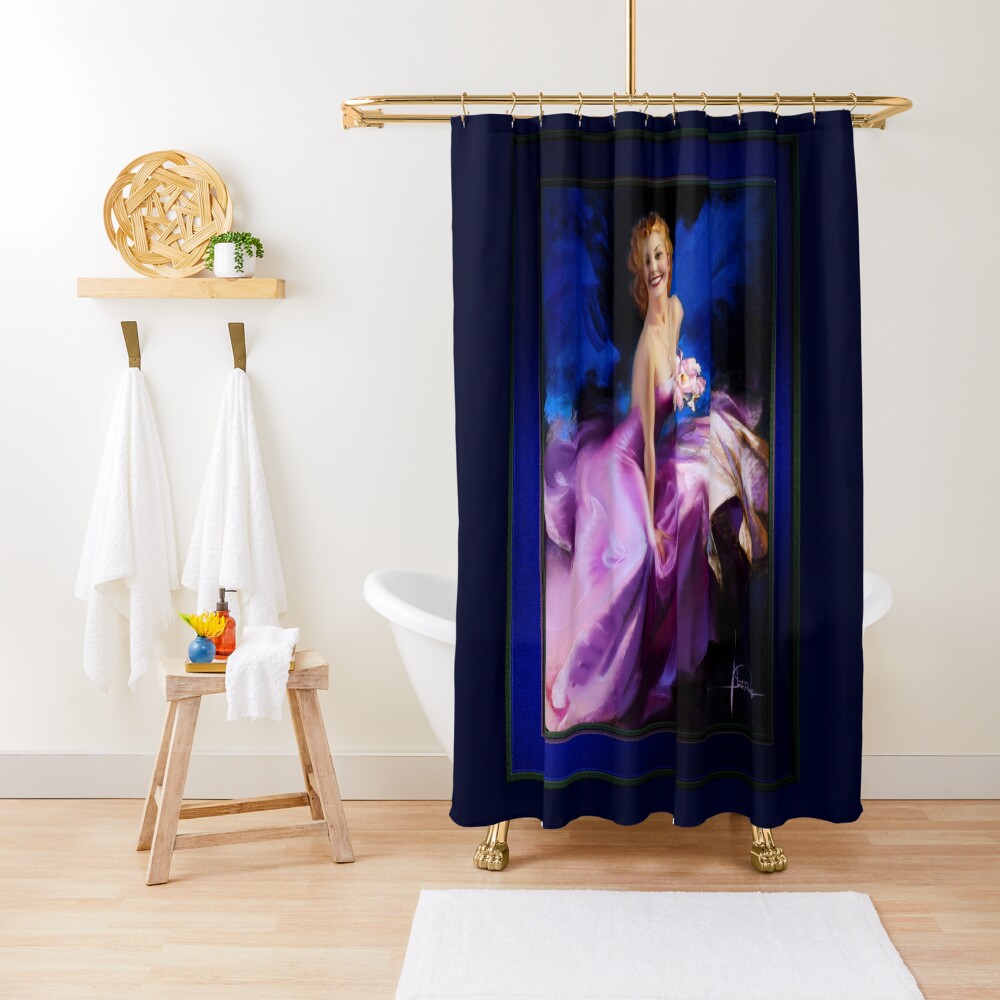
“Satinrosa” (1930), painted by the renowned American artist Rolf Armstrong (1889-1960), is an exemplary piece of early 20th-century American portraiture. Known for his luminous depictions of women in fashionable attire, Armstrong’s work captures a sense of beauty and elegance that resonates with the spirit of the Jazz Age and the Art Deco period. I det här stycket, Armstrong presents an image of femininity and grace, illustrating the intricate details of a woman in a soft, satin gown.
Innehållsförteckning
Huvudämnet
“Satinrosa” is a young woman poised gracefully, her figure rendered with a delicate balance of light and shadow. She is the embodiment of youthful beauty, wearing a gown that flows and ripples around her in soft waves. Klänningen, primarily a lavender satin, gleams in the light, its smooth fabric accentuated by folds and creases that give it a rich, almost tactile quality. Armstrong’s mastery of texture is evident in his treatment of the satin fabric, which shimmers with the soft sheen that is characteristic of this luxurious material.
Stil, Teknik, and Medium
The woman’s face is full of vitality, exuding joy and warmth. Her smile is subtle but confident, and her eyes are directed toward the viewer, establishing a sense of direct engagement. Hennes mjuka, wavy blonde hair frames her face in an effortless, yet elegant manner. The roses she holds in her right hand, delicately grasped, add a touch of romance and softness to the composition, their pale pink petals mirroring the delicate hues of the gown. Armstrong’s use of flowers is not just ornamental; they symbolize beauty, kvinnlighet, and grace, further emphasizing the overall theme of the painting.
The background of the piece is richly colored with abstract brushstrokes that suggest a dreamy, nästan eterisk kvalitet. The deep blue tones of the background contrast with the soft, lighter shades of the woman’s gown, helping her figure to stand out as the central focus. This contrast between the warm lavender tones of the figure and the cool blues of the background creates a sense of depth and dimension, which enhances the realism of the portrait. The soft gradations of color contribute to the overall serene atmosphere of the work, where the light seems to caress the surface of the satin fabric, further enhancing the mood of elegance.
Objects and Composition
The composition is tightly focused on the figure, capturing her in a moment of serene joy. Armstrong’s decision to leave the background somewhat abstract and blurred directs the viewer’s attention entirely to the subject. This emphasis on the figure over the surroundings is a characteristic feature of many of Armstrong’s works, where the human form is celebrated in its natural beauty.
Armstrong’s style in “Satinrosa” exemplifies his signature technique of blending realism with a certain idealized quality. The portraiture is not merely a representation of a woman but rather an exploration of beauty, elegans, and grace. The artist’s use of light and shadow is subtle yet effective, highlighting the contours of the woman’s face and the folds of her gown in a way that gives the painting a sense of dimensionality. Armstrong’s skill in capturing fabric, särskilt, is unparalleled, and the way the satin gown appears to catch and reflect the light gives it a fluid, almost living quality.
Tema och humör
Temat för “Satinrosa” is deeply rooted in the early 20th century’s appreciation for beauty and fashion, reflecting the cultural preoccupations of the time. The 1930s was an era that celebrated glamour, raffinemang, and modern femininity, and Armstrong’s work is an embodiment of these ideals. The use of satin fabric, the emphasis on luxurious textures, and the delicate portrayal of a young woman’s radiant beauty all speak to the high regard for elegance that permeated the social and artistic landscapes of the time.
The mood of the painting is one of warmth and serenity. The woman’s gentle smile, the soft folds of her gown, and the serene blue backdrop create an atmosphere of calm elegance. There is a sense of intimacy in the work, as if the viewer is being invited into a private moment with the subject, who stands before us in a poised yet approachable manner. The artist does not present her as an unattainable ideal but as a woman of grace and dignity, who radiates an inner beauty as much as the external qualities the painting depicts.
Slutsats
När det gäller material, Armstrong employed traditional oil paints, using the medium to build up layers of color that add depth and texture to the scene. The painting’s surface, rich in color and form, highlights Armstrong’s ability to create smooth, almost luminescent textures, particularly in the depiction of fabric and skin. The piece is framed in a classical style, with a rich blue border that complements the tones of the background and further enhances the visual impact of the work.
Satin Rose is a remastered digital art old masters reproduction of a public domain image that is available as a canvas, akryl och metalltryck online.
Artist Bio härledd från Wikipedia.org
Rolf Armstrong föddes John Scott Armstrong i Bay City, Michigan i april 21, 1889, till Richard och Harriet (Scott) Armstrong. Hans far ägde Boy-Line Fire Boat Company, som inkluderade en rad passagerarfartyg. Några var utplacerade i Chicago för användning på världsmässan i Chicago där 1893.
i alla fall, pappans företag och familj kämpade, och familjen hemman förlorades till utmätning. I 1899, familjen flyttade till Detroit, Michigan. Rolfs far dog i 1903, och ett år senare flyttade han och hans mamma till Seattle, Washington, efter hans äldsta brors fotspår, William, som hade flyttat dit ett år tidigare. Vid det här laget växte Rolfs konstnärliga intressen upp till mer än ett deltidsnöje.
Han flyttade till Chicago i 1908, där han senare studerade vid Konstinstitutet. Sedan åkte han vidare till New York, där han studerade med Robert Henri. Efter en resa till Paris in 1919 att studera vid Académie Julian, han återvände till New York och etablerade en studio. I 1921 han åkte till Minneapolis för att studera kalenderproduktion på Brown & Bigelow.
Under 1920- och 1930 -talen, hans verk syntes på många noter, liksom på omslagen till många tidskrifter, mest känd för filmfläktstidningar som Photoplay och Screenland. Hans arbete består mestadels av kvinnor; Mary Pickford, Bebe Daniels, och Greta Garbo är bara några av de många han målade.
Armstrongs arbete för Pictorial Review var i stor utsträckning ansvarig för att tidningen uppnådde en upplaga på mer än två miljoner 1926. Ett år senare, han var den mest sålda kalenderartisten på Brown & Bigelow. I 1930, RCA anlitade honom för att måla pin-ups för att marknadsföra sina produkter, och i 1933 Thomas D.. Murphy Calendar Company signerade honom för att producera en serie målningar för deras linje.
I mars 1940, Juvelblommor, en tjej från Lumberton, norra Carolina, skickade en bild på sig själv till Armstrong som svar på en annons som han hade placerat i New York Times. Armstrong, 50 just då, hade varit baserad på Hotel des Artistes på West 67th Street på Manhattan sedan 1939, och letade efter nya modeller.
Han bjöd in blommor för en intervju. På marsch 25, 1940, Blommor började modellera för Armstrong. Deras professionella samarbete och vänskap varade i två decennier. Den första målningen, betitlad “Hur mår jag?”, enligt uppgift eftersom blommor, oanvänd till modellering, frågade Armstrong upprepade gånger “Hur mår jag?” under modellpasset, publicerades först efter att andra världskriget hade börjat.
Det var Brown & Bigelows bästsäljande kalender för 1942 i en tid då företaget sålde miljontals kalendrar i Amerika, och det blev en av Armstrongs mest återgivna bilder. Blommor var populär bland amerikanska soldater under andra världskriget, några av dem skickade hennes brev med förslag om äktenskap. Armstrongs kalendrar och silhuetter av blommor kopierades till bombplan och andra plan som näskonst och målades på tanktorn.
Hon blev så känd under kriget, fast mer som ett känt ansikte än vid namn, som en serviceman brev adresserade helt enkelt som “Juvelblommor, New York City” levererades korrekt. För många amerikanska soldater utomlands, hon representerade “Varför vi slåss” anda. U.S. President Franklin D.. Roosevelts regering fick henne att hjälpa till att främja krigsförbindelser.
Januari 1, 1945 upplagan av TIME -tidningen inkluderade Armstrongs “Toast of the Town” målning av blommor i en artikel om kalenderkonst. Artikeln noterade att kalendrar med “tjejmålningar” var “köpt kraftigt av gjuterier, maskinaffärer, bilförsäljare.”
Blommor gifte sig i 1946. Hon och hennes man bodde på flera ställen medan han prövade ett antal affärsverksamheter, inklusive Laguna Beach, Kalifornien, Greenville, South Carolina, Reno, Nevada, där hon enligt uppgift arbetat som korthandlare en tid, och New York City. Enligt Michael Wooldridge, medförfattare till Pin up Dreams: Rolf Armstrongs glamourkonst, Armstrong ringde henne ett antal gånger under den period hon följde sin man från plats till plats, att försöka övertala henne att återvända till New York och modellera för honom.
Hennes modellkarriär slutade med Armstrongs död i 1960. Han lämnade en stor del av sin personliga förmögenhet till Flowers. Totalt, Armstrong skapade runt femtio till sextio verk med Flowers som modell.
Rolf Armstrong dog i 1960 på ön Oahu, Hawaii som en av de bästa “utvikningsbrud” konstnärer under 1900 -talets första hälft.