

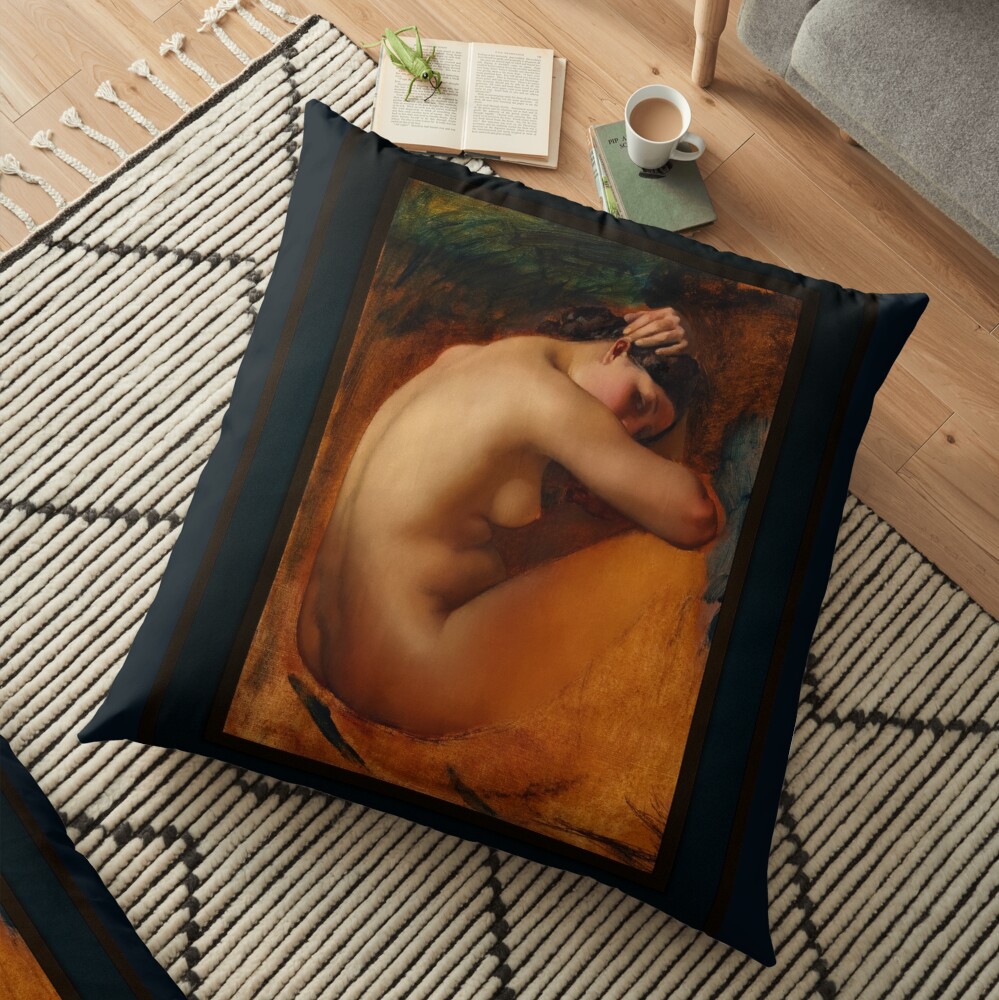
Study of a Female Nude c.1840
Henri Lehmann’s (1814 – 1882) Sgrùdadh air Nude Boireann c.1840 presents an evocative portrayal of the human form in its purest, most vulnerable state. This remarkable painting encapsulates the artist’s mastery in capturing anatomical precision and a subtle expression of human emotion. Lehmann, a French painter known for his skillful renderings of the nude form, infused this work with not only technical expertise but also a delicate sensibility to the human experience, characteristic of Romanticism. His work as a teacher and artist during the 19th century was influenced by both classical art traditions and the emerging Romantic ideals that sought to explore human emotion, an sublime, and the complex relationship between nature and humanity.
Clàr-innse
The Female Nude: Central Theme and Subject
Is e prìomh chuspair an obair-ealain ìomhaigh boireann aonaranach, a corp air a suidheachadh ann an staid fois. Tha suidheachadh a’ bhoireannaich nàdarrach ach dlùth, mar a tha i a’ lùbadh innte fhèin, a' gabhail fois air a taobh. Chan eil an dealbh den nude boireann air a chur ris no air leth freagarrach ach tha e stèidhichte ann am mothachadh air fìor-eòlas a bheir an cruth daonna beò.. Tha a corp air a thoirt seachad le aire chùramach do anatomy, a’ soilleireachadh lùban fìnealta a gualainn, gàirdeanan, agus air ais. Tha am fòcas air cruth nàdarra na bodhaig boireann a’ cur cuideam air bòidhchead bodhaig an duine gun àibheiseachd no stoidhle, a’ taisbeanadh sgil Lehmann ann a bhith a’ cothromachadh idealization le cruinneas anatomical.
The figure is presented in a vulnerable, introspective posture, with her arms wrapped around her body in a protective manner, suggesting a moment of introspection or contemplation. Her head rests on her bent arm, with her hair flowing gently, creating an impression of softness and tranquility. The closed eyes and downturned expression reinforce the mood of serenity and quiet introspection, allowing the viewer to appreciate the subtleties of human emotion through her repose.
Use of Color and Lighting
Anns a 'phìos seo, Lehmann employs a warm, rich palette dominated by ochre, òmar, and burnt orange tones. The color choices evoke a sense of warmth and intimacy, inviting the viewer to engage with the emotional quality of the work. The soft glow of these tones contrasts with the muted greens and blues that subtly appear in the background, adding depth and grounding the figure within its environment. The background’s colors blend seamlessly with the skin tones of the model, highlighting the natural harmony of the human body within the larger scope of nature.
The lighting in the painting is also particularly notable. It illuminates the figure with a soft, diffuse quality that emphasizes the model’s curves and contours without harsh contrast. The careful treatment of light allows the texture of the skin and the folds of the body to emerge subtly, creating a sense of lifelike warmth and depth. This gentle lighting enhances the feeling of calm and quiet, contributing to the overall mood of the piece.
Tòn Faireachdail agus Mothachadh a’ Pheantaidh
Faireachdainn de Sgrùdadh air Nude Boireann is one of quiet contemplation and stillness. Lehmann avoids any overtly dramatic elements in the composition, instead focusing on the internal world of the female figure. The painting does not evoke sensuality or eroticism, but rather presents the subject in a state of repose, unburdened by external influence. The calmness of the figure suggests a moment of peace, and the viewer is invited into the intimacy of this tranquil scene.
While the female nude is traditionally seen in art as a subject of desire or objectification, Lehmann’s approach is different. He creates a mood that is more akin to admiration for the natural beauty and complexity of the human form. The peaceful pose and serene facial expression further reinforce the sense of personal introspection, encouraging the viewer to appreciate the subject in a more reflective, contemplative way rather than through a lens of lust or objectification.
Cumadh agus inneach
The composition of the painting is quite simple, yet profoundly effective. The female figure is placed off-center in the painting, creating a natural balance with the surrounding background. The viewer’s eye is drawn to the curves of the body and the delicate folds of skin that add texture and life to the figure. Lehmann’s brushwork is smooth and refined, allowing the skin to appear soft and the light to flow gently across the body.
The texture of the work is especially notable in the way the artist blends his paint to create a tactile, almost tangible quality. The play of light on the skin, the slight ripple of the fabric at the woman’s side, and the way her hair flows naturally all contribute to an overall sense of realism. Lehmann’s ability to render texture—whether in the soft sheen of the skin or the contrast between the smoothness of the figure and the textured background—is part of what elevates this work to a higher level of artistic mastery.
Buaidh Romanticism agus an Traidisean Clasaigeach
Lehmann’s Sgrùdadh air Nude Boireann reflects the Romantic ideals of the 19th century while also paying homage to the classical tradition. The restrained expression of the figure, the naturalism in the body’s depiction, agus am bog, harmonious palette are all elements that recall classical art.
Ach, there is also an undercurrent of Romantic sensibility in the emotional depth conveyed through the subject’s introspective pose and the overall quiet tone of the piece. The absence of an overt narrative or dramatic backdrop allows the viewer to focus entirely on the figure itself, making the emotional depth of the piece all the more powerful.
This fusion of classical realism with Romantic introspection results in a work that is timeless in its appeal. It allows the viewer to appreciate the beauty of the human form while simultaneously exploring the subtleties of human emotion and inner life. Lehmann’s ability to evoke a sense of calm contemplation without relying on grand gestures or dramatic themes reflects the Romantic emphasis on individual experience and inner truth.
Co-dhùnadh
Henri Lehmann’s Study of a Nòs boireann (c. 1840) stands as a testament to his skill as a painter and his deep understanding of the human form. The work presents a simple yet emotionally resonant image of the female body, rendered with great sensitivity to both anatomy and expression.
It combines the classical approach to the nude with the emerging emotional depth of Romanticism, resulting in a piece that speaks not only to the viewer’s aesthetic sensibilities but also to their emotional core. The warm palette, solais bog, and intimate mood invite the viewer to engage with the painting on a personal level, appreciating not just the beauty of the body, but the quiet, reflective state of the figure within it.
Is e seo ath-riochdachadh seann mhaighstirean ealain didseatach ath-leasaichte de ìomhaigh fearann poblach a tha ri cheannach mar a clò-bhualadh canabhas air-loidhne.
An cruthachadh ealain didseatach seo, mar a tha leis a h-uile obair-ealain a gheibhear air làrach-lìn Xzendor7 ri fhaighinn airson a cheannach air-loidhne ann an grunn chruthan stuth a’ gabhail a-steach clò-bhualaidhean canabhas, dealbhan acrylic, clò-bhualaidhean meatailt, clò-bhualaidhean fiodha, lèileagan frèam, postairean, agus mar chlò-bhualadh canabhas air a roiligeadh ann an grunn mheudan bho 12 òirlich gu 72 òirlich a rèir meud an fhìor obair-ealain agus a’ bhùth clò-bhualaidh air iarrtas a thaghas tu airson an ealain a cheannach.
Tha an obair-ealain cuideachd ri fhaighinn air raon farsaing de dh’ aodach fireannaich is boireannaich, mugaichean, toitean, sgarfaichean, leabhraichean notaichean agus irisean agus mòran stuthan sgeadachaidh dachaigh.
Neach-ealain Bio
Fiosrachadh gu h-ìosal a thàinig bho Wikipedia.org
Rugadh Henri Heinrich Salem Lehmann sa Ghearmailt sa Ghiblean 14, 1814 agus chaidh a theagasg an toiseach le athair Leo Lehmann (1782 – 1859) a bha cuideachd na pheantair, an uairsin le peantairean eile ann an Hamburg.
Nuair a bha e 17 bliadhna a dh'aois chuir e roimhe gluasad gu Paris, An Fhraing gu bhith ag ionnsachadh fon Pheantair Frangach Jean-Auguste-Dominique Ingres (1780 – 1867) neach-ealain Neoclassic agus Orientalist; agus thàinig e gu bhith mar aon de na h-oileanaich a bu shoirbheachail aige agus na neach-dàimh dlùth.
Thaisbean Henri an obair ealain aige an toiseach aig an Salon ann an 1835, agus bha e comasach air bonn an dàrna àite a chruinneachadh, agus bhon àm sin a-mach bhiodh e gu cunbhalach a’ taisbeanadh an obair ealain aige; a’ buannachadh a’ chiad bhuinn ann an 1840, 1848 agus 1855.
Ann an 1842 Shuidhich Henri gu maireannach ann am Paris agus fhuair e coimiseanan airson obraichean poblach mòra a chruthachadh, anns an robh Eaglais Ste-Clothilde, am Palais a' Cheartais, am Palais du Lucsamburg agus an Hôtel de Ville, cho math ri mòran eile.
Ceithir bliadhna an dèidh sin ann an 1846 fhuair e an Légion d’honneur agus an ath bhliadhna bhiodh e na shaoranach Frangach; agus anns an aon bhliadhna dh'fhosgail e stiùidio ealain.
Ceithir bliadhna deug às deidh sin chaidh a chur an dreuchd mar neach-teagaisg aig an École des Beaux-Arts ainmeil agus le 1875 air a shuidheachadh gu dreuchd an Ollaimh.
Bhiodh Henri cuideachd a’ peantadh dhealbhan de dhaoine ainmeil aig an àm, nam measg a’ Bhana-phrionnsa Eadailteach Cristina Trivulzio Belgiojoso (1808 – 1871), Sgrìobhadair Frangach Marie-Henri Beyle (Stendhal 1783 – 1842), Sgrìobhaiche-ciùil Pòlach agus neach-piàna sàr-mhath Frédéric François Chopin (1810 – 1849), Sgrìobhaiche-ciùil às an Ungair Franz Liszt (1811 – 1886), Feallsanachd Frangach Victor Cousin (1792 – 1867), Sgrìobhaiche-ciùil Frangach Teàrlach Gounod (1818 – 1893) agus mòran eile.