

The Allegory of Fame and History
The Allegory of Fame and History: A Detailed Examination
Hendrick Goltzius’s engraving, The Allegory of Fame and History, umhergestellt 1586, is a complex and meticulously rendered work that exemplifies the Mannerist style prevalent in late 16th-century Netherlands. This piece isn’t merely an illustration; it’s a visual treatise on the ephemeral nature of human endeavor and the enduring power of historical record. The engraving’s strength lies not only in its technical virtuosity but also in its layered symbolism, drawing upon classical mythology and humanist ideals to convey a profound message about legacy and remembrance.

Inhaltsverzeichnis
Kompositionsstruktur & Technische Fähigkeiten
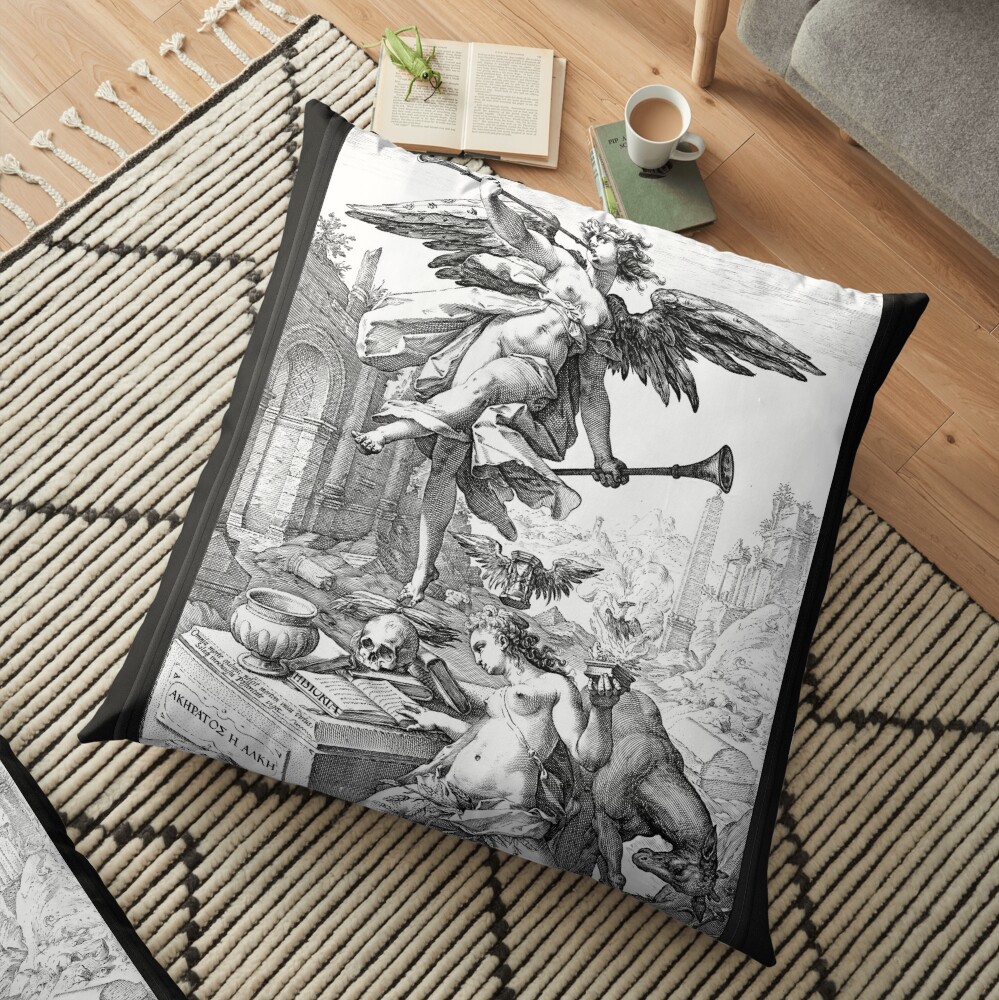
The composition is densely packed with figures and objects arranged within a theatrical architectural setting. Goltzius demonstrates exceptional mastery of line work, using varying degrees of pressure to create dramatic contrasts in light and shadow – a hallmark of Mannerist engraving. The perspective is somewhat distorted, characteristic of the style, contributing to a sense of dynamism and visual complexity rather than strict realism. The overall effect is one of controlled chaos; a carefully orchestrated arrangement that draws the viewer’s eye across the scene.
Central Figures: Fame & History
At the apex of the composition floats the figure of Fame, depicted as an angelic being with expansive wings. She holds aloft a trumpet, its sound seemingly reverberating throughout the scene. Her posture is dynamic and graceful, suggesting movement and proclamation. Unter ihr, a female figure representing History reclines upon a stone plinth. She is draped in flowing robes and supports a book – the repository of recorded events – while gazing intently at Fame’s announcement. The contrast between Fame’s ethereal flight and History’s grounded presence underscores their distinct roles: one delivering news, the other preserving it for posterity.
Unterstützende Figuren & Symbolic Objects
The scene is populated by several supporting figures that contribute to the allegorical narrative. A satyr-like creature, half-human and half-goat, lies prostrate at History’s feet, symbolizing the fleeting nature of earthly pleasures and desires. An owl, perched atop a skull, further reinforces this theme of mortality and the inevitability of decay. A cauldron sits nearby, possibly representing alchemy or transformation – perhaps alluding to the process by which events are transformed into historical narratives. A tablet inscribed with the words “AKME DE HAAH” (the height/peak of the hair) is placed near the cauldron; its meaning remains open to interpretation but likely relates to the pinnacle of achievement or recognition.
Architektonische Kulisse & Atmosphäre
The background features a crumbling architectural structure, possibly representing ruins or a decaying palace. This serves as a visual metaphor for the transience of earthly power and glory. The overall atmosphere is one of dramatic tension and solemn reflection. Goltzius’s use of chiaroscuro – the interplay of light and dark – intensifies the emotional impact of the scene, highlighting key figures and objects while shrouding others in shadow.
Mannerist Characteristics & Einflüsse
The Allegory of Fame and History exemplifies several characteristics of the Mannerist style. The elongated figures, distorted perspective, and complex composition are all hallmarks of this artistic movement, which emerged as a reaction against the High Renaissance’s emphasis on balance and harmony. Goltzius was influenced by Italian Mannerists such as Parmigianino and Bronzino, evident in his elegant poses and refined line work. The engraving also reflects the humanist intellectual climate of the time, with its focus on classical mythology and philosophical themes.
Textual Elements & Interpretation
Beneath the image, Goltzius includes a lengthy Latin inscription that provides further context for the allegory. While a full translation is beyond the scope of this description, it’s clear that the text elaborates on the relationship between Fame and History, emphasizing the importance of recording events accurately and impartially to ensure their lasting significance. The inscription serves as an integral part of the artwork, enriching its meaning and inviting viewers to engage with its intellectual depth.
Abschluss
Hendrick Goltzius’s The Allegory of Fame and History is a remarkable achievement in engraving that showcases his technical skill and artistic vision. Through its complex composition, symbolische Bilder, and humanist themes, the work offers a profound meditation on the nature of fame, Geschichte, and the enduring human desire to leave a lasting legacy. It remains a significant example of Mannerist art and a testament to Goltzius’s mastery of his craft.
Künstler Bio abgeleitet von Wikipedia.org
Hendrick wurde in der Nähe von Venlo in Bracht oder Millebrecht geboren, ein Dorf damals im Herzogtum Jülich, Seine Familie zog zu seiner Zeit nach Duisburg 3 Jahre alt und als er volljährig wurde, studierte er einige Jahre lang Glasmalerei bei seinem Vater.
Anschließend studierte er bei dem niederländischen Universalgelehrten Dirck Volckertszoon Coornhert (1522 – 1590), bei dem er Gravur studierte.
Im 1577 Anschließend zog er mit Coornhert nach Haarlem in der niederländischen Republik, wo er für den Rest seines Lebens bleiben würde; und eine Zeit lang arbeitete er in Haarlem mit Philip Galle zusammen (1537 – 1612), eine Reihe von Drucken zur Geschichte von Lucretia zu gravieren.
Randnotiz: Lucretia; anglisiert als Lucrece, war eine Adlige im antiken Rom, dessen Vergewaltigung durch Sextus Tarquinius (Tarquin) und der anschließende Selbstmord löste einen Aufstand aus, der die römische Monarchie stürzte und zum Übergang der römischen Regierung von einem Königreich zu einer Republik führte.
Aufgrund einer Brandverletzung an der rechten Hand, dass Hendrick als Baby gelitten hat und dadurch Missbildungen erlitten hat, Durch diese Verletzung erlangte er die Fähigkeit, den Stichel zu halten (scharfes Gravierwerkzeug) da er gezwungen war, mit den großen Muskeln seines Arms und seiner Schulter zu zeichnen.
Hendrick war ein Meister des “Schwellungslinie” und auch ein Pionier der “Punkt und Raute” Technik, Dabei werden Punkte in der Mitte rautenförmiger Räume platziert, die durch Kreuzschraffur entstehen, um die Tonschattierung weiter zu verfeinern.
The Allegory of Fame and History is a remastered digital art old masters reproduction of a public domain image that is available as a Leinwanddruck online.