

Die Geburt der Venus: A Celebration of Classical Beauty
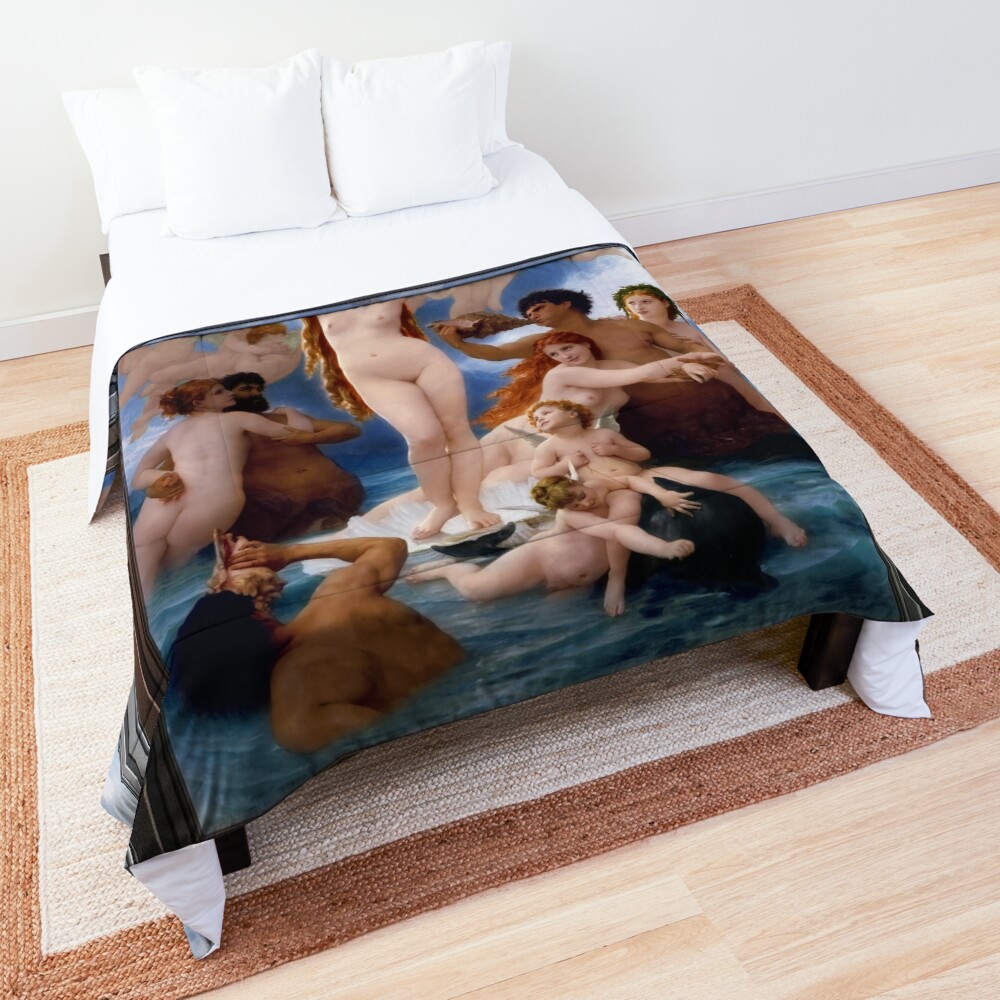
Die Geburt der Venus c1879 by French Painter William-Adolphe Bouguereau (1825 – 1905), stands as a quintessential example of Academic art, embodying the principles of idealized beauty and technical mastery prevalent in mid-19th century France. This large-scale oil painting draws heavily from classical mythology, depicting the arrival of the goddess Venus (Aphrodite to the Greeks) upon the shores of Cyprus. jedoch, Bouguereau’s interpretation is far removed from earlier depictions; instead of a dramatic or tempestuous emergence, he presents a scene of serene grace and gentle unfolding.
Inhaltsverzeichnis
Kompositionsstruktur & Erzählfluss
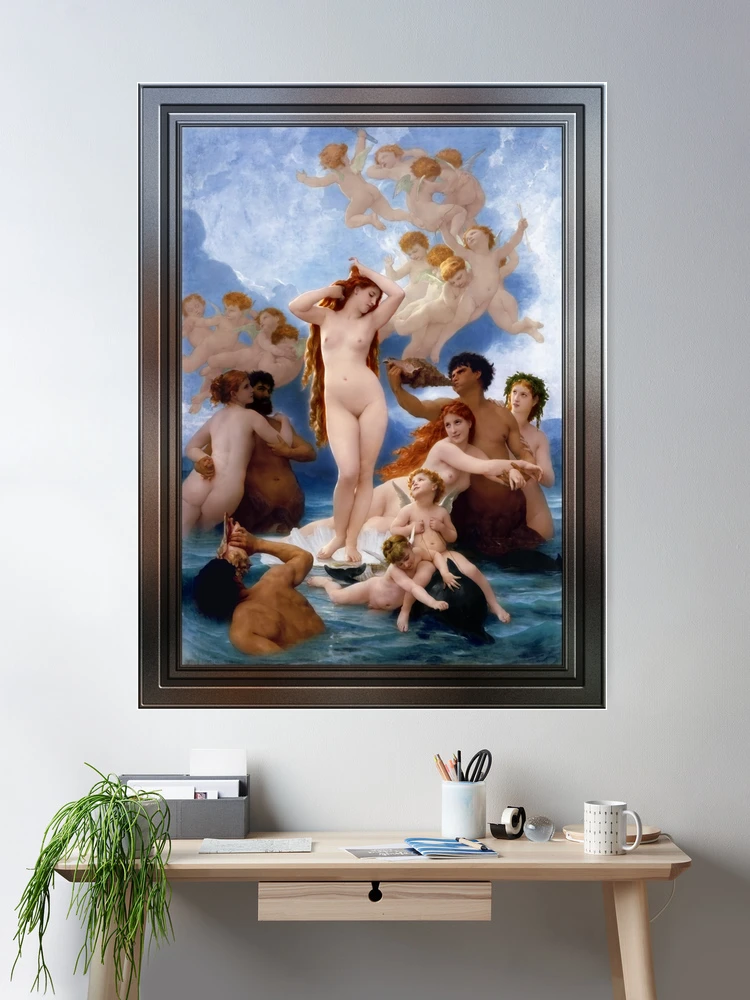
The composition is meticulously structured around Venus herself, positioned centrally within the canvas. She stands upon a massive scallop shell, which serves as her floating pedestal, gently approaching the shoreline. The arrangement isn’t haphazard; it’s carefully orchestrated to guide the viewer’s eye. Zu ihrer Linken, a figure representing Zephyr, the west wind, and his consort Chloris, blow Venus towards the shore, their bodies intertwined in a dynamic pose that conveys movement and gentle force. Rechts, a nymph, likely Hora, awaits with a floral garland, ready to welcome the goddess. The figures surrounding Venus are not merely decorative; they contribute to the narrative flow, illustrating the forces that brought her into being and the welcoming reception she receives.
Anatomical Precision & Idealized Form
Bouguereau’s reputation rested on his exceptional skill in depicting the human form with anatomical accuracy. Im “Die Geburt der Venus,” this is evident in every curve and contour of the figures. The bodies are rendered with a smooth, Fast porzellanartige Qualität, showcasing an idealized beauty that adheres to classical standards. There’s no attempt at realism in the sense of portraying imperfections; stattdessen, Bouguereau elevates the human form to a state of perfect harmony and proportion. Venus’s pose is particularly striking – she stands with one foot slightly raised, creating a sense of poised elegance and effortless grace. The subtle modeling of her flesh, achieved through delicate gradations of light and shadow, further enhances the illusion of three-dimensionality and tactile realism.
Farbpalette & Atmospheric Effects
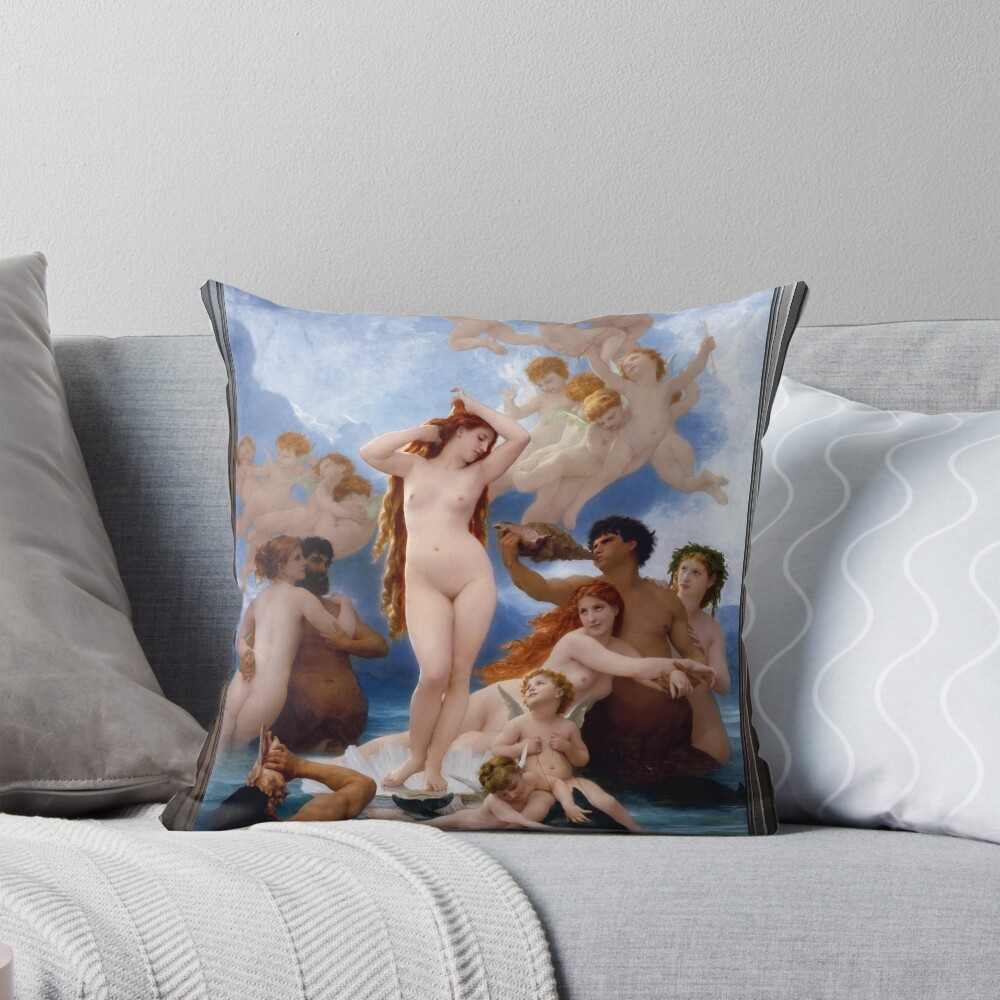
The color palette employed in “Die Geburt der Venus” is predominantly soft and harmonious. Pale blues and greens dominate the seascape, creating a sense of tranquility and ethereal beauty. The sky is rendered with swirling clouds, suggesting a gentle breeze and an atmosphere of otherworldly calm. Venus’s skin tones are luminous, contrasting beautifully with her flowing auburn hair, which cascades down her shoulders in loose waves. The warm hues of the flesh tones are balanced by the cooler colors of the surrounding environment, creating a visually pleasing contrast that draws attention to the central figure. Bouguereau masterfully uses light and shadow to create depth and volume, enhancing the overall sense of realism and beauty.
Symbolismus & Classical Allusions
Beyond its aesthetic appeal, “Die Geburt der Venus” is rich in symbolism and classical allusions. The scallop shell upon which Venus stands is a recurring motif associated with her birth in mythology – born from sea foam (Greek: aphros), hence her name Aphrodite. Zephyr and Chloris represent the gentle forces of nature that guide Venus’s arrival, while Hora symbolizes welcome and celebration. The floral garland offered by the nymph signifies beauty and fertility. These symbolic elements contribute to the painting’s overall meaning, reinforcing its connection to classical mythology and celebrating the goddess as a symbol of love, Schönheit, und Erneuerung.
Bouguereau’s Artistic Legacy & Academic Tradition
Bouguereau was a leading figure in the Academic art movement, which emphasized technical skill, idealisierte Formen, and adherence to established artistic conventions. “Die Geburt der Venus” exemplifies these principles perfectly. The painting’s popularity during its time reflects the public’s appreciation for classical themes and the mastery of traditional techniques. While later generations would critique Academic art for its perceived lack of originality and emotional depth, Bouguereau’s work remains admired for its technical brilliance and enduring beauty. “Die Geburt der Venus” continues to captivate viewers with its serene atmosphere, idealisierte Formen, and celebration of classical mythology. It stands as a testament to the power of artistic skill and the enduring appeal of timeless themes.
Biografie des Künstlers mit freundlicher Genehmigung Wikipedia.org
William-Adolphe Bouguereau wurde in La Rochelle geboren, Frankreich, an 30 November 1825, in eine Familie von Wein- und Olivenölhändlern.[4] Der Sohn von Théodore Bouguereau (geboren 1800) und Marie Bonnin (1804), bekannt als Adeline, William wurde katholisch erzogen. Er hatte einen älteren Bruder, Alfred, und eine jüngere Schwester, Marie (bekannt als Hanna), die starb, als sie sieben war.
Die Familie zog nach Saint-Martin-de-Ré in 1832. Ein weiteres Geschwisterchen wurde in . geboren 1834, Kätzchen. Im Alter von 12, Bouguereau ging nach Mortagne, um bei seinem Onkel Eugène . zu bleiben, Priester und entwickelte eine Liebe zur Natur, Religion und Literatur.
Im 1839, er wurde zum Priesterstudium an ein katholisches College in Pons . geschickt. Hier lernte er Zeichnen und Malen von Louis Sage, der bei Ingres studiert hatte. Bouguereau verließ widerwillig sein Studium, um zu seiner Familie zurückzukehren, jetzt wohnhaft in Bordeaux.
Dort lernte er einen lokalen Künstler kennen, Charles Marioneau, und begann im November an der Städtischen Schule für Zeichnen und Malen 1841. Bouguereau arbeitete auch als Verkäuferin, Handkolorieren von Lithographien und Anfertigung kleiner Gemälde, die mit Chromolithographie reproduziert wurden.
Er war bald der beste Schüler seiner Klasse, und beschloss, Künstler in Paris zu werden. Um den Umzug zu finanzieren, er verkaufte Porträts – 33 Öle in drei Monaten. Alle waren unsigniert und nur einer wurde zurückverfolgt. Er kam in Paris im Alter an 20 März 1846.
Gleichberechtigung vor dem Tod (Gleichheit vor dem Tod), 1848, Öl auf Leinwand, 141 × 269 cm (55.5 × 105.9 im), Orsay-Museum, Paris. Gleichheit ist Bouguereaus erstes großes Gemälde, produziert nach zwei Jahren an der École des Beaux-Arts de Paris im Alter von 23.
Bouguereau wurde Student an der École des Beaux-Arts.[4] Zur Ergänzung seiner formalen Ausbildung im Zeichnen, er besuchte anatomische Sektionen und studierte historische Kostüme und Archäologie.
Er wurde in das Atelier von François-Édouard Picot . aufgenommen, wo er Malerei im akademischen Stil studierte. Dante und Virgil in der Hölle (1850) war ein frühes Beispiel seiner neoklassischen Werke.
Die akademische Malerei räumte historischen und mythologischen Themen den höchsten Stellenwert ein, und Bouguereau entschlossen, den Prix de Rome zu gewinnen, was ihm einen dreijährigen Aufenthalt in der Villa Medici in Rom einbringen würde, Italien, wo er neben dem formalen Unterricht die Renaissance-Künstler und ihre Meisterwerke aus erster Hand studieren konnte, sowie Griechisch, Etrusker, und römische Altertümer.
The Birth Of Venus is a retouched digital art old masters reproduction of a public domain image that is available online as a gerollter Leinwanddruck.