

De berte fan Venus: A Celebration of Classical Beauty
De berte fan Venus c1879 by French Painter William-Adolphe Bouguereau (1825 – 1905), stands as a quintessential example of Academic art, embodying the principles of idealized beauty and technical mastery prevalent in mid-19th century France. This large-scale oil painting draws heavily from classical mythology, depicting the arrival of the goddess Venus (Aphrodite to the Greeks) upon the shores of Cyprus. lykwols, Bouguereau’s interpretation is far removed from earlier depictions; instead of a dramatic or tempestuous emergence, he presents a scene of serene grace and gentle unfolding.
Ynhâldsopjefte
Komposysje Struktuer & Narrative Flow
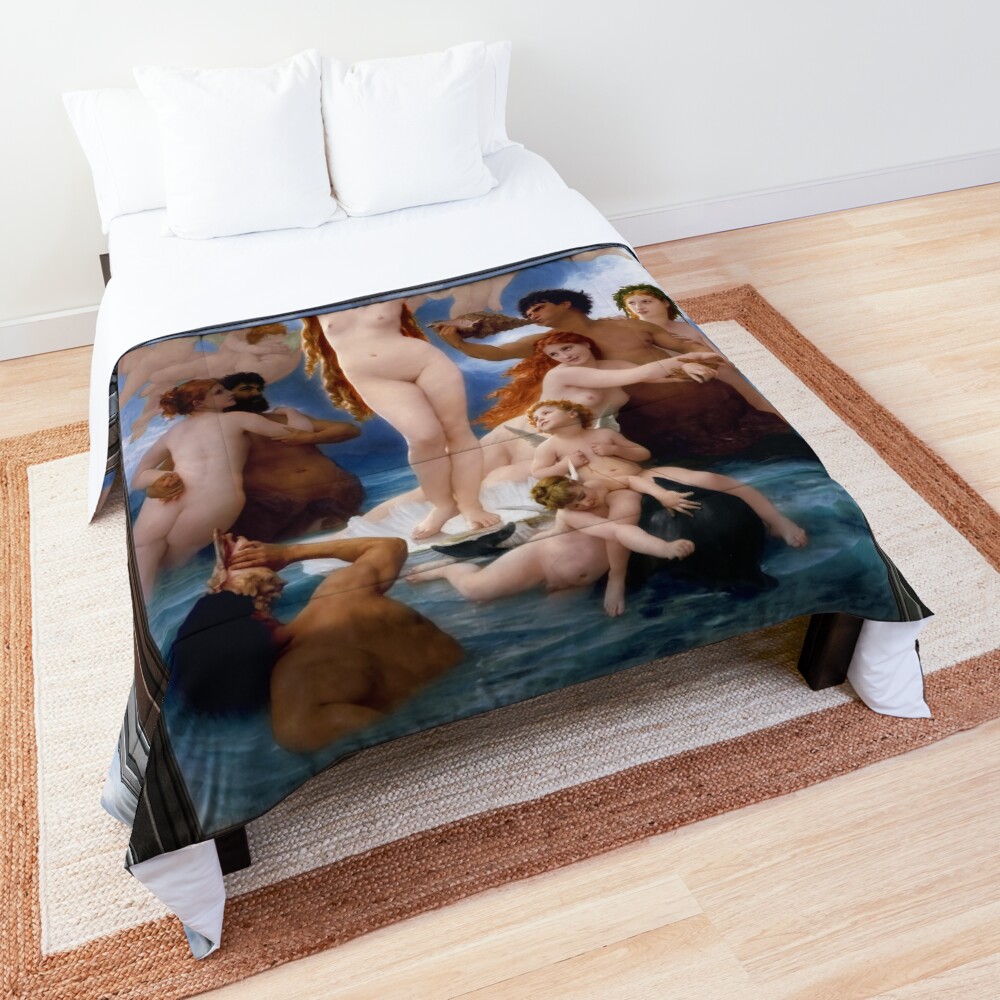
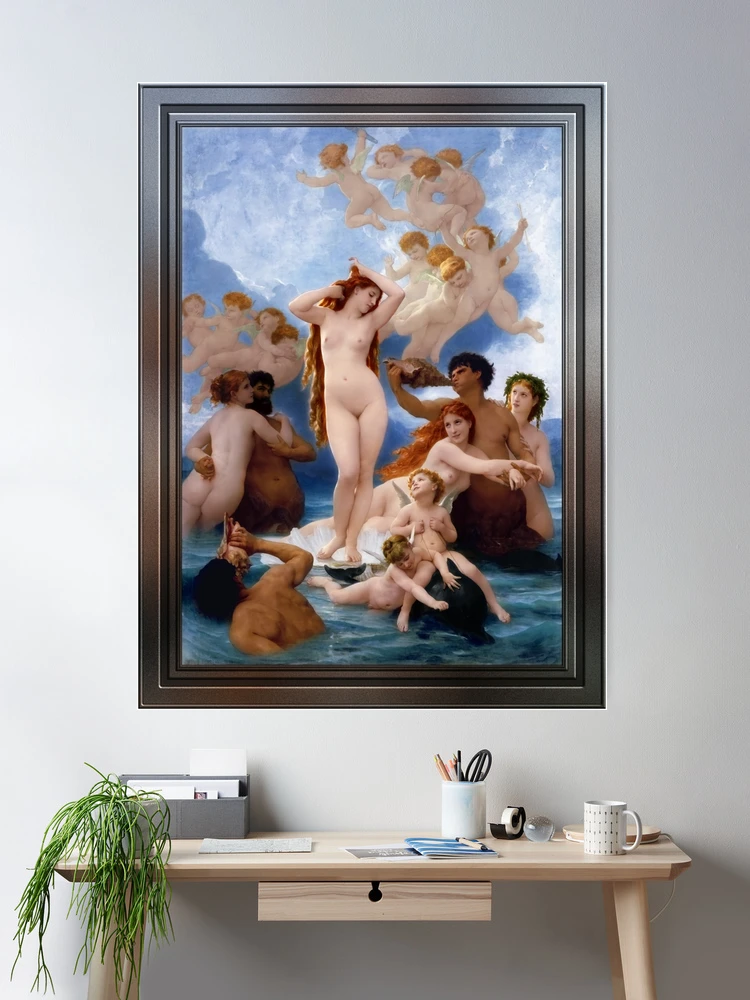
The composition is meticulously structured around Venus herself, positioned centrally within the canvas. She stands upon a massive scallop shell, which serves as her floating pedestal, gently approaching the shoreline. De regeling is net tafallich; it’s carefully orchestrated to guide the viewer’s eye. Links fan har, a figure representing Zephyr, the west wind, and his consort Chloris, blow Venus towards the shore, their bodies intertwined in a dynamic pose that conveys movement and gentle force. On the right, a nymph, likely Hora, awaits with a floral garland, ready to welcome the goddess. The figures surrounding Venus are not merely decorative; they contribute to the narrative flow, illustrating the forces that brought her into being and the welcoming reception she receives.
Anatomical Precision & Idealized Form
Bouguereau’s reputation rested on his exceptional skill in depicting the human form with anatomical accuracy. Yn “De berte fan Venus,” this is evident in every curve and contour of the figures. The bodies are rendered with a smooth, hast porslein-like kwaliteit, showcasing an idealized beauty that adheres to classical standards. There’s no attempt at realism in the sense of portraying imperfections; ynstee, Bouguereau elevates the human form to a state of perfect harmony and proportion. Venus’s pose is particularly striking – she stands with one foot slightly raised, creating a sense of poised elegance and effortless grace. The subtle modeling of her flesh, achieved through delicate gradations of light and shadow, further enhances the illusion of three-dimensionality and tactile realism.
Kleurpalet & Atmospheric Effects
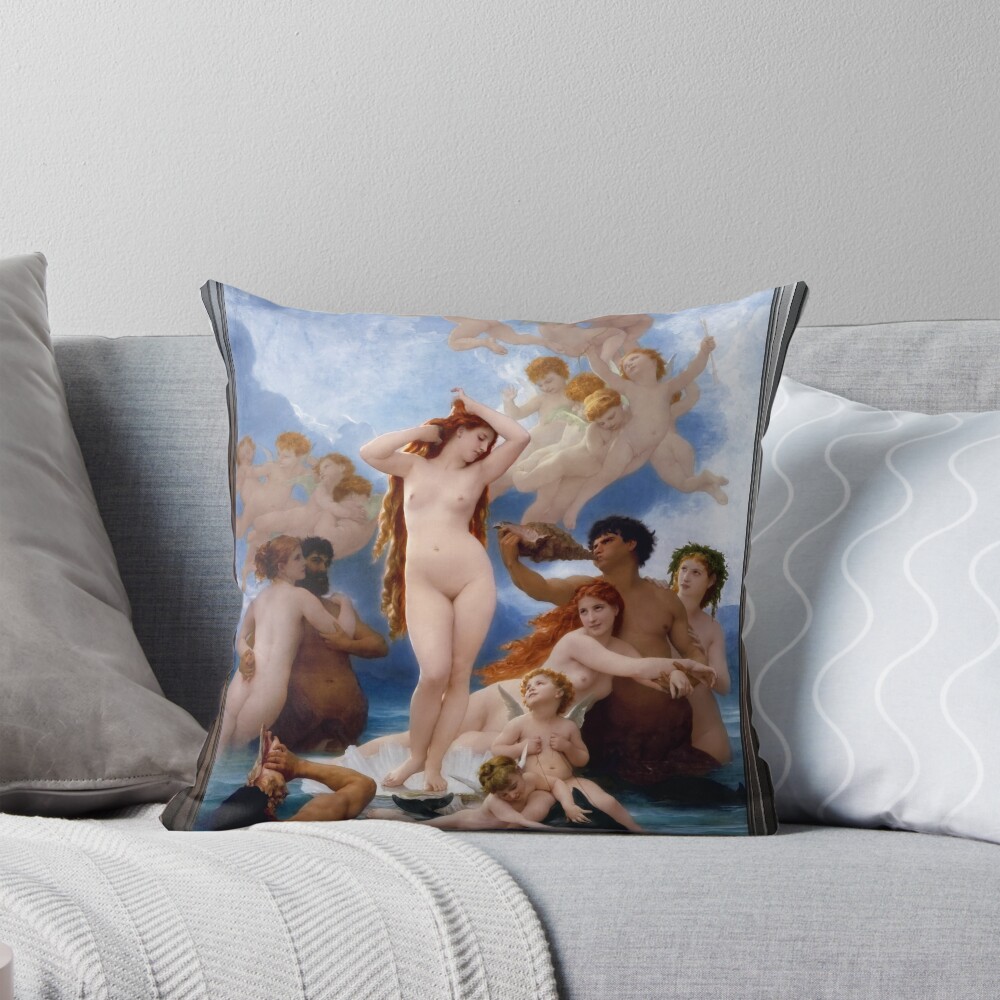
The color palette employed in “De berte fan Venus” is predominantly soft and harmonious. Pale blues and greens dominate the seascape, creating a sense of tranquility and ethereal beauty. The sky is rendered with swirling clouds, suggesting a gentle breeze and an atmosphere of otherworldly calm. Venus’s skin tones are luminous, contrasting beautifully with her flowing auburn hair, which cascades down her shoulders in loose waves. The warm hues of the flesh tones are balanced by the cooler colors of the surrounding environment, creating a visually pleasing contrast that draws attention to the central figure. Bouguereau masterfully uses light and shadow to create depth and volume, enhancing the overall sense of realism and beauty.
Symbolisme & Classical Allusions
Beyond its aesthetic appeal, “De berte fan Venus” is rich in symbolism and classical allusions. The scallop shell upon which Venus stands is a recurring motif associated with her birth in mythology – born from sea foam (Greek: aphros), hence her name Aphrodite. Zephyr and Chloris represent the gentle forces of nature that guide Venus’s arrival, while Hora symbolizes welcome and celebration. The floral garland offered by the nymph signifies beauty and fertility. These symbolic elements contribute to the painting’s overall meaning, reinforcing its connection to classical mythology and celebrating the goddess as a symbol of love, skientme, and renewal.
Bouguereau’s Artistic Legacy & Academic Tradition
Bouguereau was a leading figure in the Academic art movement, dy't beklamme technyske feardigens, idealized forms, and adherence to established artistic conventions. “De berte fan Venus” exemplifies these principles perfectly. The painting’s popularity during its time reflects the public’s appreciation for classical themes and the mastery of traditional techniques. While later generations would critique Academic art for its perceived lack of originality and emotional depth, Bouguereau’s work remains admired for its technical brilliance and enduring beauty. “De berte fan Venus” continues to captivate viewers with its serene atmosphere, idealized forms, and celebration of classical mythology. It stands as a testament to the power of artistic skill and the enduring appeal of timeless themes.
Artist Bio Courtesy Wikipedia.org
William Adolphe Bouguereau waard berne yn La Rochelle, Frankryk, op 30 novimber 1825, yn in famylje fan wyn- en oliveeljehannelers.[4] De soan fan Théodore Bouguereau (berne 1800) en Marie Bonnin (1804), bekend as Adeline, Willem waard in katolyk grutbrocht. Hy hie in âldere broer, Alfred, en in jongere suster, Marie (bekend as Hanna), dy't stoar doe't se sân wie.
De famylje ferhuze nei Saint-Martin-de-Ré yn 1832. In oare sibling waard berne yn 1834, Kitty. Yn de âldens fan 12, Bouguereau gie nei Mortagne om by syn omke Eugène te bliuwen, in pryster en ûntwikkele in leafde foar de natuer, religy en literatuer.
Yn 1839, hy waard stjoerd om te studearjen foar it prysterskip oan in katolike kolleezje yn Pons. Hjir waard hy leard te tekenjen en te skilderjen troch Louis Sage, dy't ûnder Ingres studearre hie. Bouguereau ferliet mei tsjinsin syn stúdzje om werom te gean nei syn famylje, wennet no yn Bordeaux.
Dêr moete er in pleatslike keunstner, Charles Marioneau, en begûn yn novimber oan de Gemeentelike Skoalle foar Teken en Skilderjen 1841. Bouguereau wurke ek as winkelmeiwurker, lithografy mei de hân ynkleure en lytse skilderijen meitsje dy't mei chromolithografy reprodusearre waarden.
Hy wie al gau de bêste learling yn syn klasse, en besleat keunstner te wurden yn Parys. Om de ferhuzing te finansieren, hy ferkocht portretten - 33 oaljes yn trije moannen. Allegear wiene net ûndertekene en mar ien is opspoard. Hy kaam yn Parys âld 20 yn maart 1846.
Gelikensens foar de dea (Gelikensens foar de dea), 1848, oalje op doek, 141 × 269 cm (55.5 × 105.9 yn), Musée d'Orsay, Parys. Gelikensens is Bouguereau syn earste grutte skilderij, produsearre nei twa jier oan de École des Beaux-Arts de Paris op 'e leeftyd fan 23.
Bouguereau waard studint oan de École des Beaux-Arts.[4] Om syn formele oplieding yn tekenjen oan te foljen, hy besocht anatomyske disseksjes en studearre histoaryske kostúms en argeology.
Hy waard talitten ta it atelier fan François-Édouard Picot, dêr't er skilderjen yn 'e akademyske styl studearre. Dante en Vergilius yn 'e hel (1850) wie in ier foarbyld fan syn neoklassike wurken.
Akademysk skilderjen pleatste de heechste status op histoaryske en mytologyske ûnderwerpen, en Bouguereau besletten om de Prix de Rome te winnen, dy't him in trije jier ferbliuw krije soe yn 'e Villa Medici yn Rome, Itaalje, dêr't er njonken formele lessen út 'e earste hân de keunstners fan 'e Renêssânse en har masterwurken bestudearje koe, likegoed as Gryksk, Etruskysk, en Romeinske âldheden.
The Birth Of Venus is in retouchearre digitale keunst âlde mastersreproduksje fan in ôfbylding yn it iepenbier domein dat online te krijen is as in opgerold canvas print.