

The Daughter of Herodias Salome Receiving the Head of John the Baptist
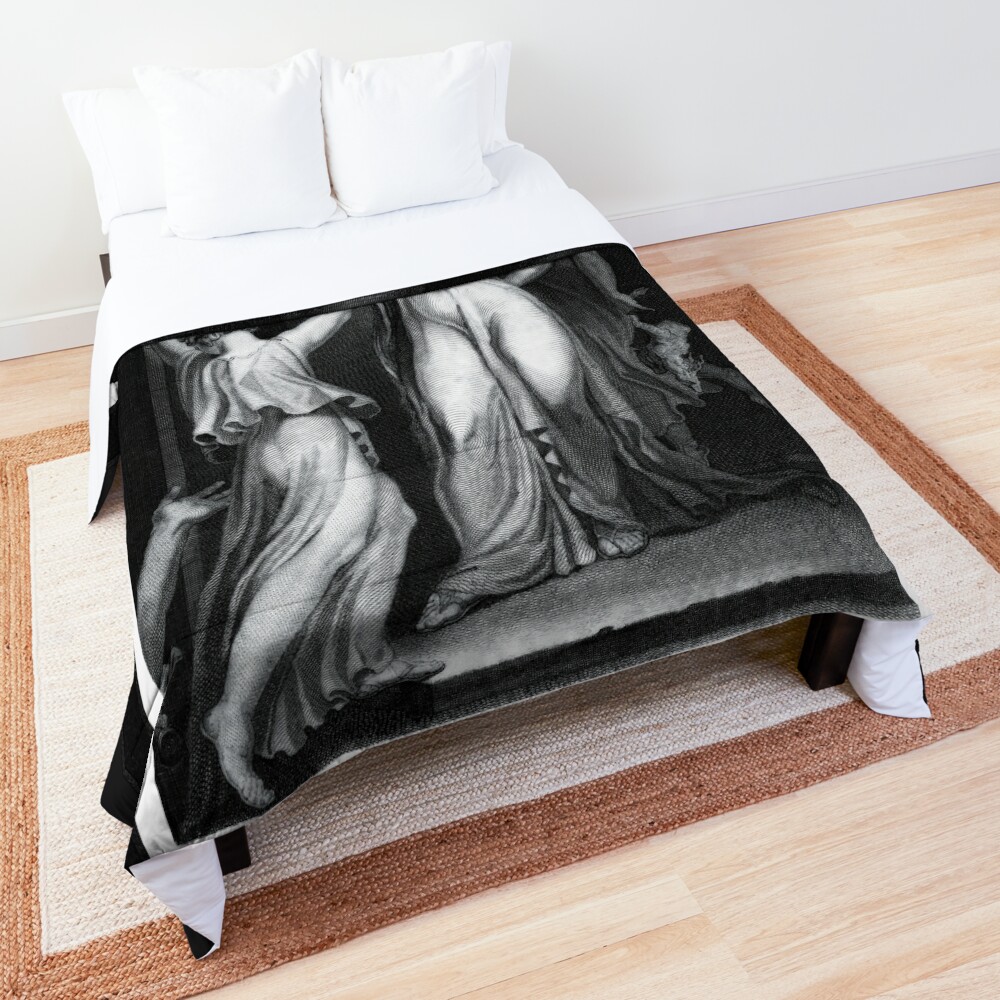
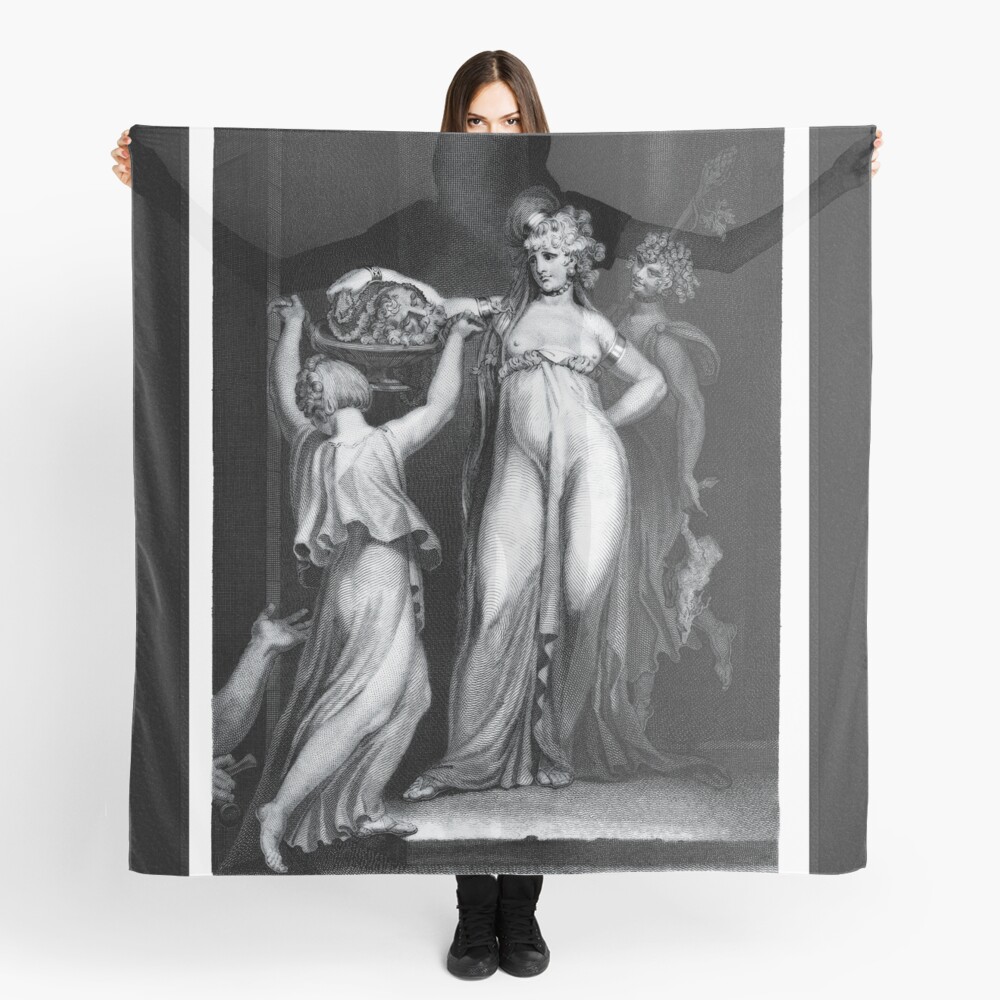
In the haunting engraving titled “Die Tochter von Herodias; Salome empfängt das Haupt von Johannes dem Täufer,” created by the British engraver Thomas Holloway in 1798, we witness a pivotal moment drawn from the Bible, specifically Matthew 14:10-11. This stark and dramatic scene captures the tragic culmination of the beheading of John the Baptist.
Holloway’s meticulous craftsmanship evokes the emotional intensity and weight of the moment, blending both the grotesque and the regal. The engraving portrays Salome, the daughter of Herodias, holding the severed head of the prophet John, an act prompted by her mother’s desire for vengeance.
Inhaltsverzeichnis
The Main Subject and Theme
At the heart of Holloway’s engraving stands the female figure of Salome, her expression a curious mix of satisfaction and cold indifference as she receives the gruesome head of John the Baptist. Salome is depicted with long flowing hair, dressed in an elegant yet understated gown that flows to the floor. Ihre Haltung ist ausgeglichen, almost regal, despite the grim nature of the event. Her delicate yet firm grasp of the dish holding the severed head of John reflects the disturbing calmness of the scene.
The head of John the Baptist is eerily centered in the image, placed on a silver platter. His features are still discernible, though his eyes are shut in death, adding to the horror of the scene. His decapitated head is an unsettling contrast to the elegant appearance of the figures around it. Behind Salome stands a smaller male figure who seems to assist in the ceremonial transfer of the head, while another figure, draped in a flowing robe, completes the scene. These secondary characters underscore the ritualistic aspect of the narrative and their submission to the will of Herodias.
The theme of the artwork revolves around the notion of vengeance and betrayal, as well as the imbalance of power. Salome’s act is one of obedience to her mother, yet there is a calculated detachment in her demeanor that speaks to the complex emotional and moral implications of her actions. Holloway portrays the moment with an intensity that transcends the physical violence of the scene, offering viewers a glimpse into the darker realms of human nature and the consequences of unchecked power.
Materialien und Technik
Thomas Holloway’s engraving is a masterwork of the intaglio process, a technique that involves incising an image onto a surface, which is then inked and pressed onto paper to create an impression. This traditional method allows for remarkable detail and tonal gradation, and Holloway’s skillful use of light and shadow brings the composition to life. The texture of the engraving, from the intricate folds of Salome’s gown to the delicate portrayal of the severed head, exhibits an exceptional level of detail characteristic of the neoclassical era. The depth of emotion is underscored by the expert contrast between light and dark, which emphasizes the drama of the moment.
The image is rendered in black and white, a stark yet powerful choice that reinforces the gravity of the scene. The contrast between the white of Salome’s skin and gown and the deep shadows of the background lends an almost theatrical quality to the image. This use of chiaroscuro – the contrast between light and dark – is particularly effective in drawing attention to the central figures, allowing their expressions and poses to dominate the composition.
Setting und Objekte
The setting of the artwork is minimalistic but purposeful. The figures are placed in a semi-darkened space, hinting at a chamber or a palace, though no specific architectural details are given. This lack of specificity enhances the sense of timelessness, allowing the narrative to be universal rather than tied to a specific location or period. The dim lighting surrounding the figures suggests a scene shrouded in secrecy or ritual, contributing to the overall somber and foreboding mood of the piece.
The dish holding John the Baptist’s severed head is one of the most critical objects in the scene. Its presence is almost ceremonial, a stark juxtaposition of death and reverence. The head, severed from the body, conveys the brutality of the execution, yet the treatment of the dish elevates it to an almost sacred object, as though the head itself is now part of a macabre offering or tribute. The blood that would naturally accompany such an event is deliberately omitted from the image, making the scene even more surreal and unsettling. It is as though the severed head is merely a symbol of the act rather than a true representation of its grisly reality.
Stimmung und emotionale Wirkung
The overall mood of the engraving is one of darkness, suspense, and moral ambiguity. The cold detachment of Salome, juxtaposed with the violent symbolism of John the Baptist’s death, creates a tense atmosphere. The lack of empathy displayed by Salome in this moment, while her expression reveals no sign of remorse or distress, calls attention to the inhumanity that often accompanies the pursuit of power. Holloway masterfully captures the eerie calmness of the scene, leaving the viewer with an unsettling sense of foreboding.
The engraved figures are imbued with a quiet stillness, but it is a stillness laced with an undercurrent of violence and intrigue. The sense of detachment from the horror of the act may provoke discomfort in the viewer, challenging them to consider the cost of vengeance and the complex nature of moral judgment. Salome’s role as the instrument of her mother’s revenge places her at the intersection of innocence and guilt, and Holloway’s work invites contemplation of the consequences of blind obedience.
Abschluss
Thomas Holloway’s “Die Tochter von Herodias; Salome empfängt das Haupt von Johannes dem Täufer” is a striking representation of a dark and tragic biblical moment. Through his expert use of engraving techniques and the careful rendering of light and shadow, Holloway brings an age-old story to life with vivid detail and emotional intensity. The scene is both beautiful and horrifying, offering a compelling reflection on the themes of power, vengeance, und moralische Komplexität.
Die Tochter von Herodias; Salome erhält den Kopf von Johannes der Täufer, Matthew 14:10-11 c1798 von dem britischen Graveur Thomas Holloway (1748 – 1827), nach einem Gemälde des Schweizer Malers Henry Fuseli (741 – 1825); Bekannt für seine Spezialisierung auf die Schaffung von Kunstwerken, die sich mit dem Übernatürlichen befassen; Wer war auch ein versierter Zeichner, Schriftsteller und Inhaber der Position des Professors für Malerei und Bewahrer an der Royal Academy.
Dieser Stich von Thomas Holloway basiert auf einem Gemälde von Henry Fuseli, das die Tochter von König Herodias zeigt, Salome akzeptiert den abgetrennten Kopf von Johannes dem Täufer im Palasthof.
The Daughter of Herodias Salome Receiving the Head of John the Baptist is a retouched digital art old masters reproduction of a public domain image that is available for purchase online as a gerollter Leinwanddruck.

Künstler Bio von Wikipedia.org
Holloway wurde in jungen Jahren zu einem Siegelstecher namens Stent ausgebildet. Ab dem Studium der Gravur studierte er an der Royal Academy 1773, während dieser Zeit wohnte er in 11 Strände Reihe, in der Nähe des Charles Square, Hoxton, und stellte Pastellporträts in der Society of Artists in 1777.
Er lebte später im Orme House in Hampton, Edgefield, Norfolk, und Coltishall, Norfolk. Er wurde Hofgraveur in 1792.
Geboren in der Broad Street, London, Er war der älteste Sohn eines Kaufmanns, der John Wesley früh folgte; Das Porträt seiner Mutter wurde von John Russell gemalt.
Er war an einen Siegelstecher namens Stent gebunden, von wem er hauptsächlich beim Schnitzen von Stahlornamenten beschäftigt war. Anschließend besuchte er die Schulen der Royal Academy, und in 1773 trat erstmals an der Royal Academy als Aussteller von Siegeln und gravierten Edelsteinen auf. Später und bis zu 1792 Er schrieb Miniaturen und Porträts in Öl und Buntstiften.
Holloways Hauptrichtung war die Liniengravur. His earliest published plates were small portraits for magazines, chiefly of nonconformist ministers. He later undertook an edition of Johann Kaspar Lavater’s Essays on Physiognomy, translated by Henry Hunter, 5 vols., 1789–98.
The work was illustrated with about 800 plates executed by Holloway himself, Francesco Bartolozzi, William Blake, and other engravers, under the direction of Henry Fuseli.
His portraits included those of Charles Howard, 11th Duke of Norfolk, after Robert Edge Pine, and of Timothy Priestley, 1792, and Richard Price, nach Benjamin West, 1793.
Er war auch an den Illustrationen zu John Boydells Shakespeare beteiligt, Robert Bowyers Geschichte Englands, und Bell's British Theatre.
Holloway ist bekannt für seine mühsamen Gravuren von Cartoons von Raphael in Windsor Castle in 1800, an dem er gearbeitet hat 30 Jahre. Dieses ehrgeizige Projekt war ein finanzieller Misserfolg. Die Cartoons waren bereits von Nicolas Dorigny graviert worden.
Durch den Einfluss von Benjamin West, Holloway erhielt die Erlaubnis, die sieben Raphael-Cartoons in Windsor in großem Maßstab zu gravieren, und dieser Aufgabe war der Rest seines Lebens gewidmet.
Er engagierte als Assistenten seine ehemaligen Schüler, R.. Slann und T.. S.. Webb, Jeder von ihnen heiratete eine Nichte von Holloway, zusammen mit Joseph Thomson, ein Künstler, der jung gestorben ist. Sie arbeiteten zusammen in Windsor bis 1814, als die Cartoons nach Hampton Court gebracht wurden.
Nach Fertigstellung der ersten Platte, Paulus predigt in Athen, im 1806, Der König ernannte Holloway zu seinem historischen Kupferstecher; der Zweite, Christi Anklage an Petrus, erschien in 1810; der dritte, Der Tod von Ananias, im 1816; und der vierte, Elymas, im 1820.
In diesem Jahr wurden alle vorläufigen Zeichnungen fertiggestellt, und Holloway zog sich mit seinen Mitarbeitern nach Edgefield in Norfolk zurück, und später nach Coltishall, in der Nähe von Norwich, ihre Arbeit auf den Tellern fortzusetzen, davon der fünfte, Der wundersame Entwurf der Fische, wurde ausgestellt in 1824. Dies war das letzte, das Holloway vollendete.
Die sechste Platte, Paul und Barnabas in Lystra, war fast fertig in 1827, und der siebte, Peter und John am schönen Tor, begonnen.
Ersteres erschien im folgenden Jahr, 1828, aber die Fertigstellung des letzteren verzögerte sich bis 1839, als es mit einer Widmung an die Königin veröffentlicht wurde, und wie die anderen trugen sie die Namen von Holloway, Slann, und Webb als Graveure und Verleger.