

De dochter fan Herodias Salome ûntfangt it haad fan Johannes de Doper
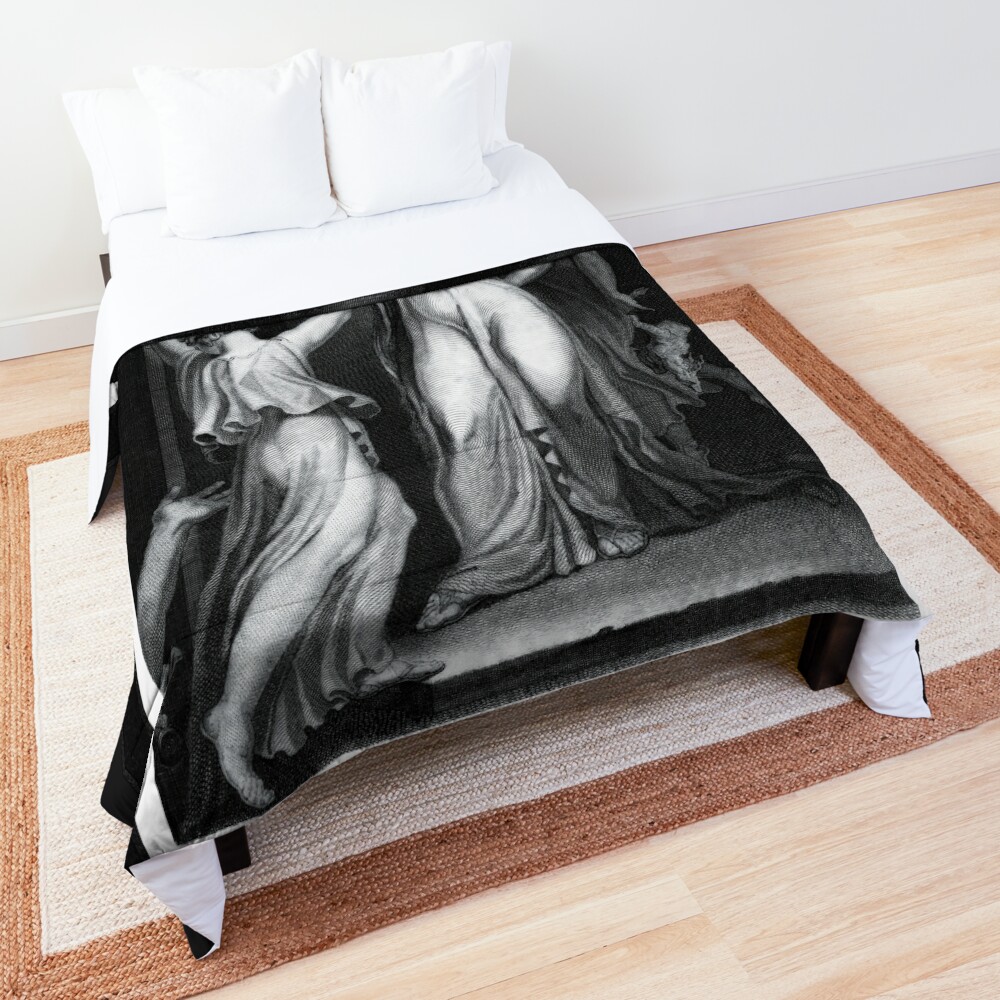
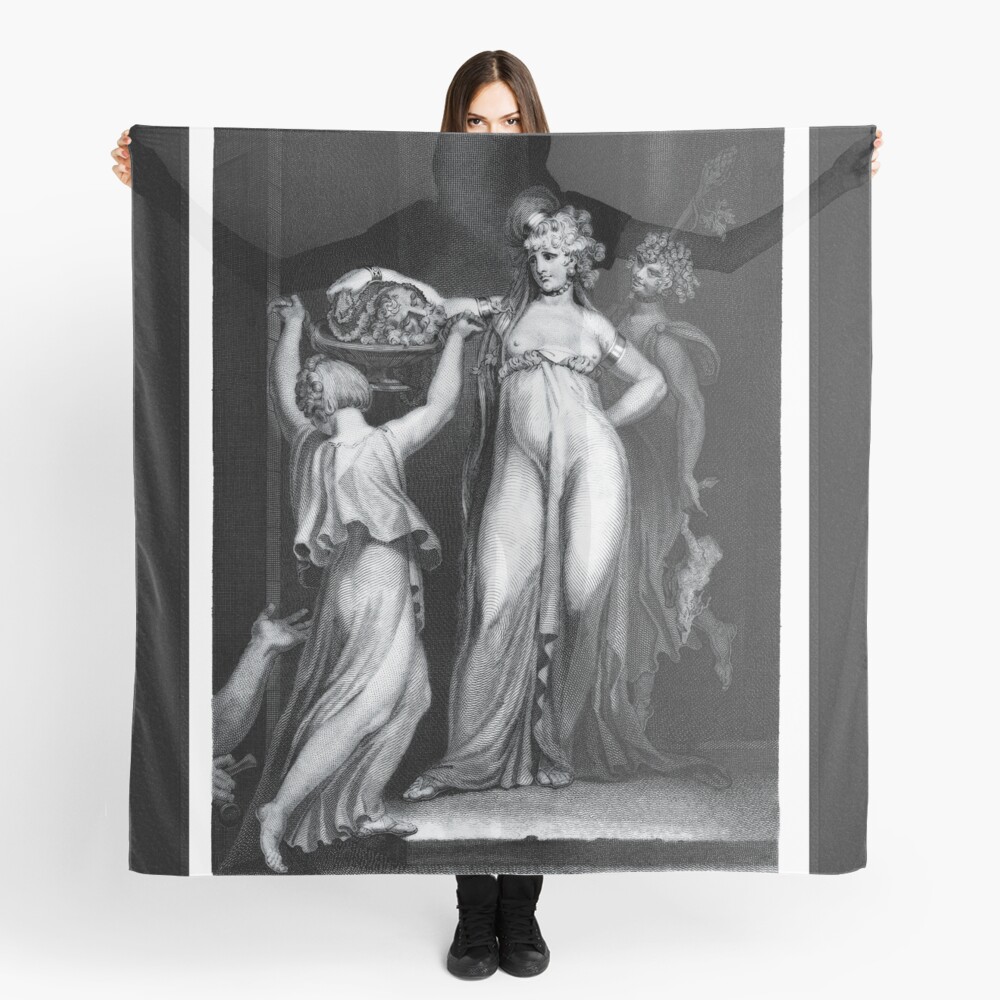
In de spookachtige gravure titele “De dochter fan Herodias; Salome ûntfangt it haad fan Johannes de Doper,” makke troch de Britske graveur Thomas Holloway yn 1798, wy binne tsjûge fan in pivotal momint lutsen út 'e Bibel, spesifyk Matthew 14:10-11. Dit skerpe en dramatyske sêne vangt de tragyske kulminaasje fan 'e ûnthalzing fan Johannes de Doper.
Holloway's sekuere fakmanskip ropt de emosjonele yntensiteit en gewicht fan it momint op, it mingen fan sawol it groteske as it keninklike. De gravuere portrettearret Salome, de dochter fan Herodias, mei de ôfsnien holle fan de profeet Jehannes, in hanneling dy't feroarsake waard troch de winsk fan har mem nei wraak.
Ynhâldsopjefte
It haadûnderwerp en tema
Yn it hert fan Holloway syn gravuere stiet de froulike figuer fan Salome, har útdrukking in nijsgjirrige miks fan tefredenheid en kâlde ûnferskilligens as se it grouwélige holle fan Jehannes de Doper ûntfangt. Salome wurdt ôfbylde mei lang streamend hier, klaaid yn in elegante noch understated jurk dy't streamt nei de flier. Har postuer is klear, hast keninklik, nettsjinsteande de grimmitige aard fan it evenemint. Har delikate, mar fêste greep fan it skûtel dat de ôfsketten holle fan Johannes hâldt, wjerspegelet de fersteurende kalmte fan it toaniel.
It haad fan Jehannes de Doper is skriklik midden yn it byld, pleatst op in sulveren skûtel. His features are still discernible, though his eyes are shut in death, adding to the horror of the scene. His decapitated head is an unsettling contrast to the elegant appearance of the figures around it. Behind Salome stands a smaller male figure who seems to assist in the ceremonial transfer of the head, while another figure, draped in a flowing robe, completes the scene. These secondary characters underscore the ritualistic aspect of the narrative and their submission to the will of Herodias.
The theme of the artwork revolves around the notion of vengeance and betrayal, as well as the imbalance of power. Salome’s act is one of obedience to her mother, yet there is a calculated detachment in her demeanor that speaks to the complex emotional and moral implications of her actions. Holloway portrettearret it momint mei in yntensiteit dy't it fysike geweld fan it toaniel te boppe giet, it oanbieden fan sjoggers in blik yn 'e tsjustere riken fan' e minsklike natuer en de gefolgen fan net kontrolearre macht.
Materiaal en technyk
De gravuere fan Thomas Holloway is in masterwurk fan it yntaglioproses, in technyk wêrby't it ynsnijen fan in byld op in oerflak is, dat wurdt dan ynkt en op papier drukke om in yndruk te meitsjen. Dizze tradisjonele metoade soarget foar opmerklike detail en tonale gradaasje, en Holloway syn betûfte gebrûk fan ljocht en skaad bringt de komposysje ta libben. De tekstuer fan 'e gravuere, fan 'e yngewikkelde plooien fan Salome's jurk oant de delikate ôfbylding fan 'e ôfsnien holle, eksposearret in útsûnderlik nivo fan detail karakteristyk foar it neoklassisistyske tiidrek. The depth of emotion is underscored by the expert contrast between light and dark, which emphasizes the drama of the moment.
The image is rendered in black and white, a stark yet powerful choice that reinforces the gravity of the scene. The contrast between the white of Salome’s skin and gown and the deep shadows of the background lends an almost theatrical quality to the image. This use of chiaroscuro – the contrast between light and dark – is particularly effective in drawing attention to the central figures, allowing their expressions and poses to dominate the composition.
Ynstelling en Objekten
The setting of the artwork is minimalistic but purposeful. The figures are placed in a semi-darkened space, hinting at a chamber or a palace, though no specific architectural details are given. This lack of specificity enhances the sense of timelessness, allowing the narrative to be universal rather than tied to a specific location or period. The dim lighting surrounding the figures suggests a scene shrouded in secrecy or ritual, contributing to the overall somber and foreboding mood of the piece.
The dish holding John the Baptist’s severed head is one of the most critical objects in the scene. Its presence is almost ceremonial, a stark juxtaposition of death and reverence. The head, severed from the body, conveys the brutality of the execution, dochs ferheft de behanneling fan it skûtel it ta in hast hillich objekt, as soe de holle sels no diel útmeitsje fan in makabere offer of earbetoan. It bloed dat natuerlik by sa'n barren begeliede soe, wurdt mei opsetsin út it byld weilitten, it meitsjen fan it toaniel noch surrealer en ûnrêstiger. It is as is de ôfsnien holle mar in symboal fan 'e hanneling yn stee fan in wiere foarstelling fan syn grize realiteit.
Stimming en emosjonele ynfloed
De algemiene stimming fan 'e gravuere is ien fan tsjuster, spanning, en morele dûbelsinnigens. De kâlde ôfskieding fan Salome, njonken de gewelddiedige symbolyk fan 'e dea fan Johannes de Doper, soarget foar in spannende sfear. It gebrek oan empasy werjûn troch Salome op dit momint, wylst har útdrukking gjin teken fan berou of need ferriedt, freget omtinken foar de ûnminsklikheid dy't faaks begeliedt mei it stribjen nei macht. Holloway masterfully captures the eerie calmness of the scene, leaving the viewer with an unsettling sense of foreboding.
The engraved figures are imbued with a quiet stillness, but it is a stillness laced with an undercurrent of violence and intrigue. The sense of detachment from the horror of the act may provoke discomfort in the viewer, challenging them to consider the cost of vengeance and the complex nature of moral judgment. Salome’s role as the instrument of her mother’s revenge places her at the intersection of innocence and guilt, and Holloway’s work invites contemplation of the consequences of blind obedience.
Konklúzje
Thomas Holloway’s “De dochter fan Herodias; Salome ûntfangt it haad fan Johannes de Doper” is a striking representation of a dark and tragic biblical moment. Troch syn saakkundich gebrûk fan gravueretechniken en it soarchfâldich werjaan fan ljocht en skaad, Holloway bringt in ieuwenâld ferhaal ta libben mei libbendich detail en emosjonele yntinsiteit. It toaniel is sawol moai as ôfgryslik, it oanbieden fan in twingende refleksje oer de tema's fan macht, wraak, en morele kompleksiteit.
De dochter fan Herodias; Salome ûntfangt it haad fan Johannes de Doper, Matthew 14:10-11 c1798 troch Britske graveur Thomas Holloway (1748 – 1827), út in skilderij fan de Switserske skilder Henry Fuseli (741 – 1825); bekend om it spesjalisearjen yn it meitsjen fan keunstwurken dy't dûke yn it boppenatuerlike; dy't ek in betûft tekener wie, Skriuwer en hâlder fan de posysje fan heechlearaar Skilderij en Keeper oan de Keninklike Akademy.
Dizze gravuere troch Thomas Holloway is basearre op in skilderij makke Henry Fuseli dat de dochter fan kening Herodias toant, Salome accepting the severed head of John The Baptist in the palace court.
The Daughter of Herodias Salome Receiving the Head of John the Baptist is a retouched digital art old masters reproduction of a public domain image that is available for purchase online as a opgerold canvas print.

Artist Bio From Wikipedia.org
Holloway was apprenticed to a seal engraver named Stent at a young age. He went on to study engraving at the Royal Academy beginning in 1773, during which time he resided at 11 Beaches Row, near Charles Square, Hoxton, and exhibited pastel portraits at the Society of Artists in 1777.
He later lived in Orme House in Hampton, Edgefield, Norfolk, and Coltishall, Norfolk. He became a court engraver in 1792.
Born in Broad Street, Londen, he was eldest son of a merchant who was an early follower of John Wesley; his mother’s portrait was painted by John Russell.
He was articled to a seal-engraver named Stent, by whom he was mainly employed in carving steel ornaments. He subsequently attended the Royal Academy schools, en yn 1773 first appeared at the Royal Academy as an exhibitor of seals and engraved gems. Later and up to 1792 he was a contributor of miniatures and portraits in oils and crayons.
Holloway’s main direction was line engraving. His earliest published plates were small portraits for magazines, chiefly of nonconformist ministers. He later undertook an edition of Johann Kaspar Lavater’s Essays on Physiognomy, translated by Henry Hunter, 5 vols., 1789–98.
The work was illustrated with about 800 plates executed by Holloway himself, Francesco Bartolozzi, William Blake, and other engravers, under the direction of Henry Fuseli.
His portraits included those of Charles Howard, 11th Duke of Norfolk, after Robert Edge Pine, and of Timothy Priestley, 1792, and Richard Price, after Benjamin West, 1793.
He was also employed on the illustrations to John Boydell’s Shakespeare, Robert Bowyer’s History of England, and Bell’s British Theatre.
Holloway is noted for his arduous engravings of cartoons by Raphael at Windsor Castle in 1800, on which he worked for 30 jierren. This ambitious project was a financial failure. The cartoons had already been engraved by Nicolas Dorigny.
Through the influence of Benjamin West, Holloway obtained permission to engrave on a large scale the seven Raphael cartoons at Windsor, and to this task the remainder of his life was devoted.
He engaged as assistants his former pupils, R. Slann and T. S. Webb, each of whom married a niece of Holloway, together with Joseph Thomson, an artist who died young. They worked together at Windsor until 1814, when the cartoons were moved to Hampton Court.
On the completion of the first plate, Paul preaching at Athens, yn 1806, the king appointed Holloway his historical engraver; the second, Christ’s Charge to Peter, appeared in 1810; the third, The Death of Ananias, yn 1816; and the fourth, Elymas, yn 1820.
In that year all the preliminary drawings were finished, and Holloway retired with his associates to Edgefield in Norfolk, and later to Coltishall, near Norwich, to pursue their work on the plates, of which the fifth, The Miraculous Draught of Fishes, was issued in 1824. This was the last that Holloway lived to complete.
The sixth plate, Paul and Barnabas at Lystra, was almost finished in 1827, and the seventh, Peter and John at the Beautiful Gate, begun.
The former appeared in the following year, 1828, but the completion of the latter was delayed until 1839, when it was published with a dedication to the Queen, and like the rest bore the names of Holloway, Slann, and Webb as the engravers and publishers.