

Soraidh le Telemachus agus Eucharis
Soraidh le Telemachus agus Eucharis c1818 le peantair Frangach Jacques-Louis Daibhidh (1748 – 1825); air a mheas mar am prìomh pheantair san stoidhle Neoclassical.
Tha an dealbh seo a’ sealltainn nan caractaran Telemachus agus Eucharis bhon nobhail c1699 Les Aventures de Télémaque le Àrd-easbaig Frangach Combrai François de Salignac de la Mothe-Fénelon (1651 – 1715); a bha air am brosnachadh le Odeyssey Homer.
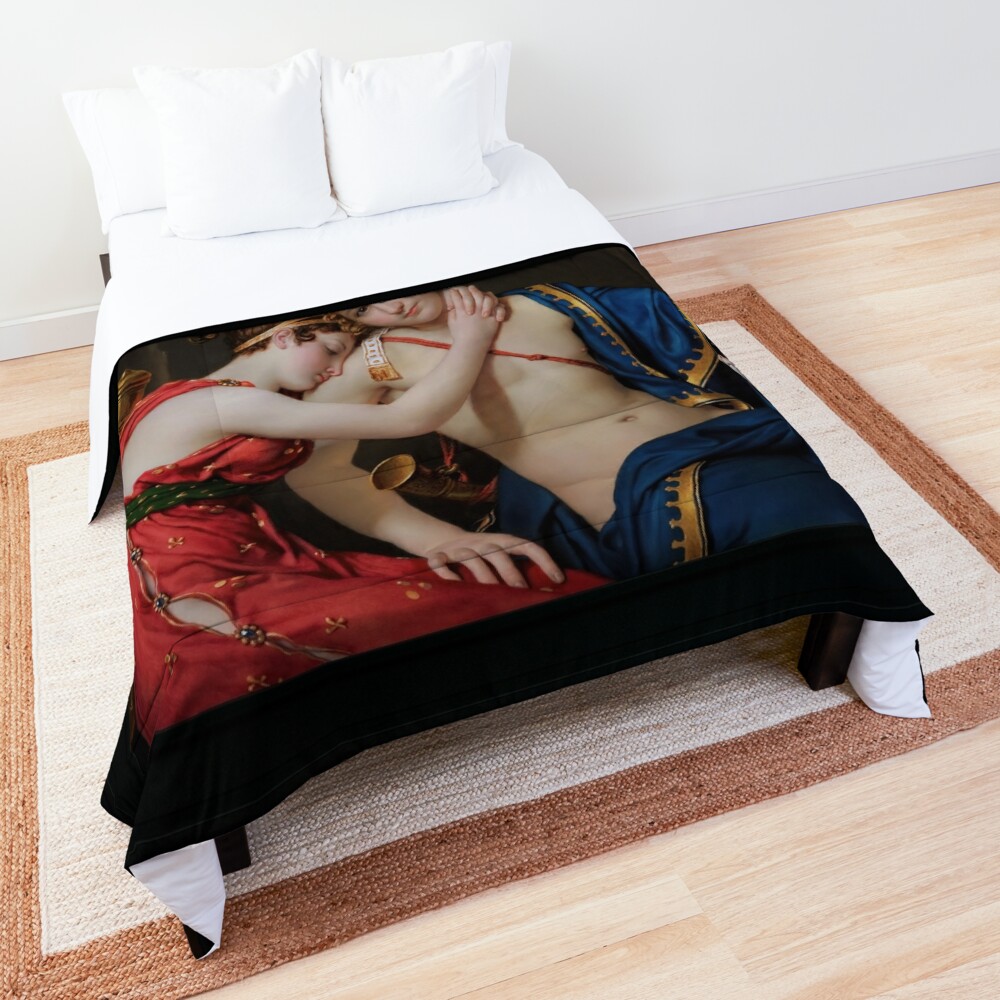
Ann am miotas-eòlas Grèigeach tha Telemachus na mhac aig Odysseus agus Penelope; fhad ‘s a tha Eucharis nach eil na phàirt de bheul-aithris na Grèige mar aon den luchd-frithealaidh nymph Calypso ann an nobhail Fénelon Les Aventures de Télémaque c1699.
In the painting Eucharis who is wearing a reddish gold accent dress with a gold accent emerald green sash around her waist, a gold band around her hair and a brass cylinder with the artist last name David on it.
She is embracing Telemachus; who is partially clothed with a blue robe with gold crown accents along its perimeter and has a white band with gold circles wrapped around his head.
He also has a cord tied across his chest from which a brass horn is hanging from his right side with the date of the work and the letters BRVX engraved on it, as he rest his right hand on the left thigh of Eucharis; while holding a metal tipped spear in his left hand with his white dog looking up at him from between the spear and his left arm.
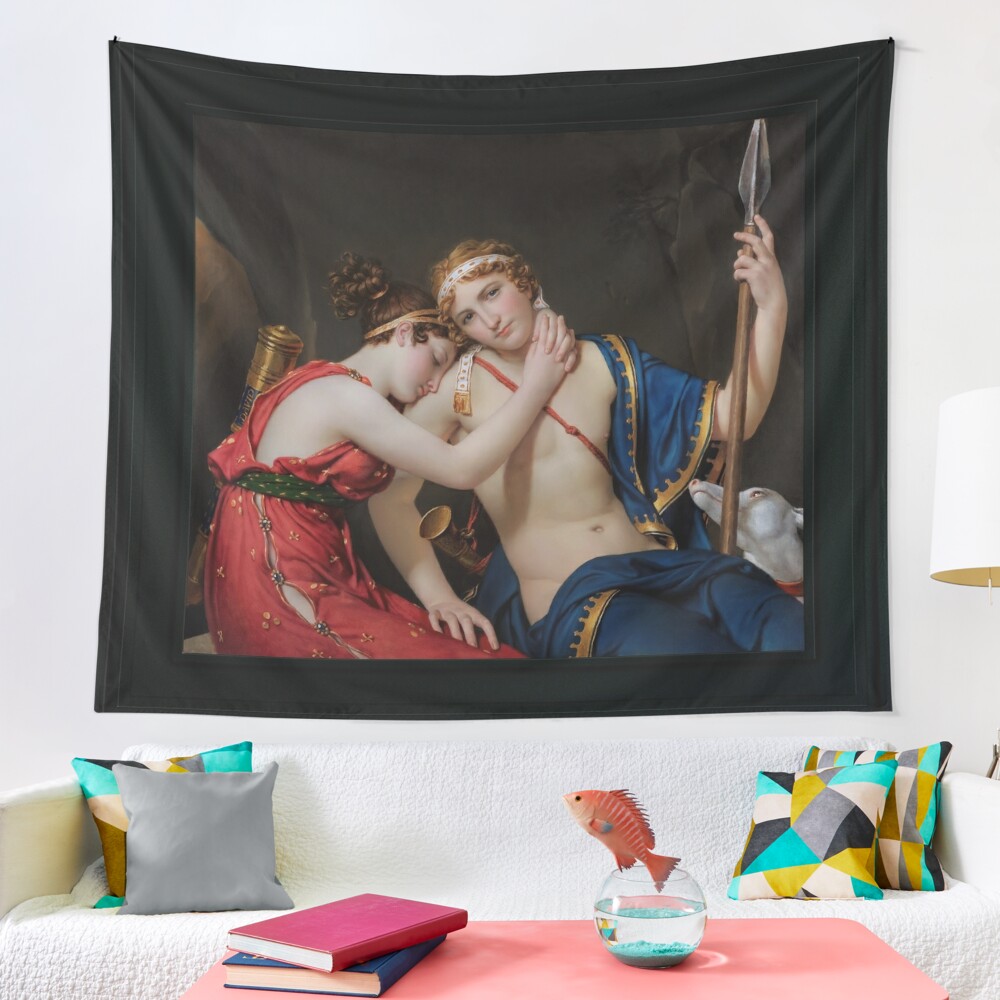
The Farewell of Telemachus and Eucharis is a remastered digital art old masters reproduction of a public domain image that is available as a canvas print online.
Fiosrachadh gu h-ìosal a thàinig bho Wikipedia.org
Jacques was born in Paris, France on August 30, 1748 agus aig aois 9 was sent to live with his uncles who architects, by is mother; after his father was killed in a duel.
His uncles saw to it that he received a first class education by sending him to the Collège des Quatre-Nations, University of Paris; but he found it difficult and never reached the level of other students that attended the school, and was more preoccupied with drawing.
Though his uncles and mother wanted Jacques to become an architect, an àite sin bha e airson a bhith na pheantair agus bha e comasach dha toirt a chreidsinn orra na chùrsa gnìomh; a thug air sgrùdadh leis a’ phrìomh pheantair Rococo aig an àm François Boucher (1703 – 1770); a thachair cuideachd a bhith na chàirdean fad às.
Ach a bheil blas an stoidhle Rococo air a bhith ag atharrachadh gu stoidhle nas Clasaigeach, Chuir Boucher e gu bhith ag ionnsachadh còmhla ri a charaid Joseph-Marie Vien (1716 – 1809); far an do rinn e sgrùdadh aig Acadamaidh Rìoghail Peantadh is Deilbhidh.
Chùm an acadamaidh farpais bhliadhnail, a thug duais chliùiteach Prix de Rome don oileanach a bhuannaich; a leig le oileanaich fuireach anns an Ròimh airson ùine de 3 gu 5 bliadhnaichean a’ maoineachadh an daor agus iad a’ sgrùdadh obraichean mòra nam maighstirean clasaigeach.
Ged nach do bhuannaich Jacques anns a’ chiad trì oidhirpean aige, on his fourth attempt he took the prize with his painting Erasistratus Discovering the Cause of Antiochus’ Disease, agus a-steach 1775 journed to Italy with his mentor Joseph-Marie Vien, who had just been appointed director of the French Academy at Rome.