

The Flood Destroying The World
The Flood Destroying The World c1866 by French Painter Gustave Doré (1832 – 1883); obwohl er hauptsächlich als Holzstecher tätig war, er war auch ein drucker, Karikaturist, Comiczeichner, Illustrator und Bildhauer.
This is another harrowing scene of the Great Flood story told in the Christian Bible and that is part of Gustave’s Bible Illustration tales.
In this scene we can see in the far distance Noah’s Ark; the only place on the planet earth of salvation; while in the foreground we see all the non believers and sinners.
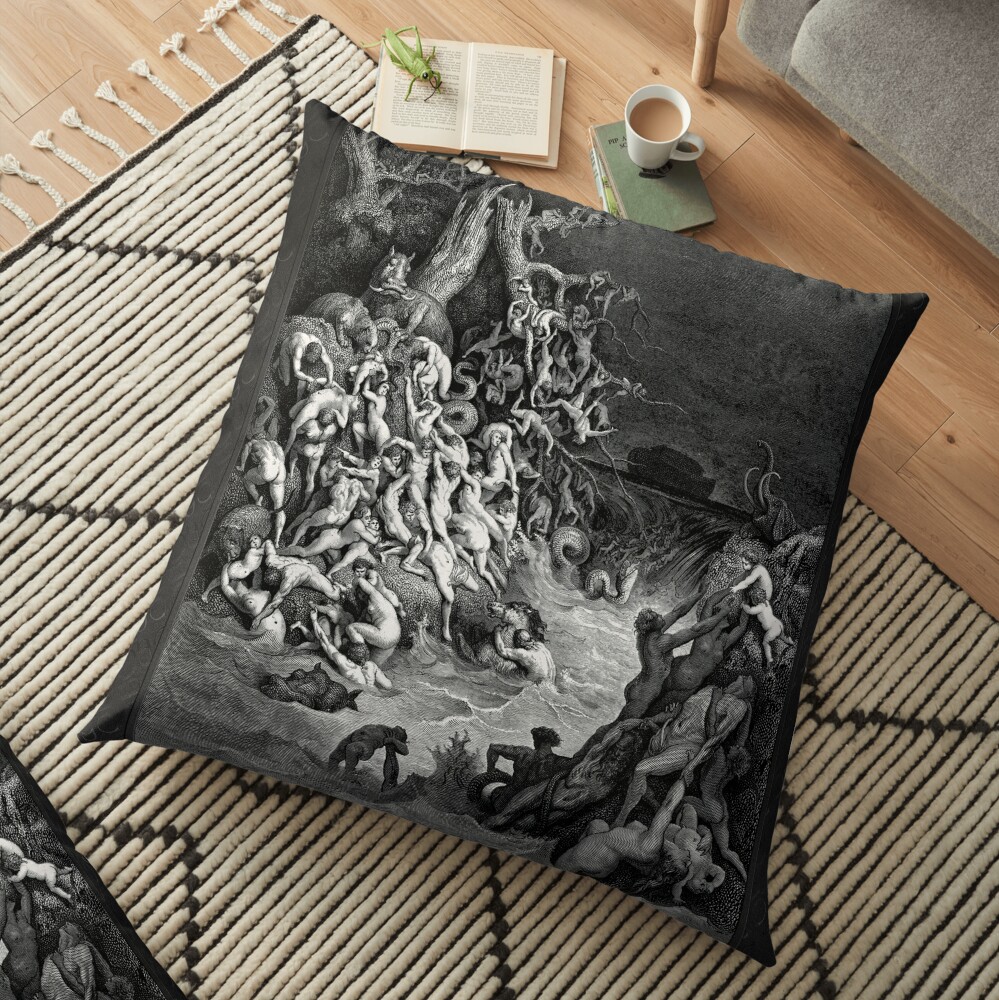
These individuals a grasping on rocks and trees trying to save themselves from the deluge of on coming water, as mothers and fathers try to pull and lift their children to safety; and children already on the rocks try to help their parents climb on top of them.
In the water are people and animals such as snakes and horses and on what little land that there is left that everyone is scrambling for are dozens of men, Frauen und Kinder, along with various animals such as wild cats, buffalo and elephants; with more people dangling off broken trees as the end approaches quickly.
The Flood Destroying The World is a remastered digital art old masters reproduction of a public domain image that is available as a Leinwanddruck online.
Info unten abgeleitet von Wikipedia.org
Doré was born in Strasbourg, Frankreich und im Alter von 5 war ein Wunderkind Künstler; Zeichnungen zu schaffen, die über seine Jahre hinaus reif waren. Dann im Alter von 12, Er begann in Stein zu meißeln, und von 15, begann seine Karriere als Karikaturist für die französische Zeitung Le journal pour rire.
Am Anfang war der Holzstich in den späten 1840er und frühen 1850er Jahren seine primäre künstlerische Ausdrucksmethode, Erstellen mehrerer Textcomics, like Les Travaux d’Hercule (1847), Drei missverstandene und verärgerte Künstler (1851), Les Dés-agréments d’un voyage d’agrément (1851) and L’Histoire de la Sainte Russie (1854).
Anschließend gewann Doré Aufträge, um Szenen aus Büchern von Cervantes darzustellen, Rabelais, Balzac, Milton, und Dante. He also illustrated “Gargantua et Pantagruel” im 1854; als er gerade war 22 Jahre alt.
Im 1853 Doré wurde gebeten, die Werke von Lord Byron zu illustrieren; und dieser Auftrag führte zu zusätzlicher Arbeit für britische Verleger, darunter eine neue illustrierte Bibel, und drei Jahre später würde er produzieren 12 foliogroße Illustrationen von The Legend of The Wandering Jew, die langjährige antisemitische Ansichten der Zeit propagierte, für ein kurzes Gedicht, das Pierre-Jean de Béranger aus einem Roman von Eugène Sue abgeleitet hatte 1845.
During the 1860s Doré illustrated a French edition of Cervantes’s Don Quixote, und seine Darstellungen des Ritters und seines Knappen, Sancho Pansa, sind so berühmt geworden, dass sie nachfolgende Leser beeinflusst haben, Künstler, und Bühnen- und Filmregisseure’ ideas of the physical “look” der beiden Charaktere.
He also illustrated an oversized edition of Edgar Allan Poe’s “The Raven”, ein Unterfangen, das ihn verdient hat 30,000 Franken vom Verlag Harper & Brüder ein 1883.
Seine Illustrationen für die Bibel (1866) waren sehr erfolgreich, und in 1867 Doré hatte eine große Ausstellung seiner Arbeiten in London, das führte zur Gründung der Doré Gallery in der Bond Street, London. Im 1869, Blanchard Jarrold, der Sohn von Douglas William Jerrold, schlug vor, gemeinsam ein umfassendes Porträt Londons zu erstellen.
Jerrold hatte die Idee von The Microcosm of London, produziert von Rudolph Ackermann, erhalten, William Pyne, und Thomas Rowlandson (erschienen in drei Bänden ab 1808 zu 1810). Doré unterzeichnete einen Fünfjahresvertrag mit dem Verlag Grant & Dazu gehörte, dass er drei Monate im Jahr in London blieb, und er erhielt für das Projekt die enorme Summe von 10.000 Pfund pro Jahr.
Obwohl Doré zu seiner Zeit hauptsächlich für seine Gemälde gefeiert wurde, und obwohl sie bis heute weltberühmt sind, es sind seine Holzschnitte und Stiche, wie die, die er für Jerrold getan hat, das beweist außergewöhnliches künstlerisches Talent als Künstler mit individueller Vision.