

De Blommenferkeaper
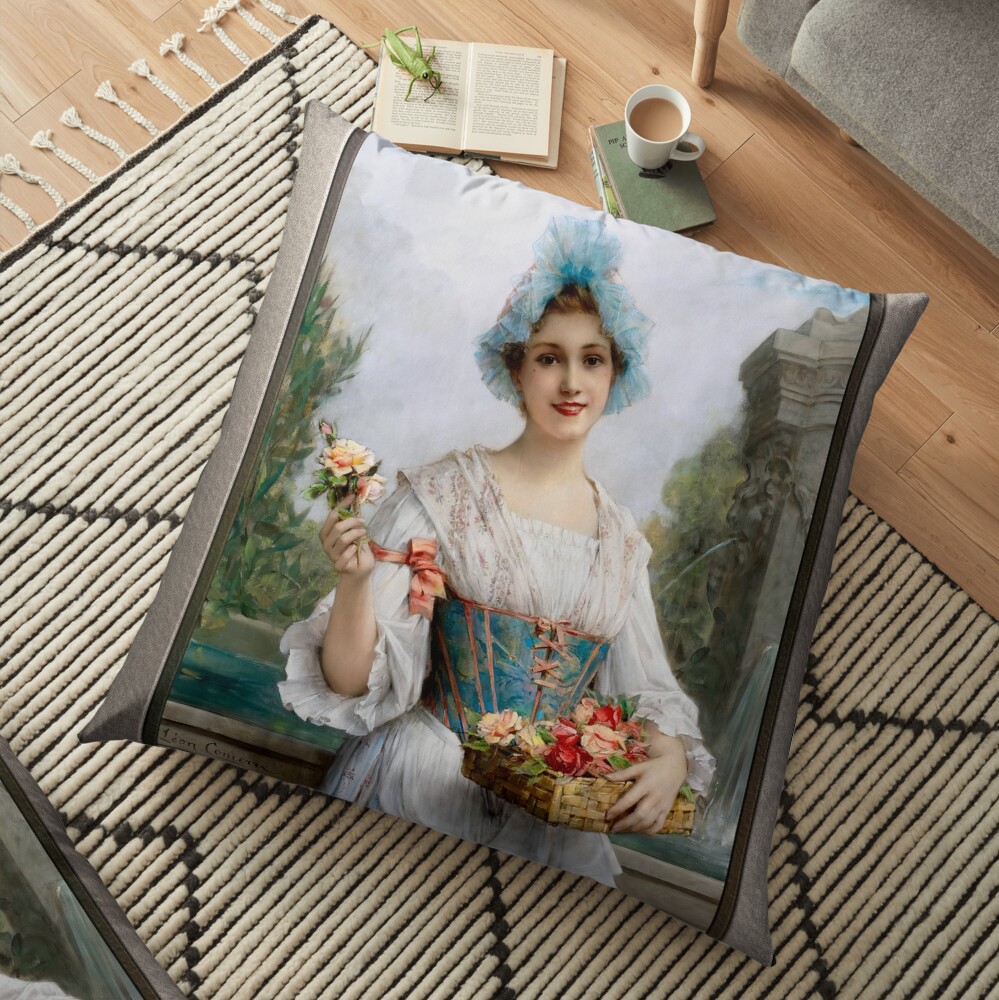
Léon François Comerre's keunstwurk mei de titel De Blommenferkeaper, makke tusken de lette 19e en begjin 20e ieu, stiet as in prachtich foarbyld fan akademysk realisme en de fassinaasje mei delikate froulikens yn keunst. Léon François Comerre, berne yn 1850 en fuortgean yn 1916, wie in priizge Frânske keunstner dy't de essinsje fan it deistich libben mei in ferheven gefoel fan genede en sjarme behendich fêstige. Dit wurk is in perfekte foarstelling fan syn styl, mei syn ôfbylding fan in serene jonge frou dwaande mei de ienfâldige, mar oangripende hanneling fan blommenferkeap.
Ynhâldsopjefte
Haad ûnderwerp: De Jonge Blommenferkeaper
Yn it hert fan it skilderij is in jonge frou, dy't reedlik en sêft stiet, har jeugdige útdrukking strielet in loft fan ûnskuld en blydskip. Har posysje is ûntspannen noch elegant, in klassike foarstelling fan froulike genede. De frou is klaaid yn in ensemble dat suggerearret fan in ienfâldige, plattelân of doarpslibben, hoewol de details fan har klean ek sprekke ta de oandacht fan 'e skilder foar modieuze froulikens fan 'e tiid.
De frou draacht in ljocht, streamend wite jurk mei sêfte pastelkleurige florale ûntwerpen op 'e stof, in stik dat har natuerlike skientme troch skine lit. In turquoise korset knipt har taille, in touch fan kleur tafoegje en har figuer markearje. Har klean wurdt foltôge troch in ljochtblauwe motorkap dy't har gesicht sêft omskriuwt en in touch fan sêftens tafoeget oan har algemiene uterlik.
Yn ien hân, se hâldt fyn in boeket roazen, an important element within the narrative of the painting, symbolizing the freshness of life, skientme, and the tender emotions associated with the selling of flowers. In her other hand, she carries a basket brimming with more roses, adding depth to the scene and suggesting her livelihood as a flower seller.
These roses, captured with vibrant detail and subtle shading, are rendered almost as lifelike as the young woman herself, a testament to the artist’s attention to detail and reverence for the natural world. The colors of the roses, a mix of soft pinks, reads, en blanken, further evoke the feeling of purity and delicate beauty.
Eftergrûn en Terrain: In sêfte túnynstelling
De eftergrûn fan De Blommenferkeaper is equally as serene and harmonious as the subject. The setting is a lush garden or park, a peaceful environment that underscores the softness and tranquility of the moment. Yn 'e fierte, we see the suggestion of stone walls and fountains, elements of classical architecture that provide an elegant backdrop.
These elements suggest that the young woman is not in a rural countryside, but rather in a more cultivated, upper-class environment. The gentle curve of the garden’s green foliage frames the subject, drawing the viewer’s eye to her, while also enhancing the idyllic nature of the scene.
A fountain, barely visible to the right of the composition, adds a sense of movement to the otherwise calm and still atmosphere. The water in the fountain is captured as a gentle stream, falling in delicate, feathery arcs into the stone basin below. The presence of water, often symbolic of life and purity, reinforces the peaceful and refreshing tone of the piece. The soft sky above, painted in light, cloudy tones, further contributes to the serene and peaceful atmosphere, evoking a sense of stillness and quiet contemplation.
Styl en artistike technyk
Léon François Comerre’s work is deeply rooted in academic realism, where meticulous attention is paid to detail and composition, while also embracing romantic ideals. The artist’s use of fine brushstrokes to depict the textures of the woman’s clothing, the delicate petals of the roses, and the subtle nuances of the background, showcases his mastery of the technique. The use of light is also particularly noteworthy; it bathes the figure in a soft glow, emphasizing the beauty of the subject and the flowers she holds. This lighting, combined with the pale colors of the woman’s attire, creates a harmonious blend of tones that are soothing to the eye.
The work exemplifies the characteristic aesthetic of the Belle Époque period, which celebrated the beauty of nature and human form. The artist’s use of vibrant yet soft hues—particularly in the skin tones of the young woman and the roses she holds—imbues the painting with a warmth that radiates both innocence and refinement. The portrayal of the flowers as nearly tangible objects adds a layer of realism that draws the viewer into the painting’s world. Each petal, each leaf, is carefully delineated, inviting closer inspection, while the overall composition is harmoniously balanced and pleasing to the eye.
Moommet en tema
De stimming fan De Blommenferkeaper is one of quiet beauty and subtle elegance. The young woman, with her soft smile and gentle gaze, evokes a sense of serenity and calmness, while the act of selling flowers suggests a connection to the natural world and to simple, everyday life. There is no indication of hardship or drama in the scene; leaver, the viewer is invited to enjoy the peaceful moment alongside the subject. The bouquet of roses, the natural setting, and the young woman’s graceful demeanor combine to create a theme of timeless beauty, untouched by the complexities of the world beyond the garden walls.
The theme of femininity and beauty is central to this work. The flower seller is not just a simple vendor but a symbol of youthful beauty and purity, as represented by the flowers she holds. Flowers themselves have long been symbols of beauty, leafde, and innocence, and by placing them in the hands of the young woman, Comerre elevates the subject, giving her an almost ethereal quality. There is an implied connection between the woman and the flowers she sells, as if she too, like the blooms, is part of nature’s cycle of growth and renewal.
Konklúzje
De Blommenferkeaper by Léon François Comerre is a quintessential work of late 19th-century French academic realism, dêr't skientme, graasje, and nature are intertwined in a visual harmony that speaks to the viewer’s emotions. Through meticulous detail, the artist captures a moment of timeless femininity, portraying a young woman in the act of selling flowers in a tranquil garden setting. The painting’s soft colors, delikate boarstelwurk, and serene mood invite the viewer into a world of grace and elegance, making it a masterpiece of its genre and an enduring example of the artist’s skill and vision.
Dit is in retouched digitale keunst âlde masters reproduksje fan in publike domein ôfbylding dat is beskikber online as in canvas print.
Artist Bio
Info hjirûnder Fan Wikipedia.org
Léon was born in Trélon, in the Département du Nord, the son of a schoolteacher. He moved to Lille with his family in 1853. From an early age he showed an interest in art and became a student of Alphonse Colas at the École des Beaux-Arts in Lille, winning a gold medal in 1867.
Fan 1868 a grant from the Département du Nord allowed him to continue his studies in Paris at the famous École nationale supérieure des Beaux-Arts in the studio of Alexandre Cabanel. There he came under the influence of orientalism.
Léon first exhibited at the Paris Salon in 1871 and went on to win prizes there in 1875 en 1881. Yn 1875, he won the Grand Prix de Rome for his painting “L’Ange annonçant aux bergers la naissance du Christ” (The Angel announcing the birth of Christ to the shepherds).
This led to a scholarship at the French Academy in Rome from January 1876 to December 1879. Yn 1885 he won a prize at the “Universele eksposysje” te Antwerpen. He also won prestigious art prizes in the USA (1876) and Australia (1881 en 1897). He became a Knight of the Legion of Honour in 1903.
He exhibited in London at the Royal Academy and the Royal Society of Portrait Painters, and in Glasgow at the Glasgow Institute of the Fine Arts.