

The Innocent Swan (Le Cygne; Nevinnost)
“The Innocent Swan (Le Cygne; Nevinnost)” je pozoruhodné dílo vytvořené Elisabeth Sonrel (1874 – 1953), v 1905, encapsulating the graceful and serene qualities associated with the Symbolist movement that defined much of the late 19th and early 20th centuries. Narozen v 1874 a zemřít v 1953, Sonrel was a French artist whose works often blended the ethereal and the earthly, producing dreamlike scenes that were deeply influenced by mythology and the natural world. This specific piece, infused with both tranquility and delicate beauty, perfectly exemplifies Sonrel’s ability to combine the elegance of natural forms with symbolic richness.
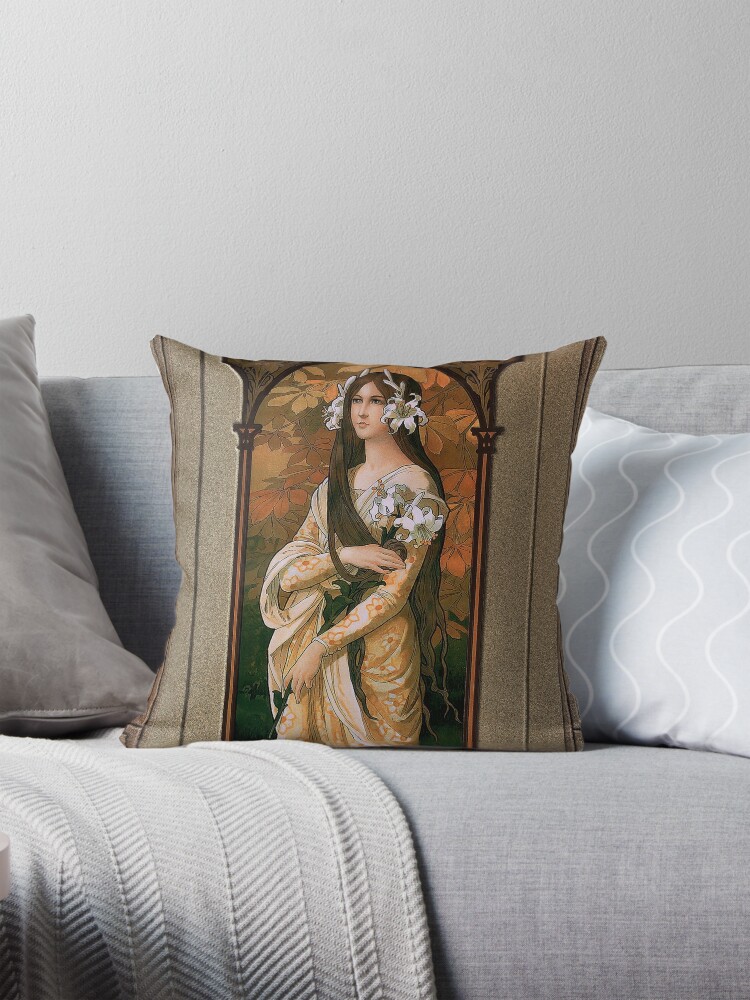
The central figure of the painting is a young woman dressed in an opulent yellow gown adorned with soft floral patterns. Her long brown hair cascades past her shoulders, entwined with white lilies that give her a pure and almost mystical appearance. She stands in a calm, poised stance with a swan at her feet, symbolizing the innocence and grace attributed to both the bird and the figure she represents. The soft rendering of her face, with an expression of contemplation, invites the viewer to ponder her thoughts while gazing upon the tranquil setting that surrounds her.
Obsah
Composition and Surroundings
The composition of the painting is characterized by a harmonious blend of the natural and the human, with the figure of the woman placed in a vertical format that emphasizes the elongated style of the subject. She is situated against a lush, verdant background, where delicate autumn leaves in shades of orange, zlato, and green suggest the time of year and create a backdrop that contrasts beautifully with the pale, luminous gown she wears. The subtle inclusion of the swan further elevates the symbolic aspect of the work, as swans are traditionally linked with themes of purity, nevinnost, a krásu, reinforcing the title of the piece.
The swan, which rests at the woman’s feet, seems to mirror her own graceful posture. Its neck curves delicately, almost as if echoing the lines of her figure. This visual connection between the human and the bird further deepens the symbolism of the painting, suggesting a harmonious relationship between humanity and nature. The swan’s white feathers reflect the woman’s innocence, offering a serene presence that balances the vibrancy of the autumn leaves in the background.
Color Palette and Technique
Sonrel’s use of color is one of the most striking aspects of the painting. The soft pastel tones of the yellow gown are balanced by the earthier tones of the foliage behind the figure, creating a warm and inviting ambiance. The yellows, zlata, and subtle greens of the dress blend with the oranges and reds of the autumn leaves, evoking a sense of calm serenity that is further reflected in the softness of the background. The subdued hues work together to draw attention to the figure of the woman, allowing her to remain the focal point of the piece.
The technique employed by Sonrel showcases her skill in using soft brushstrokes and a gentle application of light and shadow. Štětcem, though precise, retains an air of fluidity that enhances the overall delicacy of the scene. There is an almost translucent quality to the woman’s skin, suggesting her ethereal nature, while the details in the gown, květiny, and leaves are rendered with a subtle yet deliberate attention to texture and form. This blending of realism with a dreamy, almost otherworldly quality is characteristic of Sonrel’s approach to painting.
Symbolism and Meaning
The swan in “The Innocent Swan” is not just a decorative element, but rather a powerful symbol. In various cultures, the swan is associated with purity, transformace, a božské. V řecké mytologii, například, swans were often connected to gods and goddesses, embodying both grace and the higher realms of beauty. Zde, the swan’s purity is reflected in the figure of the young woman, who is portrayed with an expression of innocence and calm. The lily flowers, which intertwine with her hair, further reinforce this symbolism of purity and innocence.
The combination of the woman’s serene posture, the swan’s graceful presence, and the natural elements around them creates a timeless scene of tranquility, emphasizing the connection between humanity and nature. The autumnal setting could be seen as a representation of the fleeting nature of innocence and beauty, reminding the viewer of the transient moments in life. The gentle curve of the woman’s figure and the soft tones of the piece give the painting a nostalgic quality, evoking a sense of longing for a simpler, purer time.
Style and Artistic Influence
“The Innocent Swan” is a prime example of the Symbolist style, which was marked by an emphasis on emotions, the imagination, and an exploration of the mystical and metaphysical realms. Sonrel’s work is deeply embedded in this tradition, capturing moments that evoke a sense of reverie and contemplation. Jemné linie, pozornost k detailům, and use of symbolic imagery also tie her work to the Art Nouveau movement, which was flourishing in France during her time. The floral motifs, tekoucí čáry, and organic forms in the painting align it with the decorative and ornamental elements that defined Art Nouveau.
In terms of mood, the painting exudes a quiet, peaceful atmosphere, filled with an air of timeless grace. The subject’s expression, the soft light, and the harmonious relationship between the figure and the swan all contribute to a sense of calm and purity. It is a work that encourages the viewer to pause, to appreciate the subtle beauty of the scene, and to reflect on the deeper symbolism that lies beneath the surface.
Závěr
v “The Innocent Swan (Le Cygne; Nevinnost),” Élisabeth Sonrel captures the delicate beauty of innocence through the portrayal of a young woman in a serene, dreamlike setting. The careful composition, combined with the symbolic imagery of the swan and the soft palette, creates a work that is both visually captivating and emotionally resonant. Through her meticulous rendering of natural forms and the symbolic interplay between the human and the animal, Sonrel invites the viewer into a world of tranquil reverie, where innocence, čistota, and beauty are forever preserved in time.
The Innocent Swan (Le Cygne; Nevinnost) od francouzského malíře Elisabeth Sonrel (1874 – 1953); a ilustrátor secesního stylu; kdo pracoval, zahrnoval alegorické předměty, mystika a symbolika, portréty a krajiny.
The Innocent Swan is a retouched digital art old masters reproduction of a public domain image.
Tato digitální umělecká tvorba, stejně jako všechna umělecká díla, která lze nalézt na webu Xzendor7, je k dispozici ke koupi online v různých materiálových formátech včetně tisků na plátno, akrylové tisky, kovové potisky, otisky dřeva, zarámované tisky, plakáty, a jako rolované obrazy na plátně v různých velikostech od 12 palce až 72 palce v závislosti na velikosti skutečného uměleckého díla a obchodu s tiskem na vyžádání, ve kterém se rozhodnete umění koupit.
Umělecká díla jsou k dispozici také na široké škále pánského a dámského oblečení, hrnky, totes, šátky, sešity a deníky a mnoho produktů pro domácí dekoraci.
Životopis umělce
Informace níže S laskavým svolením Wikipedia.org
Elizabeth Sonrel (1874 Prohlídky – 1953 těsnění) byl francouzský malíř a ilustrátor v secesním stylu. Její díla zahrnovala alegorické náměty, mystika a symbolika, portréty a krajiny.
Byla dcerou Nicolase Stéphane Sonrel, malíř z Tours, a získala od něj rané školení. Pro další studium odešla do Paříže jako studentka Julese Lefebvrea na Ecole des Beaux-Arts..
v 1892 namalovala svou diplomovou práci, "Pax et Labor", dílo k vidění v Museum of Fine Arts of Tours. Od té doby vystavovala na Salon des Artistes Français mezi 1893 a 1941, její podpisové kusy jsou velké akvarely v prerafaelském způsobu, kterou přijala po cestě do Florencie a Říma, objevování renesančních malířů – některé její práce mají jasné podtexty Botticelliho. Její obrazy byly často inspirovány artušovskou romantikou, Božská komedie Danteho Alighieriho’ a "Nový život", biblická témata, a středověké legendy. Mezi její mystická díla patří ‚Ames errantes’ (Salon of 1894) a „Duchové propasti“.’ (Salon of 1899) a ‚Mladá žena s gobelínem‘.
Na výstavě Universelle of 1900, jehož hlavním tématem byla secese, její 1895 obraz „Spánek Panny“.’ (Spánek Panny), byl oceněn bronzovou medailí, a cenu Henriho Lehmanna 3000 franků Akademií výtvarných umění.[3] Z 1900 dále se omezila ve své malbě na portréty, malebné bretaňské krajiny, a příležitostné květinové studium.
Pravidelně podnikala malířské cesty do Bretaně, inspirované lesem Brocéliande, a od 1910 na různá místa na pobřeží, jako je Concarneau, Plougastel, Pont-l'Abbé a Loctudy, často pobývají v hostincích a v doprovodu jednoho nebo dvou studentů. Namalovala několik děl v Le Faouët, než postavila vilu v La Baule ve třicátých letech 20.. Pracuje hlavně v akvarelu a kvaši, objevila připravenou zásobu modelek mezi mladými dívkami v okolí, a shledal, že Bretonci jsou obecně přátelští, upřímný a sebevědomý.
Její poslední výstava v Salonu byla in 1941 ve věku 67. Existuje také záznam, že vystavovala v Liverpoolu. V jejích raných létech Sonrel produkoval plakáty, pohlednice a ilustrace, v secesním stylu.