

Der unschuldige Schwan (Der Schwan; Unschuld)
“Der unschuldige Schwan (Der Schwan; Unschuld)” is a remarkable work created by Elisabeth Sonrel (1874 – 1953), im 1905, encapsulating the graceful and serene qualities associated with the Symbolist movement that defined much of the late 19th and early 20th centuries. Geboren in 1874 und vergeht in 1953, Sonrel was a French artist whose works often blended the ethereal and the earthly, producing dreamlike scenes that were deeply influenced by mythology and the natural world. This specific piece, infused with both tranquility and delicate beauty, perfectly exemplifies Sonrel’s ability to combine the elegance of natural forms with symbolic richness.
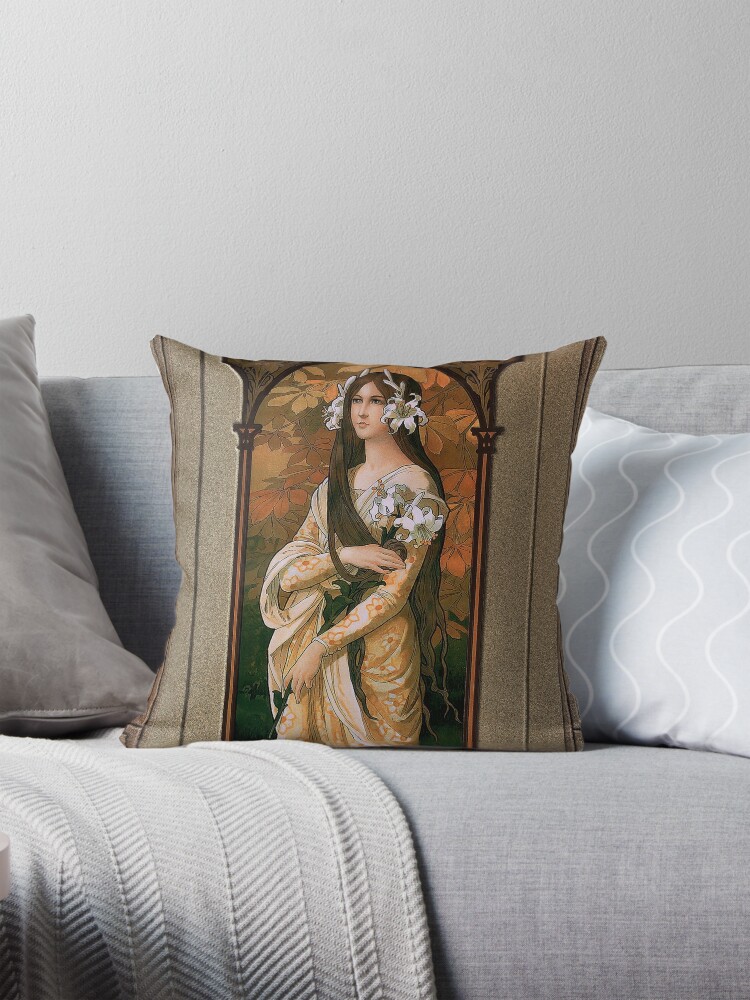
The central figure of the painting is a young woman dressed in an opulent yellow gown adorned with soft floral patterns. Her long brown hair cascades past her shoulders, entwined with white lilies that give her a pure and almost mystical appearance. She stands in a calm, poised stance with a swan at her feet, symbolizing the innocence and grace attributed to both the bird and the figure she represents. The soft rendering of her face, with an expression of contemplation, invites the viewer to ponder her thoughts while gazing upon the tranquil setting that surrounds her.
Inhaltsverzeichnis
Composition and Surroundings
The composition of the painting is characterized by a harmonious blend of the natural and the human, with the figure of the woman placed in a vertical format that emphasizes the elongated style of the subject. She is situated against a lush, verdant background, where delicate autumn leaves in shades of orange, Gold, and green suggest the time of year and create a backdrop that contrasts beautifully with the pale, luminous gown she wears. The subtle inclusion of the swan further elevates the symbolic aspect of the work, as swans are traditionally linked with themes of purity, Unschuld, und Schönheit, reinforcing the title of the piece.
The swan, which rests at the woman’s feet, seems to mirror her own graceful posture. Its neck curves delicately, almost as if echoing the lines of her figure. This visual connection between the human and the bird further deepens the symbolism of the painting, suggesting a harmonious relationship between humanity and nature. The swan’s white feathers reflect the woman’s innocence, offering a serene presence that balances the vibrancy of the autumn leaves in the background.
Color Palette and Technique
Sonrel’s use of color is one of the most striking aspects of the painting. The soft pastel tones of the yellow gown are balanced by the earthier tones of the foliage behind the figure, creating a warm and inviting ambiance. The yellows, Gold, and subtle greens of the dress blend with the oranges and reds of the autumn leaves, evoking a sense of calm serenity that is further reflected in the softness of the background. The subdued hues work together to draw attention to the figure of the woman, allowing her to remain the focal point of the piece.
The technique employed by Sonrel showcases her skill in using soft brushstrokes and a gentle application of light and shadow. Die Pinselführung, though precise, retains an air of fluidity that enhances the overall delicacy of the scene. There is an almost translucent quality to the woman’s skin, suggesting her ethereal nature, while the details in the gown, Blumen, and leaves are rendered with a subtle yet deliberate attention to texture and form. This blending of realism with a dreamy, almost otherworldly quality is characteristic of Sonrel’s approach to painting.
Symbolism and Meaning
The swan in “Der unschuldige Schwan” is not just a decorative element, but rather a powerful symbol. In various cultures, the swan is associated with purity, Transformation, und das Göttliche. In der griechischen Mythologie, beispielsweise, swans were often connected to gods and goddesses, embodying both grace and the higher realms of beauty. Hier, the swan’s purity is reflected in the figure of the young woman, who is portrayed with an expression of innocence and calm. The lily flowers, which intertwine with her hair, further reinforce this symbolism of purity and innocence.
The combination of the woman’s serene posture, the swan’s graceful presence, and the natural elements around them creates a timeless scene of tranquility, emphasizing the connection between humanity and nature. The autumnal setting could be seen as a representation of the fleeting nature of innocence and beauty, reminding the viewer of the transient moments in life. The gentle curve of the woman’s figure and the soft tones of the piece give the painting a nostalgic quality, evoking a sense of longing for a simpler, purer time.
Stil und künstlerischer Einfluss
“Der unschuldige Schwan” is a prime example of the Symbolist style, which was marked by an emphasis on emotions, the imagination, and an exploration of the mystical and metaphysical realms. Sonrel’s work is deeply embedded in this tradition, capturing moments that evoke a sense of reverie and contemplation. The fine lines, Liebe zum Detail, and use of symbolic imagery also tie her work to the Art Nouveau movement, which was flourishing in France during her time. The floral motifs, fließende Linien, and organic forms in the painting align it with the decorative and ornamental elements that defined Art Nouveau.
In terms of mood, the painting exudes a quiet, peaceful atmosphere, filled with an air of timeless grace. The subject’s expression, the soft light, and the harmonious relationship between the figure and the swan all contribute to a sense of calm and purity. It is a work that encourages the viewer to pause, to appreciate the subtle beauty of the scene, and to reflect on the deeper symbolism that lies beneath the surface.
Abschluss
Im “Der unschuldige Schwan (Der Schwan; Unschuld),” Élisabeth Sonrel captures the delicate beauty of innocence through the portrayal of a young woman in a serene, dreamlike setting. The careful composition, combined with the symbolic imagery of the swan and the soft palette, creates a work that is both visually captivating and emotionally resonant. Through her meticulous rendering of natural forms and the symbolic interplay between the human and the animal, Sonrel invites the viewer into a world of tranquil reverie, where innocence, Reinheit, and beauty are forever preserved in time.
Der unschuldige Schwan (Der Schwan; Unschuld) von französischer Maler Elisabeth Sonrel (1874 – 1953); und Illustrator des Jugendstils; Zu seinen Werken gehörten allegorische Themen, Mystik und Symbolik, Porträts und Landschaften.
The Innocent Swan is a retouched digital art old masters reproduction of a public domain image.
Diese digitale Kunstschöpfung, Wie alle Kunstwerke, die auf der Xzendor7-Website zu finden sind, können sie online in einer Vielzahl von Materialformaten einschließlich Leinwanddrucken erworben werden, Acryldrucke, Metalldrucke, Holzdrucke, gerahmte Drucke, Plakate, und als gerollte Leinwanddrucke in verschiedenen Größen von 12 Zoll zu 72 Zoll, abhängig von der Größe des tatsächlichen Kunstwerks und dem Print-on-Demand-Shop, in dem Sie das Kunstwerk kaufen möchten.
Das Kunstwerk ist auch auf einer breiten Palette von Herren- und Damenbekleidung erhältlich, Tassen, Tragetaschen, Schals, Notizbücher und Tagebücher sowie viele Heimdekorationsprodukte.
Biografie des Künstlers
Info unten mit freundlicher Genehmigung Wikipedia.org
Elisabeth Sonrel (1874 Touren – 1953 Dichtungen) war ein französischer Maler und Illustrator im Jugendstil. Ihre Werke umfassten allegorische Themen, Mystik und Symbolik, Porträts und Landschaften.
Sie war die Tochter von Nicolas Stéphane Sonrel, ein Maler aus Tours, und erhielt ihre frühe Ausbildung von ihm. Für weitere Studien ging sie als Schülerin von Jules Lefebvre an der Ecole des Beaux-Arts nach Paris.
Im 1892 sie hat ihre Diplomarbeit gemalt, „Pax und Arbeit“, ein Werk, das im Musée des Beaux-Arts de Tours zu sehen ist. Von da an stellte sie im Salon des Artistes Français zwischen 1893 und 1941, ihre charakteristischen Stücke sind große Aquarelle in präraffaelitischer Manier, die sie nach einer Reise nach Florenz und Rom adoptiert hat, die Renaissance-Maler entdecken – einige ihrer Arbeiten haben deutliche Obertöne von Botticelli. Ihre Gemälde wurden oft von der Artus-Romanze inspiriert, Dante Alighieris Göttliche Komödie’ und „Das neue Leben“, biblische Themen, und mittelalterliche Legenden. Zu ihren mystischen Werken gehören „Ames errantes“’ (Salon von 1894) und „Geister des Abgrunds“’ (Salon von 1899) und "Junge Frau mit dem Wandteppich".
Auf der Weltausstellung von 1900, das Hauptthema war Jugendstil, Sie 1895 Gemälde „Der Schlaf der Jungfrau“’ (Schlaf der Jungfrau), wurde mit einer Bronzemedaille ausgezeichnet, und den Henri-Lehmann-Preis von 3000 Franken von der Akademie der Schönen Künste.[3] Von 1900 von da an beschränkte sie ihre Malerei auf Porträts, malerische Landschaften der Bretagne, und die gelegentliche Blumenstudie.
Sie unternahm regelmäßige Malreisen in die Bretagne, inspiriert vom Wald von Brocéliande, und von 1910 zu verschiedenen Orten an der Küste wie Concarneau, Plougastel, Pont-l'Abbé und Loctudy, oft in Gasthäusern übernachten und von ein oder zwei Studenten begleitet. Sie malte mehrere Werke in Le Faouët, bevor sie in den 1930er Jahren eine Villa in La Baule baute. Arbeiten hauptsächlich in Aquarell und Gouache, sie entdeckte unter jungen Mädchen in der Gegend einen großen Vorrat an Models, und fand Bretonen im Allgemeinen freundlich, ehrlich und selbstbewusst.
Ihre letzte Ausstellung im Salon war in 1941 im Alter von 67. Es gibt auch eine Aufzeichnung darüber, dass sie in Liverpool ausgestellt hat. In ihren frühen Jahren produzierte Sonrel Poster, Postkarten und Illustrationen, im Jugendstil.