

The Innocent Swan (Le Cygne; Senkulpeco)
“The Innocent Swan (Le Cygne; Senkulpeco)” is a remarkable work created by Elisabeth Sonrel (1874 – 1953), en 1905, encapsulating the graceful and serene qualities associated with the Symbolist movement that defined much of the late 19th and early 20th centuries. Naskita en 1874 kaj forpasante en 1953, Sonrel was a French artist whose works often blended the ethereal and the earthly, producing dreamlike scenes that were deeply influenced by mythology and the natural world. This specific piece, infused with both tranquility and delicate beauty, perfectly exemplifies Sonrel’s ability to combine the elegance of natural forms with symbolic richness.
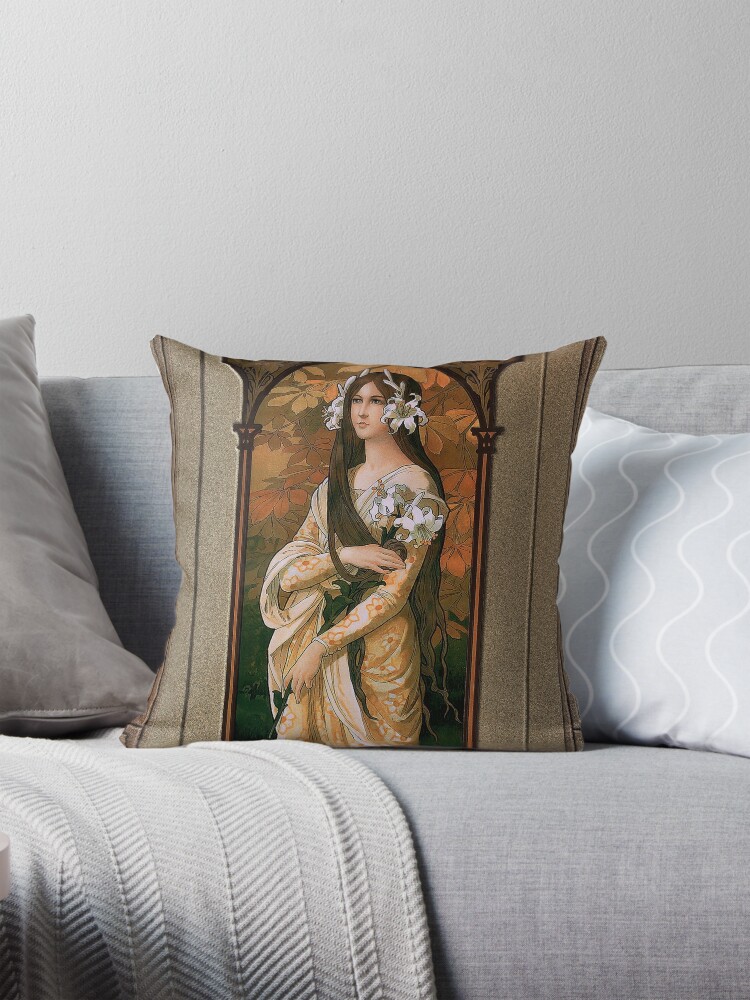
The central figure of the painting is a young woman dressed in an opulent yellow gown adorned with soft floral patterns. Her long brown hair cascades past her shoulders, entwined with white lilies that give her a pure and almost mystical appearance. She stands in a calm, poised stance with a swan at her feet, symbolizing the innocence and grace attributed to both the bird and the figure she represents. The soft rendering of her face, with an expression of contemplation, invites the viewer to ponder her thoughts while gazing upon the tranquil setting that surrounds her.
Enhavtabelo
Composition and Surroundings
The composition of the painting is characterized by a harmonious blend of the natural and the human, with the figure of the woman placed in a vertical format that emphasizes the elongated style of the subject. She is situated against a lush, verdant background, where delicate autumn leaves in shades of orange, oro, and green suggest the time of year and create a backdrop that contrasts beautifully with the pale, luminous gown she wears. The subtle inclusion of the swan further elevates the symbolic aspect of the work, as swans are traditionally linked with themes of purity, Senkulpeco, kaj beleco, reinforcing the title of the piece.
The swan, which rests at the woman’s feet, seems to mirror her own graceful posture. Its neck curves delicately, almost as if echoing the lines of her figure. This visual connection between the human and the bird further deepens the symbolism of the painting, suggesting a harmonious relationship between humanity and nature. The swan’s white feathers reflect the woman’s innocence, offering a serene presence that balances the vibrancy of the autumn leaves in the background.
Color Palette and Technique
Sonrel’s use of color is one of the most striking aspects of the painting. The soft pastel tones of the yellow gown are balanced by the earthier tones of the foliage behind the figure, creating a warm and inviting ambiance. The yellows, oroj, and subtle greens of the dress blend with the oranges and reds of the autumn leaves, evoking a sense of calm serenity that is further reflected in the softness of the background. The subdued hues work together to draw attention to the figure of the woman, allowing her to remain the focal point of the piece.
The technique employed by Sonrel showcases her skill in using soft brushstrokes and a gentle application of light and shadow. La peniko, kvankam preciza, retains an air of fluidity that enhances the overall delicacy of the scene. There is an almost translucent quality to the woman’s skin, suggesting her ethereal nature, while the details in the gown, floroj, and leaves are rendered with a subtle yet deliberate attention to texture and form. This blending of realism with a dreamy, almost otherworldly quality is characteristic of Sonrel’s approach to painting.
Symbolism and Meaning
The swan in “The Innocent Swan” is not just a decorative element, but rather a powerful symbol. In various cultures, the swan is associated with purity, transformo, kaj la dia. In Greek mythology, ekzemple, swans were often connected to gods and goddesses, embodying both grace and the higher realms of beauty. Jen, the swan’s purity is reflected in the figure of the young woman, who is portrayed with an expression of innocence and calm. The lily flowers, which intertwine with her hair, further reinforce this symbolism of purity and innocence.
The combination of the woman’s serene posture, the swan’s graceful presence, and the natural elements around them creates a timeless scene of tranquility, emphasizing the connection between humanity and nature. The autumnal setting could be seen as a representation of the fleeting nature of innocence and beauty, reminding the viewer of the transient moments in life. The gentle curve of the woman’s figure and the soft tones of the piece give the painting a nostalgic quality, evoking a sense of longing for a simpler, purer time.
Style and Artistic Influence
“The Innocent Swan” is a prime example of the Symbolist style, which was marked by an emphasis on emotions, the imagination, and an exploration of the mystical and metaphysical realms. Sonrel’s work is deeply embedded in this tradition, capturing moments that evoke a sense of reverie and contemplation. The fine lines, atento al detaloj, and use of symbolic imagery also tie her work to the Art Nouveau movement, which was flourishing in France during her time. The floral motifs, fluantaj linioj, and organic forms in the painting align it with the decorative and ornamental elements that defined Art Nouveau.
In terms of mood, the painting exudes a quiet, paca etoso, filled with an air of timeless grace. The subject’s expression, the soft light, and the harmonious relationship between the figure and the swan all contribute to a sense of calm and purity. It is a work that encourages the viewer to pause, to appreciate the subtle beauty of the scene, and to reflect on the deeper symbolism that lies beneath the surface.
Konkludo
En “The Innocent Swan (Le Cygne; Senkulpeco),” Élisabeth Sonrel captures the delicate beauty of innocence through the portrayal of a young woman in a serene, dreamlike setting. The careful composition, combined with the symbolic imagery of the swan and the soft palette, creates a work that is both visually captivating and emotionally resonant. Through her meticulous rendering of natural forms and the symbolic interplay between the human and the animal, Sonrel invites the viewer into a world of tranquil reverie, where innocence, pureco, and beauty are forever preserved in time.
The Innocent Swan (Le Cygne; Senkulpeco) de Franca Pentristo Elisabeth Sonrel (1874 – 1953); kaj ilustristo de la art -nouveau -stilo; La verkoj de Who inkluzivis alegoriajn temojn, mistikismo kaj simbolismo, portretoj kaj pejzaĝoj.
The Innocent Swan is a retouched digital art old masters reproduction of a public domain image.
Ĉi tiu cifereca arta kreaĵo, kiel kun ĉiuj artaĵoj, kiuj troveblas en la retejo de Xzendor7, estas aĉetebla interrete en diversaj materialaj formatoj inkluzive de kanvasaj presaĵoj., akrilaj presaĵoj, metalaj presaĵoj, lignaj presaĵoj, enkadrigitaj presaĵoj, afiŝoj, kaj kiel rulitaj kanvasaj presaĵoj en diversaj grandecoj de 12 colojn al 72 coloj depende de la grandeco de la reala artaĵo kaj la presaĵo laŭpeta butiko, de kiu vi elektas aĉeti la arton.
La artaĵo ankaŭ haveblas sur larĝa gamo de vestaĵoj de viroj kaj virinoj, tasoj, totoj, koltukoj, kajeroj kaj ĵurnaloj kaj multaj hejmornamaj produktoj.
Artisto Bio
Informoj Sub Ĝentileco Vikipedio.org
Elisabeth Sonrel (1874 Turneoj - 1953 fokoj) estis franca pentristo kaj ilustristo en la Secesio-stilo. Ŝiaj verkoj inkludis alegoriajn temojn, mistikismo kaj simbolismo, portretoj kaj pejzaĝoj.
Ŝi estis la filino de Nicolas Stéphane Sonrel, pentristo el Tours, kaj ricevis ŝian fruan trejnadon de li. Por plua studo ŝi daŭriĝis al Parizo kiel studento de Jules Lefebvre ĉe la Ecole des Beaux-Arts..
En 1892 ŝi pentris sian diplomverkon, "Paco kaj laboro", verko vidota ĉe la Musée des Beaux-Arts de Tours. De tiam ŝi ekspoziciis ĉe la Salon des Artistes Français inter 1893 kaj 1941, ŝiaj signaturpecoj estante grandaj akvareloj en Antaŭrafaelita maniero, kiun ŝi adoptis post vojaĝo al Florenco kaj Romo, malkovrante la renesancan pentristojn – iuj el ŝia laboro havanta klarajn nuancojn de Botticelli. Ŝiaj pentraĵoj ofte estis inspiritaj per artura enamiĝo, La dia komedio de Dante Alighieri’ Kaj 'La Nova Vivo', bibliaj temoj, kaj mezepokaj legendoj. Ŝiaj mistikaj verkoj inkluzivas 'Ames eraras’ (Salono de 1894) kaj 'la spiritoj de la abismo’ (Salono de 1899) Kaj "Juna Virino Havas Tapiŝon".
Ĉe la Universala Ekspozicio de 1900, kies primara temo estis Secesio, ŝia 1895 Pentrante 'la dormon de la virgulino’ (Dormo de la Virgulino), ricevis bronzan medalon, kaj la Henri Lehmann-premio de 3000 Francanoj de la Akademio de Belartoj.[3] De 1900 pluen ŝi limigis sian pentraĵon al portretoj, pitoreskaj Bretoniaj pejzaĝoj, kaj la foja studo de floroj.
Ŝi faris regulajn pentrovojaĝojn al Bretonio, inspirite de la arbaro de Brocéliande, kaj de 1910 al diversaj lokoj sur la marbordo kiel ekzemple Concarneau, Plougastel, Pont-l´abbé kaj Lorudy, ofte loĝante en gastejoj kaj akompanate de unu aŭ du studentoj. Ŝi pentris plurajn verkojn en Le Faouët antaŭ konstruado de vilao en La Baule en la 1930-aj jaroj.. Laborante ĉefe en akvarelo kaj guaŝo, ŝi malkovris pretan provizon de modeloj inter junaj knabinoj en la areo, kaj trovis bretonojn ĝenerale amikemaj, honesta kaj memfida.
Ŝia fina ekspoziciaĵo ĉe la Salono estis en 1941 en la aĝo de 67. Ekzistas ankaŭ noto pri ŝi ekspoziciis en Liverpool. En ŝiaj fruaj jaroj Sonrel produktis afiŝojn, poŝtkartoj kaj ilustraĵoj, en Secesio-stilo.