

The Innocent Swan (An Eala; Neamhchiontacht)
“The Innocent Swan (An Eala; Neamhchiontacht)” is a remarkable work created by Elisabeth Sonrel (1874 – 1953), in 1905, encapsulating the graceful and serene qualities associated with the Symbolist movement that defined much of the late 19th and early 20th centuries. Rugadh i 1874 agus bás i 1953, Sonrel was a French artist whose works often blended the ethereal and the earthly, producing dreamlike scenes that were deeply influenced by mythology and the natural world. This specific piece, infused with both tranquility and delicate beauty, perfectly exemplifies Sonrel’s ability to combine the elegance of natural forms with symbolic richness.
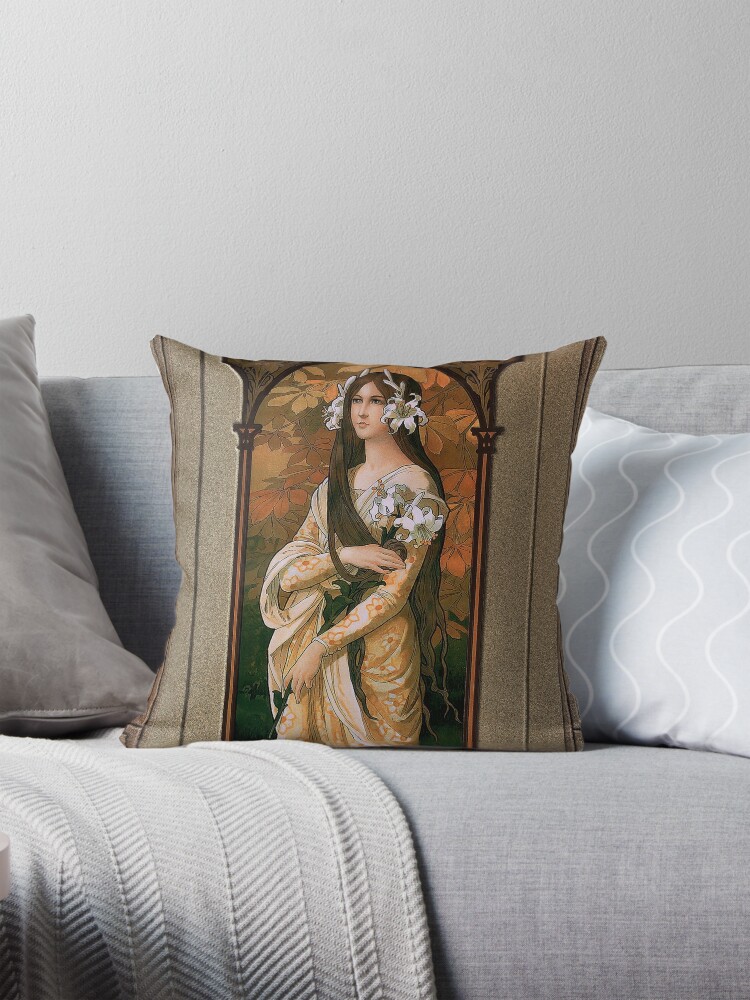
The central figure of the painting is a young woman dressed in an opulent yellow gown adorned with soft floral patterns. Her long brown hair cascades past her shoulders, entwined with white lilies that give her a pure and almost mystical appearance. She stands in a calm, poised stance with a swan at her feet, symbolizing the innocence and grace attributed to both the bird and the figure she represents. The soft rendering of her face, with an expression of contemplation, invites the viewer to ponder her thoughts while gazing upon the tranquil setting that surrounds her.
Clár na nÁbhar
Composition and Surroundings
The composition of the painting is characterized by a harmonious blend of the natural and the human, with the figure of the woman placed in a vertical format that emphasizes the elongated style of the subject. She is situated against a lush, verdant background, where delicate autumn leaves in shades of orange, ór, and green suggest the time of year and create a backdrop that contrasts beautifully with the pale, luminous gown she wears. The subtle inclusion of the swan further elevates the symbolic aspect of the work, as swans are traditionally linked with themes of purity, innocence, and beauty, reinforcing the title of the piece.
The swan, which rests at the woman’s feet, seems to mirror her own graceful posture. Its neck curves delicately, almost as if echoing the lines of her figure. This visual connection between the human and the bird further deepens the symbolism of the painting, suggesting a harmonious relationship between humanity and nature. The swan’s white feathers reflect the woman’s innocence, offering a serene presence that balances the vibrancy of the autumn leaves in the background.
Color Palette and Technique
Sonrel’s use of color is one of the most striking aspects of the painting. The soft pastel tones of the yellow gown are balanced by the earthier tones of the foliage behind the figure, creating a warm and inviting ambiance. The yellows, óir, and subtle greens of the dress blend with the oranges and reds of the autumn leaves, evoking a sense of calm serenity that is further reflected in the softness of the background. The subdued hues work together to draw attention to the figure of the woman, allowing her to remain the focal point of the piece.
The technique employed by Sonrel showcases her skill in using soft brushstrokes and a gentle application of light and shadow. An scuab-obair, though precise, retains an air of fluidity that enhances the overall delicacy of the scene. There is an almost translucent quality to the woman’s skin, suggesting her ethereal nature, while the details in the gown, bláthanna, and leaves are rendered with a subtle yet deliberate attention to texture and form. This blending of realism with a dreamy, almost otherworldly quality is characteristic of Sonrel’s approach to painting.
Symbolism and Meaning
The swan in “The Innocent Swan” is not just a decorative element, but rather a powerful symbol. In various cultures, the swan is associated with purity, transformation, agus an diaga. In Greek mythology, mar shampla, swans were often connected to gods and goddesses, embodying both grace and the higher realms of beauty. Anseo, the swan’s purity is reflected in the figure of the young woman, who is portrayed with an expression of innocence and calm. The lily flowers, which intertwine with her hair, further reinforce this symbolism of purity and innocence.
The combination of the woman’s serene posture, the swan’s graceful presence, and the natural elements around them creates a timeless scene of tranquility, emphasizing the connection between humanity and nature. The autumnal setting could be seen as a representation of the fleeting nature of innocence and beauty, reminding the viewer of the transient moments in life. The gentle curve of the woman’s figure and the soft tones of the piece give the painting a nostalgic quality, evoking a sense of longing for a simpler, purer time.
Style and Artistic Influence
“The Innocent Swan” is a prime example of the Symbolist style, which was marked by an emphasis on emotions, the imagination, and an exploration of the mystical and metaphysical realms. Sonrel’s work is deeply embedded in this tradition, capturing moments that evoke a sense of reverie and contemplation. The fine lines, aird ar mhionsonraí, and use of symbolic imagery also tie her work to the Art Nouveau movement, which was flourishing in France during her time. The floral motifs, línte ag sileadh, and organic forms in the painting align it with the decorative and ornamental elements that defined Art Nouveau.
In terms of mood, the painting exudes a quiet, atmaisféar suaimhneach, filled with an air of timeless grace. The subject’s expression, the soft light, and the harmonious relationship between the figure and the swan all contribute to a sense of calm and purity. It is a work that encourages the viewer to pause, to appreciate the subtle beauty of the scene, and to reflect on the deeper symbolism that lies beneath the surface.
Conclúid
I “The Innocent Swan (An Eala; Neamhchiontacht),” Élisabeth Sonrel captures the delicate beauty of innocence through the portrayal of a young woman in a serene, dreamlike setting. The careful composition, combined with the symbolic imagery of the swan and the soft palette, creates a work that is both visually captivating and emotionally resonant. Through her meticulous rendering of natural forms and the symbolic interplay between the human and the animal, Sonrel invites the viewer into a world of tranquil reverie, where innocence, purity, and beauty are forever preserved in time.
The Innocent Swan (An Eala; Neamhchiontacht) le Péintéir Francach Elisabeth Sonrel (1874 – 1953); agus maisitheoir ar stíl Art Nouveau; I measc na saothar a bhí aige bhí ábhair chomhréireacha, misteachas agus siombalachas, portráidí agus tírdhreacha.
Is é atá san Innocent Swan ná seanmháistrí ealaíne digiteacha atá á n-atáirgeadh ar íomhá fearainn phoiblí.
Cruthú ealaíne digiteach seo, mar atá an saothar ealaíne go léir atá le fáil ar shuíomh Gréasáin Xzendor7 ar fáil le ceannach ar líne i bhformáidí éagsúla ábhar lena n-áirítear priontaí canbháis, priontaí aicrileach, priontaí miotail, priontaí adhmaid, priontaí frámaithe, póstaeir, agus mar phriontaí chanbhás rollta i méideanna éagsúla ó 12 orlach go 72 orlach ag brath ar mhéid an tsaothair ealaíne iarbhír agus ar an siopa priontála ar éileamh a roghnaíonn tú an ealaín a cheannach uaidh.
Tá an saothar ealaíne ar fáil freisin ar raon leathan éadaí fear agus ban, mugaí, totes, scaifeanna, leabhair nótaí agus irisleabhair agus go leor táirgí maisiúcháin tí.
Beathaisnéis Ealaíontóir
Eolas Thíos Cúirtéis Wikipedia.org
Elisabeth Sonrel (1874 Turais - 1953 Séalaí) péintéir agus maisitheoir Francach i stíl Art Nouveau a bhí ann. I measc a cuid saothar bhí ábhair chomhréireacha, misteachas agus siombalachas, portráidí agus tírdhreacha.
Ba iníon í le Nicolas Stéphane Sonrel, péintéir ó Turais, agus fuair sí a luathoiliúint uaidh. Le haghaidh tuilleadh staidéir chuaigh sí ar aghaidh go Páras mar mhac léinn le Jules Lefebvre ag an Ecole des Beaux-Arts.
I 1892 phéinteáil sí a cuid oibre dioplóma, ‘Pax et Labour’, saothar le feiceáil ag an Musée des Beaux-Arts de Tours. As sin amach chuir sí taispeántas ag an Salon des Artistes Français idir 1893 agus 1941, uiscedhathanna móra a bhí ina píosaí sínithe ar bhealach Réamh-Raphaelite, a ghlac sí tar éis turas go Florence agus an Róimh, ag fáil amach péintéirí na hAthbheochana – cuid de a cuid oibre le huaireanta soiléire Botticelli. Ba mhinic a spreag a cuid pictiúr rómánsaíocht Airtéanach, Coiméide Dhiaga Dante Alighieri’ agus 'An Saol Nua', téamaí Bhíobla, agus finscéalta meánaoiseacha. I measc a cuid saothar mistéireach tá ‘Ames errantes’ (Salon de 1894) agus ‘Biotáille an Abyss’ (Salon de 1899) agus "Bean óg leis an taipéis".
Ag an Exposition Universelle de 1900, Art Nouveau an príomhthéama a bhí aige, léi 1895 ag péinteáil ‘Codladh na Maighdine’ (Codladh na Maighdine), bronnadh bonn cré-umha air, agus duais Henri Lehmann de 3000 franc le Acadamh na nEalaíon Mín.[3] Ó 1900 ar aghaidh chuir sí a péintéireacht teoranta do phortráidí, tírdhreacha áille sa Bhriotáin, agus an staidéar bláthanna ó am go chéile.
Thug sí turais phéintéireachta rialta go dtí an Bhriotáin, spreagtha ag foraois Brocéliande, agus ó 1910 chuig áiteanna éagsúla ar an gcósta mar Concarneau, Plougastel, Pont-l'Abbé agus Loctudy, go minic ag fanacht i dtithe ósta agus in éineacht le mac léinn nó dhó. Phéinteáil sí roinnt saothar i Le Faouët sular thóg sí Villa i La Baule sna 1930idí. Ag obair go príomha i uiscedhath agus gouache, fuair sí soláthar réidh samhlacha i measc cailíní óga an cheantair, agus fuair siad go raibh Bretons cairdiúil go ginearálta, macánta agus féinmhuiníneach.
Bhí a taispeántas deiridh ag an Salon i 1941 ag aois 67. Tá taifead ann freisin gur thaispeáin sí i Learpholl. Ina blianta tosaigh chuir Sonrel póstaeir ar fáil, cártaí poist agus léaráidí, i stíl Art Nouveau.