

Niewinny łabędź (Łabądź; Niewinność)
“Niewinny łabędź (Łabądź; Niewinność)” is a remarkable work created by Elisabeth Sonrel (1874 – 1953), w 1905, encapsulating the graceful and serene qualities associated with the Symbolist movement that defined much of the late 19th and early 20th centuries. Urodzony w 1874 i odejście w 1953, Sonrel was a French artist whose works often blended the ethereal and the earthly, producing dreamlike scenes that were deeply influenced by mythology and the natural world. This specific piece, infused with both tranquility and delicate beauty, perfectly exemplifies Sonrel’s ability to combine the elegance of natural forms with symbolic richness.
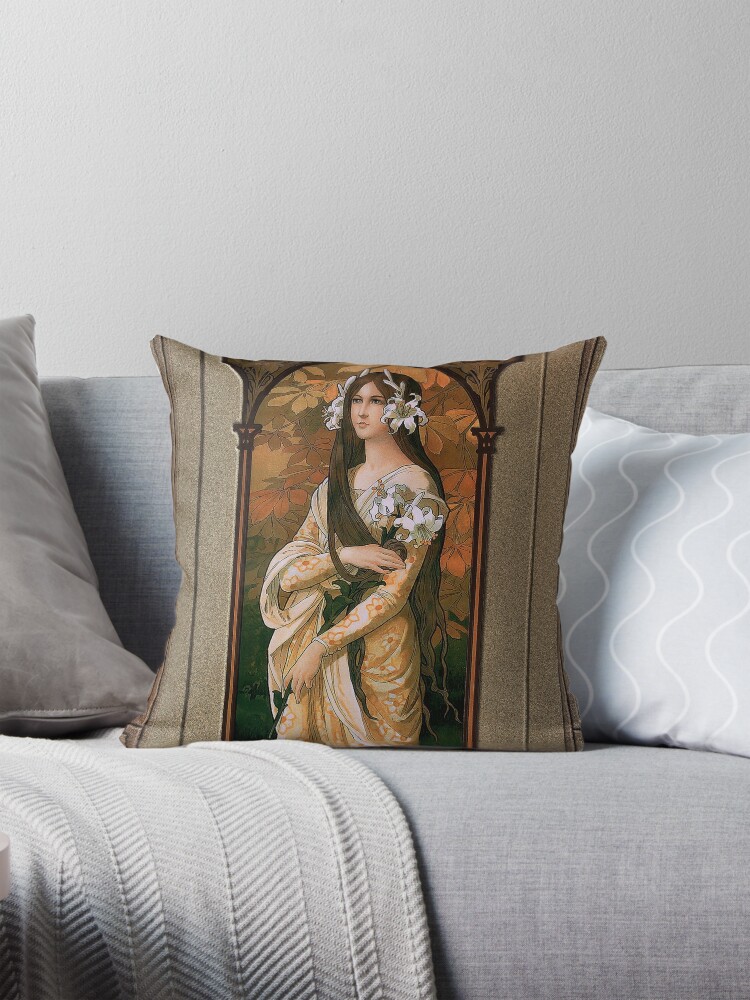
The central figure of the painting is a young woman dressed in an opulent yellow gown adorned with soft floral patterns. Her long brown hair cascades past her shoulders, entwined with white lilies that give her a pure and almost mystical appearance. She stands in a calm, poised stance with a swan at her feet, symbolizing the innocence and grace attributed to both the bird and the figure she represents. The soft rendering of her face, with an expression of contemplation, invites the viewer to ponder her thoughts while gazing upon the tranquil setting that surrounds her.
Spis treści
Composition and Surroundings
The composition of the painting is characterized by a harmonious blend of the natural and the human, with the figure of the woman placed in a vertical format that emphasizes the elongated style of the subject. She is situated against a lush, verdant background, where delicate autumn leaves in shades of orange, złoto, and green suggest the time of year and create a backdrop that contrasts beautifully with the pale, luminous gown she wears. The subtle inclusion of the swan further elevates the symbolic aspect of the work, as swans are traditionally linked with themes of purity, niewinność, i piękno, reinforcing the title of the piece.
The swan, which rests at the woman’s feet, seems to mirror her own graceful posture. Its neck curves delicately, almost as if echoing the lines of her figure. This visual connection between the human and the bird further deepens the symbolism of the painting, suggesting a harmonious relationship between humanity and nature. The swan’s white feathers reflect the woman’s innocence, offering a serene presence that balances the vibrancy of the autumn leaves in the background.
Color Palette and Technique
Sonrel’s use of color is one of the most striking aspects of the painting. The soft pastel tones of the yellow gown are balanced by the earthier tones of the foliage behind the figure, creating a warm and inviting ambiance. The yellows, złote, and subtle greens of the dress blend with the oranges and reds of the autumn leaves, evoking a sense of calm serenity that is further reflected in the softness of the background. The subdued hues work together to draw attention to the figure of the woman, allowing her to remain the focal point of the piece.
The technique employed by Sonrel showcases her skill in using soft brushstrokes and a gentle application of light and shadow. Praca pędzla, though precise, retains an air of fluidity that enhances the overall delicacy of the scene. There is an almost translucent quality to the woman’s skin, suggesting her ethereal nature, while the details in the gown, kwiaty, and leaves are rendered with a subtle yet deliberate attention to texture and form. This blending of realism with a dreamy, almost otherworldly quality is characteristic of Sonrel’s approach to painting.
Symbolism and Meaning
The swan in “Niewinny łabędź” is not just a decorative element, but rather a powerful symbol. In various cultures, the swan is associated with purity, transformacja, i boskie. W mitologii greckiej, na przykład, swans were often connected to gods and goddesses, embodying both grace and the higher realms of beauty. Tutaj, the swan’s purity is reflected in the figure of the young woman, who is portrayed with an expression of innocence and calm. The lily flowers, which intertwine with her hair, further reinforce this symbolism of purity and innocence.
The combination of the woman’s serene posture, the swan’s graceful presence, and the natural elements around them creates a timeless scene of tranquility, emphasizing the connection between humanity and nature. The autumnal setting could be seen as a representation of the fleeting nature of innocence and beauty, reminding the viewer of the transient moments in life. The gentle curve of the woman’s figure and the soft tones of the piece give the painting a nostalgic quality, evoking a sense of longing for a simpler, purer time.
Styl i wpływy artystyczne
“Niewinny łabędź” is a prime example of the Symbolist style, which was marked by an emphasis on emotions, the imagination, and an exploration of the mystical and metaphysical realms. Sonrel’s work is deeply embedded in this tradition, capturing moments that evoke a sense of reverie and contemplation. The fine lines, dbałość o szczegóły, and use of symbolic imagery also tie her work to the Art Nouveau movement, which was flourishing in France during her time. Motywy kwiatowe, płynne linie, and organic forms in the painting align it with the decorative and ornamental elements that defined Art Nouveau.
In terms of mood, the painting exudes a quiet, peaceful atmosphere, filled with an air of timeless grace. The subject’s expression, the soft light, and the harmonious relationship between the figure and the swan all contribute to a sense of calm and purity. It is a work that encourages the viewer to pause, to appreciate the subtle beauty of the scene, and to reflect on the deeper symbolism that lies beneath the surface.
Wniosek
W “Niewinny łabędź (Łabądź; Niewinność),” Élisabeth Sonrel captures the delicate beauty of innocence through the portrayal of a young woman in a serene, dreamlike setting. The careful composition, combined with the symbolic imagery of the swan and the soft palette, creates a work that is both visually captivating and emotionally resonant. Through her meticulous rendering of natural forms and the symbolic interplay between the human and the animal, Sonrel invites the viewer into a world of tranquil reverie, where innocence, czystość, and beauty are forever preserved in time.
Niewinny łabędź (Łabądź; Niewinność) przez francuskiego malarza Elisabeth Sonrel (1874 – 1953); i ilustrator stylu Art Nouveau; czyje prace zawierały tematy alegoryczne?, mistycyzm i symbolika, portrety i pejzaże.
Niewinny łabędź to wyretuszowana cyfrowa reprodukcja starych mistrzów obrazu z domeny publicznej.
To dzieło sztuki cyfrowej, podobnie jak wszystkie dzieła sztuki, które można znaleźć na stronie internetowej Xzendor7, można kupić online w różnych formatach materiałów, w tym odbitki na płótnie, wydruki akrylowe, metalowe nadruki, druki na drewnie, wydruki w ramkach, plakaty, oraz jako zwinięte wydruki na płótnie w różnych rozmiarach od 12 cale do 72 cale w zależności od rozmiaru rzeczywistej grafiki i sklepu z drukiem na żądanie, w którym zdecydujesz się kupić sztukę.
Grafika jest również dostępna na szerokiej gamie odzieży męskiej i damskiej, kubki, torby, szaliki, notesy i czasopisma oraz wiele produktów do dekoracji wnętrz.
Biografia artysty
Informacje poniżej dzięki uprzejmości Wikipedia.org
Elisabeth Sonrel (1874 Wycieczki – 1953 Uszczelki) był francuskim malarzem i ilustratorem w stylu Art Nouveau. Jej prace zawierały tematy alegoryczne, mistycyzm i symbolika, portrety i pejzaże.
Była córką Nicolasa Stéphane'a Sonrel, malarz z Tours, i otrzymała od niego wczesne szkolenie. Na dalsze studia wyjechała do Paryża jako uczennica Julesa Lefebvre'a w Ecole des Beaux-Arts.
W 1892 namalowała swoją pracę dyplomową, „Pax i praca”, dzieło do obejrzenia w Musée des Beaux-Arts de Tours. Od tego czasu wystawiała w Salon des Artistes Français między 1893 i 1941, jej charakterystyczne dzieła to duże akwarele w stylu prerafaelickim, którą adoptowała po podróży do Florencji i Rzymu, odkrywanie malarzy renesansowych – niektóre z jej prac mają wyraźny wydźwięk Botticellego. Jej obrazy były często inspirowane romansami arturiańskimi, Boska komedia Dantego Alighieri’ i „Nowe życie”, motywy biblijne, i średniowieczne legendy. Jej mistyczne prace to „Ames errantes”’ (Salon 1894) i „Duchy Otchłani”’ (Salon 1899) i „Młoda kobieta z gobelinem”.
Na Wystawie Universelle of 1900, której głównym tematem była secesja, ją 1895 obraz „Sen Dziewicy”’ (Sen Dziewicy), otrzymał brązowy medal, oraz nagrodę im. Henriego Lehmanna 3000 franków Akademii Sztuk Pięknych.[3] Od 1900 odtąd swoje malarstwo ograniczyła do portretów, malownicze krajobrazy Bretanii, i okazjonalne badanie kwiatów.
Regularnie odbywała malarskie wycieczki do Bretanii, inspirowany lasem Brocéliande, i od 1910 do różnych miejsc na wybrzeżu, takich jak Concarneau, Plougastel, Pont-l'Abbé i Loctudy, często przebywają w karczmach w towarzystwie jednego lub dwóch uczniów. Namalowała kilka prac w Le Faouet przed wybudowaniem willi w La Baule w latach 30. XX wieku. Pracuje głównie w akwareli i gwaszu, odkryła gotową dostawę modeli wśród młodych dziewcząt w okolicy, i ogólnie Bretonowie byli przyjaźni, szczery i pewny siebie.
Jej ostatnia wystawa w Salonie była in 1941 w wieku 67. Istnieje również zapis jej wystawiania w Liverpoolu. W młodości Sonrel produkowała plakaty, pocztówki i ilustracje, w stylu Art Nouveau.