

Den oskyldiga svanen (Svanen; Oskuld)
“Den oskyldiga svanen (Svanen; Oskuld)” is a remarkable work created by Elisabeth Sonrel (1874 – 1953), i 1905, encapsulating the graceful and serene qualities associated with the Symbolist movement that defined much of the late 19th and early 20th centuries. Född i 1874 och går bort i 1953, Sonrel was a French artist whose works often blended the ethereal and the earthly, producing dreamlike scenes that were deeply influenced by mythology and the natural world. This specific piece, infused with both tranquility and delicate beauty, perfectly exemplifies Sonrel’s ability to combine the elegance of natural forms with symbolic richness.
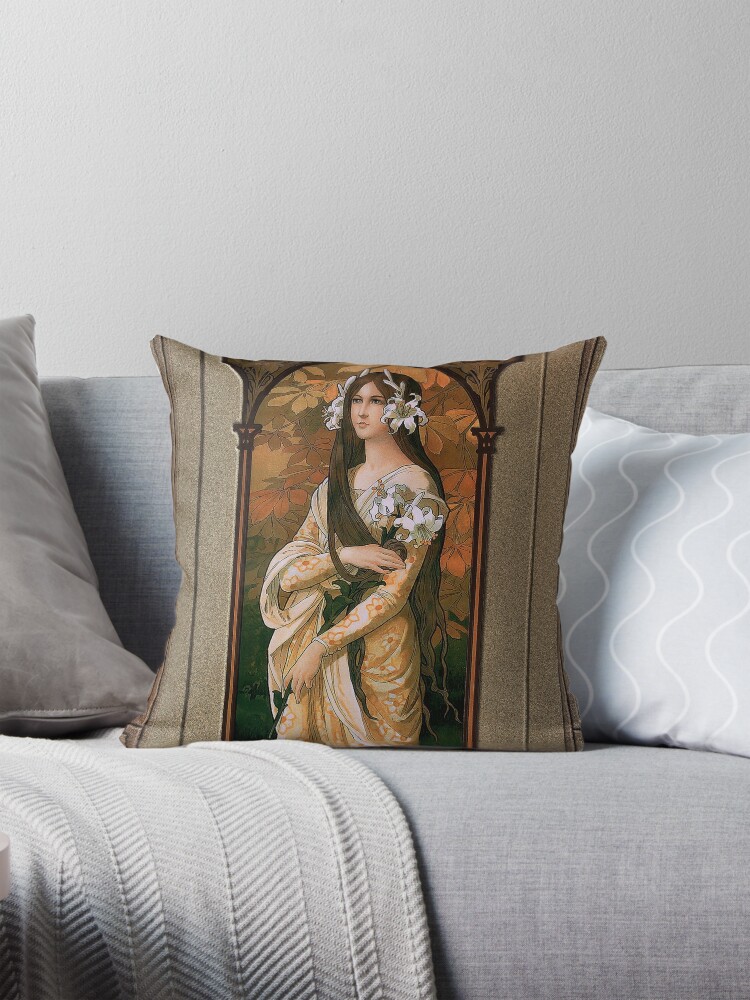
The central figure of the painting is a young woman dressed in an opulent yellow gown adorned with soft floral patterns. Her long brown hair cascades past her shoulders, entwined with white lilies that give her a pure and almost mystical appearance. She stands in a calm, poised stance with a swan at her feet, symbolizing the innocence and grace attributed to both the bird and the figure she represents. The soft rendering of her face, with an expression of contemplation, invites the viewer to ponder her thoughts while gazing upon the tranquil setting that surrounds her.
Innehållsförteckning
Composition and Surroundings
The composition of the painting is characterized by a harmonious blend of the natural and the human, with the figure of the woman placed in a vertical format that emphasizes the elongated style of the subject. She is situated against a lush, verdant background, where delicate autumn leaves in shades of orange, guld, and green suggest the time of year and create a backdrop that contrasts beautifully with the pale, luminous gown she wears. The subtle inclusion of the swan further elevates the symbolic aspect of the work, as swans are traditionally linked with themes of purity, oskuld, och skönhet, reinforcing the title of the piece.
The swan, which rests at the woman’s feet, seems to mirror her own graceful posture. Its neck curves delicately, almost as if echoing the lines of her figure. This visual connection between the human and the bird further deepens the symbolism of the painting, suggesting a harmonious relationship between humanity and nature. The swan’s white feathers reflect the woman’s innocence, offering a serene presence that balances the vibrancy of the autumn leaves in the background.
Color Palette and Technique
Sonrel’s use of color is one of the most striking aspects of the painting. The soft pastel tones of the yellow gown are balanced by the earthier tones of the foliage behind the figure, creating a warm and inviting ambiance. The yellows, guld, and subtle greens of the dress blend with the oranges and reds of the autumn leaves, evoking a sense of calm serenity that is further reflected in the softness of the background. The subdued hues work together to draw attention to the figure of the woman, allowing her to remain the focal point of the piece.
The technique employed by Sonrel showcases her skill in using soft brushstrokes and a gentle application of light and shadow. Borstverket, though precise, retains an air of fluidity that enhances the overall delicacy of the scene. There is an almost translucent quality to the woman’s skin, suggesting her ethereal nature, while the details in the gown, blommor, and leaves are rendered with a subtle yet deliberate attention to texture and form. This blending of realism with a dreamy, almost otherworldly quality is characteristic of Sonrel’s approach to painting.
Symbolism and Meaning
The swan in “Den oskyldiga svanen” är inte bara ett dekorativt element, but rather a powerful symbol. In various cultures, the swan is associated with purity, omvandling, and the divine. I grekisk mytologi, till exempel, swans were often connected to gods and goddesses, embodying both grace and the higher realms of beauty. Här, the swan’s purity is reflected in the figure of the young woman, who is portrayed with an expression of innocence and calm. The lily flowers, which intertwine with her hair, further reinforce this symbolism of purity and innocence.
The combination of the woman’s serene posture, the swan’s graceful presence, and the natural elements around them creates a timeless scene of tranquility, emphasizing the connection between humanity and nature. The autumnal setting could be seen as a representation of the fleeting nature of innocence and beauty, reminding the viewer of the transient moments in life. The gentle curve of the woman’s figure and the soft tones of the piece give the painting a nostalgic quality, evoking a sense of longing for a simpler, purer time.
Style and Artistic Influence
“Den oskyldiga svanen” is a prime example of the Symbolist style, which was marked by an emphasis on emotions, the imagination, and an exploration of the mystical and metaphysical realms. Sonrel’s work is deeply embedded in this tradition, capturing moments that evoke a sense of reverie and contemplation. De fina linjerna, uppmärksamhet på detaljer, and use of symbolic imagery also tie her work to the Art Nouveau movement, which was flourishing in France during her time. The floral motifs, flödande linjer, and organic forms in the painting align it with the decorative and ornamental elements that defined Art Nouveau.
In terms of mood, the painting exudes a quiet, peaceful atmosphere, filled with an air of timeless grace. The subject’s expression, the soft light, and the harmonious relationship between the figure and the swan all contribute to a sense of calm and purity. It is a work that encourages the viewer to pause, to appreciate the subtle beauty of the scene, and to reflect on the deeper symbolism that lies beneath the surface.
Slutsats
I “Den oskyldiga svanen (Svanen; Oskuld),” Élisabeth Sonrel captures the delicate beauty of innocence through the portrayal of a young woman in a serene, dreamlike setting. The careful composition, combined with the symbolic imagery of the swan and the soft palette, creates a work that is both visually captivating and emotionally resonant. Through her meticulous rendering of natural forms and the symbolic interplay between the human and the animal, Sonrel invites the viewer into a world of tranquil reverie, where innocence, renhet, and beauty are forever preserved in time.
Den oskyldiga svanen (Svanen; Oskuld) av franska målaren Elisabeth Sonrel (1874 – 1953); och illustratör av jugendstil; vars verk inkluderade allegoriska ämnen, mysticism och symbolism, porträtt och landskap.
The Innocent Swan is a retouched digital art old masters reproduction of a public domain image.
Detta digitala konstskapande, som med alla konstverk som kan hittas på Xzendor7-webbplatsen finns att köpa online i en mängd olika materialformat inklusive canvastavlor, akryltryck, metalltryck, trätryck, inramade tryck, affischer, och som rullade canvastryck i en mängd olika storlekar från 12 tum till 72 tum beroende på storleken på det faktiska konstverket och den print on demand-butik du väljer att köpa konsten från.
Konstverket är också tillgängligt på ett brett utbud av herr- och damkläder, muggar, väskor, halsdukar, anteckningsböcker och tidskrifter och många heminredningsprodukter.
Konstnärsbio
Info nedan med tillstånd Wikipedia.org
Elisabeth Sonrel (1874 Rundturer - 1953 Sälar) var en fransk målare och illustratör i jugendstil. Hennes verk inkluderade allegoriska ämnen, mysticism och symbolism, porträtt och landskap.
Hon var dotter till Nicolas Stéphane Sonrel, en målare från Tours, och fick hennes tidiga utbildning av honom. För vidare studier fortsatte hon till Paris som student vid Jules Lefebvre vid Ecole des Beaux-Arts.
I 1892 hon målade sitt diplomarbete, "Pax et Labor", ett verk att se på Musée des Beaux-Arts de Tours. Från och med då ställde hon ut på Salon des Artistes Français mellan 1893 och 1941, hennes signaturstycken är stora akvareller på ett pre-Raphaelite-sätt, som hon antog efter en resa till Florens och Rom, upptäcka renässansmålarna – några av hennes verk har tydliga övertoner av Botticelli. Hennes målningar inspirerades ofta av Arthurian romans, Dante Alighieris gudomliga komedi’ och "Det nya livet", bibliska teman, och medeltida legender. Hennes mystiska verk inkluderar "Ames errantes’ (Salong av 1894) och "Avgrundens andar’ (Salong av 1899) och "Ung kvinna med gobelängen".
Vid Exposition Universelle of 1900, vars huvudsakliga tema var jugendstil, henne 1895 målning "Jungfruns sömn’ (Jungfruens sömn), fick en bronsmedalj, och Henri Lehmann -priset av 3000 franc av The Academy of Fine Arts.[3] Från 1900 framåt begränsade hon sin målning till porträtt, natursköna Bretagne landskap, och en och annan blomsterstudie.
Hon gjorde regelbundna måleresor till Bretagne, inspirerad av skogen Brocéliande, och från 1910 till olika platser på kusten som Concarneau, Plougastel, Pont-l'Abbé och Loctudy, vistas ofta på värdshus och åtföljs av en eller två studenter. Hon målade flera verk i Le Faouët innan hon byggde en villa i La Baule på 1930 -talet. Arbetar främst i akvarell och gouache, hon upptäckte ett klart utbud av modeller bland unga tjejer i området, och tyckte att bretoner i allmänhet var vänliga, ärlig och självsäker.
Hennes sista utställning på salongen var i 1941 vid en ålder av 67. Det finns också ett register över att hon hade ställt ut i Liverpool. Under sina första år producerade Sonrel affischer, vykort och illustrationer, i jugendstil.