

De kus

De kus (De kus) c1859 door de Italiaanse schilder Francesco Hayez (1791 – 1882); werd gezien als de leidende schilder van de Romantiek in het midden van de 19e eeuw in Milaan, Italië. Hij stond bekend om zijn grote historische schilderijen, politieke allegorieën en uitzonderlijke mooie portretten.
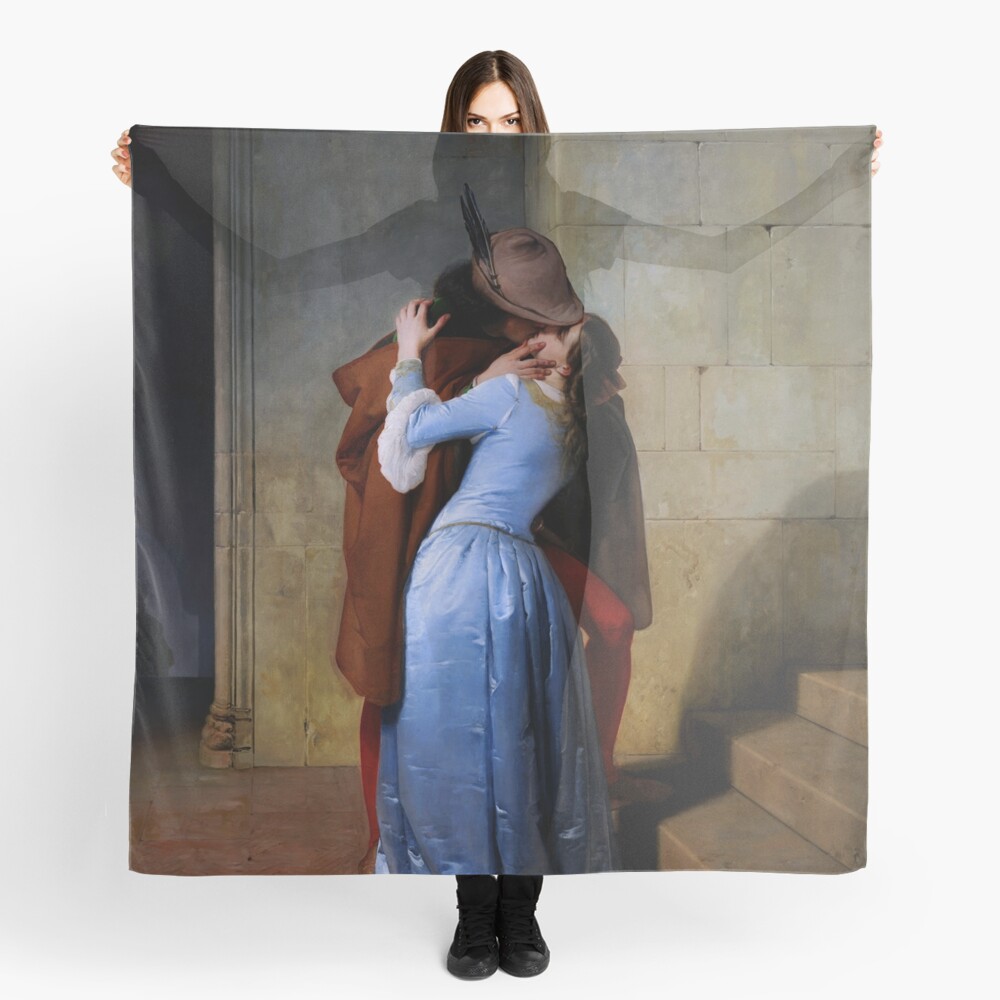
“De Kus” is a powerful and evocative painting by the renowned Italian artist Francesco Hayez, gemaakt in 1859. The artwork is a stunning example of Romanticism, a movement that was characterized by an emphasis on intense emotion, individualism, en het sublieme. Hayez’s portrayal of an intimate and passionate kiss between two figures is not just a romantic gesture but a deep, symbolic act reflecting the political and social turmoil of 19th-century Italy.
In dit stuk, the central focus is the kiss shared between a man and a woman, each dressed in period-specific attire, their bodies entwined in a tender yet fervent embrace. The lovers’ faces, captured at the moment of their kiss, convey an overwhelming sense of passion and longing. The man, dressed in a reddish-brown cloak, holds the woman with one hand, while his other hand grips a green object, possibly symbolizing life or hope. His face is partially obscured by his hat, but the tension in his posture reveals both his deep affection for the woman and the sense of urgency that seems to pervade the scene.
The woman, clothed in a flowing blue gown, stands close to him, her body pressed against his in a stance that signifies emotional and physical closeness. Haar lang, flowing hair is partially visible, her face bathed in the soft light that seems to emanate from the left, highlighting her delicate features. The deep emotional intensity in her expression, coupled with the almost sacred nature of the kiss, suggests that this moment is one of profound importance for both characters. The sensuality of the kiss is palpable, yet it is underscored by a sense of melancholy, as if this act of love must be performed in secrecy, or perhaps as a final farewell.
The setting of the artwork is crucial to understanding the deeper layers of its meaning. The scene takes place in an open, stone-walled interior, with towering, almost monolithic walls that loom over the lovers. These walls are not merely a backdrop but symbolize the oppression and constraints of the era, particularly in the context of Italy’s political situation. De ruwe, unfinished stone surfaces hint at a time of transition and struggle.
The archway in the background frames the lovers, emphasizing their isolation in the moment and their vulnerability to the outside world. The positioning of the couple in front of the stone walls may also allude to the notion of love as a fortress in a time of uncertainty or political strife, where their embrace provides a form of protection from the harsh reality beyond.
The colors in the painting are rich and symbolic. The warm tones of the man’s cloak contrast with the cooler blues and whites of the woman’s gown, signifying a balance between opposing forces—passion and purity, action and passivity. The use of light is also notable; the couple is illuminated from one side, casting shadows on their bodies and the environment around them. This creates a sense of intimacy and draws the viewer’s attention solely to the couple, ensuring that the emotional intensity of their embrace remains the focal point of the composition.
In terms of materials, the painting is executed with oil on canvas, a traditional medium that allows Hayez to achieve a remarkable level of detail and depth in his figures and surroundings. The texture of the canvas is almost palpable, with the brushstrokes contributing to the tactile nature of the painting. The artist’s skillful manipulation of light and shadow gives the piece a three-dimensional quality, making it feel as though the viewer could step into the scene and experience the emotional weight of the kiss firsthand.
Het algemene thema van “De kus” is one of passion, defiance, en verlangen. The moment captured is not simply a tender exchange between two lovers; it is an act of rebellion and a declaration of love against the backdrop of an oppressive society. At the time Hayez painted this work, Italy was undergoing significant political upheaval, as various regions were striving for unification and freedom from foreign domination.

The kiss, dan, can be seen as a metaphor for the struggle for independence, with the lovers representing the spirit of resistance and the hope for a brighter, freer future. The kiss is not just an emotional act but a political statement, an expression of the deep desire for change that resonated with the people of Italy during the Romantic period.
The mood of the painting is complex and multi-layered. While it captures the intense passion of the lovers, it also evokes a sense of sorrow and longing. The lovers are caught in a moment of transcendence, but there is a sense that this moment is fleeting.
The raw emotion conveyed through their embrace suggests that their love is either forbidden or destined to end, making the act of kissing both a sweet and painful experience. The viewer is left to ponder whether the kiss signifies the beginning of a relationship, a final farewell, or a stolen moment in a turbulent world.
Tot slot, Francesco Hayez’s “De kus” is not just a beautiful depiction of love and romance; it is a rich, symbolic painting that speaks to the political, social, and emotional climate of its time. The work’s exquisite use of light, kleur, en compositie, combined with its deep thematic resonance, makes it a timeless masterpiece that continues to captivate viewers. It invites reflection on the nature of love, the power of passion, and the struggles that shape our world, all while celebrating the profound connection between two individuals caught in the midst of history.
The Kiss is a retouched digital art old masters reproduction of a public domain image that is available as an acrylic, metaal, hout, gerold en canvas print online.
Info hieronder van Wikipedia.org
Francesco Hayez kwam uit een relatief arm gezin uit Venetië. Zijn vader, Giovanni, was van Franse afkomst terwijl zijn moeder, Chiara Torcella, kwam uit Murano. Francesco was de jongste van vijf zonen.
Hij werd opgevoed door de zus van zijn moeder, die was getrouwd met Giovanni Binasco, een welgestelde reder en kunstverzamelaar. Hayez vertoonde van kinds af aan aanleg voor tekenen. Zijn oom, zijn vroegrijp talent hebben opgemerkt, hem in de leer bij een kunstrestaurator in Venetië. Hayez zou later een leerling worden van de schilder Francesco Maggiotto bij wie hij zijn studie drie jaar voortzette.
Hij werd toegelaten tot de schildercursus van de Nieuwe Academie voor Schone Kunsten in Venetië in 1806, waar hij studeerde onder Teodoro Matteini. In 1809 hij won een wedstrijd van de Academie van Venetië voor een verblijf van een jaar aan de Accademia di San Luca in Rome.
Hij bleef in Rome tot... 1814, verhuisde vervolgens naar Napels, waar hij van Joachim Murat de opdracht kreeg om een groot werk te schilderen met de afbeelding van Ulysses aan het hof van Alcinous. In het midden van de jaren 1830 bezocht hij de Maffei Salon in Milaan, gehost door Clara Maffei. Maffei's man zou Hayez later een portret van zijn vrouw laten maken. In 1850 Hayez werd benoemd tot directeur van de Brera Academy.
In de loop van een lange carrière, Hayez bleek bijzonder productief te zijn. Zijn output omvatte historische schilderijen die waren ontworpen om een beroep te doen op de patriottische gevoeligheid van zijn opdrachtgevers, evenals werken die de wens weerspiegelen om een neoklassieke stijl te begeleiden bij grote thema's, hetzij uit bijbelse of klassieke literatuur.
Hij schilderde ook scènes uit theatervoorstellingen. Opvallend afwezig in zijn oeuvre, echter, zijn altaarstukken – mogelijk als gevolg van de Napoleontische invasies die veel kerken en kloosters in Noord-Italië hebben ontwijd. Kunsthistoricus Corrado Ricci beschreef Hayez als een classicus die vervolgens evolueerde naar een stijl van emotioneel tumult. Francesco Hayez, De kus (1859)
Zijn portretten hebben de intensiteit van Ingres en de Nazarener-beweging. Vaak zittend, De onderwerpen van Hayez zijn vaak sober gekleed, zwarte en witte kleding, met weinig tot geen uitrusting. Terwijl Hayez portretten maakte voor de adel, hij verkende ook andere onderwerpen zoals collega-artiesten en muzikanten. Laat in zijn carrière, het is bekend dat hij met foto's heeft gewerkt.
Een van de favoriete thema's van Hayez was de halfgeklede Odalisque, die doet denken aan oosterse thema's - een favoriet onderwerp van romantische schilders.[3] De afbeeldingen van harems en hun vrouwen gaven kunstenaars de mogelijkheid om scènes te schilderen die anders niet acceptabel waren in de samenleving. Zelfs Mary Magdalene van Hayez heeft meer sensualiteit dan religieuze ijver.
Het schilderij van Hayez De kus werd door zijn tijdgenoten als een van zijn beste werken beschouwd, en is misschien wel zijn meest bekende poging. de anonieme, onaangetast gebaar van het paar vereist geen kennis van mythe of literatuur om te interpreteren, en appelleert aan een moderne blik.
Een wetenschappelijke beoordeling van de carrière van Hayez is bemoeilijkt door zijn neiging om zijn werken niet te signeren of te dateren. Vaak geven data in zijn schilderijen aan wanneer het werk is aangekocht of verkocht, niet de tijd van zijn schepping. Bovendien, hij schilderde vaak dezelfde composities meerdere keren met minimale variaties of helemaal niet.
Onder zijn leerlingen van de Brera Academy waren Carlo Belgioioso, Amanzio Cattaneo, Alessandro Focosi, Giovanni Battista Lamperti, Livo Schaap, Angelo Pietrasanta, Antonio Silo, Carlo Antonio Tavella, Ismaele Teglio Milla en Francesco Valaperta.
Hayez stierf in Milaan, leeftijd 91. Zijn atelier aan de Brera Academy is gemarkeerd met een bord.