

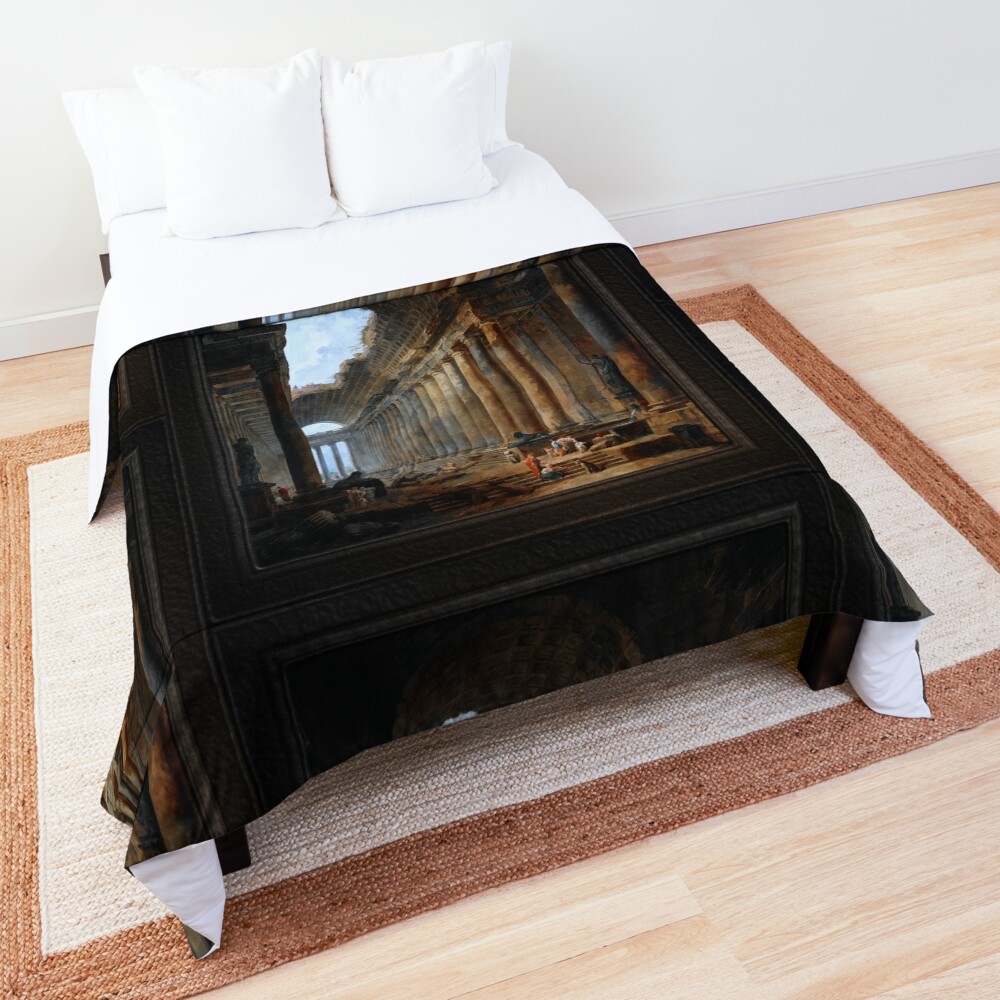
The Old Temple c1788
Hubert Robert‘s painting The Old Temple, makke om 1788, captures a striking representation of ancient ruins, masterfully blending history with the passage of time. Berne yn 1733 en fuortgean yn 1808, Robert was a prominent French painter of the Rococo and early Neoclassical periods, known for his romanticized depictions of ruins and imaginary landscapes.
Yn The Old Temple, the artist explores the theme of decay and the eternal passage of time, a subject that was central to the intellectual and artistic movements of the late 18th century. The work reflects the fascination of the era with classical antiquity and the sublime, which was often juxtaposed with the concept of destruction and the fragility of human creation.

Ynhâldsopjefte
Underwerp en komposysje
The central focus of the painting is a vast ruin of an ancient temple, its once grandiose architecture now weathered and eroded by centuries of neglect. The temple’s towering columns rise majestically, despite their crumbling state. De arsjitektuer, though in ruins, retains the classical order of the past, with tall, fluted Corinthian columns and an arching ceiling that hints at the grandeur of a lost civilization.
The viewer’s eye is drawn through the temple’s vast interior, where shafts of light pierce through the dilapidated roof, illuminating the remains of the stone floor. The scene is not devoid of life, lykwols; human figures occupy the foreground, some appearing to study the ruins, others engaging in idle conversation, perhaps contemplating the history of the structure they stand within.
The structure’s vastness is amplified by the carefully constructed perspective of the artist, who utilizes the length of the temple’s columns to guide the viewer’s gaze toward the light-filled arch at the far end of the composition. The architectural forms are exaggerated in their scale, evoking a sense of awe and reverence.
The deliberate use of light and shadow also adds to the dramatic mood of the painting, where the natural elements interact with the built environment to create a melancholic yet beautiful effect. The rubble scattered on the ground further emphasizes the ruinous state of the temple, with stone fragments and collapsed structures evoking the passage of time and the inevitable decay of all things.
It Lânskip en Terrein
Beyond the temple’s grand interior, the landscape opens up into a wide vista. A faint blue sky, dotted with clouds, serves as a backdrop to the crumbled columns and statues. The contrast between the bright sky and the shadowed ruins highlights the passing of time, as nature continues its cycle, indifferent to the fall of civilizations. Some sparse vegetation, possibly moss or ivy, has begun to grow in the cracks of the stone, suggesting that nature is reclaiming its dominion over the human-made structure. The terrain is rocky and uneven, further suggesting the erosion caused by years of exposure to the elements.
The scene’s open expanse also gives a sense of isolation and abandonment. The figures are placed within the ruins, not as part of a vibrant society, but as passive observers of something long past its prime. Their small scale in relation to the monumental ruins evokes the transient nature of human life compared to the timelessness of the world itself. Through this, Robert poignantly suggests that while human creations may fall, the land and the forces of nature endure.
Materialen en techniken
Hubert Robert’s meticulous use of oil paints is evident in the fine details and textures within the scene. The artist’s masterful handling of light and shadow enhances the three-dimensionality of the columns and figures, creating depth and a sense of realism. The surface of the stone columns is textured, with visible cracks and worn surfaces that add to the sense of decay. It spul fan ljocht, particularly as it filters through the broken roof, is rendered with such skill that it appears almost ethereal, casting delicate shadows and highlighting the fine details of the architecture and rubble.
It boarstelwurk, while intricate in the foreground, becomes looser and more fluid as it recedes into the background, particularly in the rendering of the sky. This technique allows the viewer to focus on the foreground while gently leading the eye toward the horizon. The subtle transitions between light and shadow, combined with the precise depiction of architectural elements, showcase Robert’s ability to balance both the human and natural aspects of the scene, blending them into a harmonious whole.
Styl, Tema, en Mood
Yn termen fan styl, Robert’s The Old Temple reflects the late 18th-century interest in Romanticism and the Sublime, which often dealt with themes of decay, ruin, and the ephemeral nature of human achievement. This movement emphasized the power of nature and the insignificance of mankind in the face of its vastness. The juxtaposition of human figures within the monumental ruins serves as a reminder of this contrast. While the figures seem to occupy the space, they are overwhelmed by the sheer size and decay of the temple, suggesting that even the greatest human endeavors are transient in the grand scope of history.
The mood of the painting is one of reflection and melancholy. The ruinous state of the temple and the solitary, almost contemplative poses of the figures invoke a sense of nostalgia for a bygone era. Tagelyk, there is a beauty in the decay, as the natural world begins to reclaim the space, illustrating the cyclical nature of life and death. The peacefulness of the scene, despite the temple’s destruction, suggests a sense of acceptance, as though the passage of time is a natural and inevitable process.
The Old Temple is a retouched digital art old masters reproduction of a public domain image that you can by as a opgerold canvas print.
Artist Bio
Info hjirûnder Fan Wikipedia.org
Hubert Robert waard berne yn Parys yn 1733. Syn heit, Nicolas Robert, wie yn tsjinst fan François-Joseph de Choiseul, markies de Stainville in liedende diplomaat út Lorraine. De jonge Robert die syn stúdzje ôf by de jezuïten oan it Collège de Navarre yn 1751 en kaam yn it atelier fan 'e byldhouwer Michel-Ange Slodtz dy't him ûntwerp en perspektyf learde, mar him oanmoedige om nei it skilderjen te gean. Yn 1754 hy gie nei Rome yn 'e trein fan Étienne-François de Choiseul, soan fan syn heit syn wurkjouwer, dy't de Frânske ambassadeur beneamd wie en steatssekretaris fan Bûtenlânske Saken wurde soe by Loadewyk XV yn 1758.
Hy brocht folslein alve jier yn Rome troch, in opmerklike lingte fan tiid; neidat de offisjele residinsje fan de jonge keunstner oan de Frânske Akademy yn Rome oprûn, hy stipe him troch wurken dy't er produsearre foar besikers fan kenners lykas de abbé de Saint-Non, dy't Robert yn april nei Napels naam 1760 om de ruïnes fan Pompeii te besykjen. Marquis de Marigny, direkteur fan de Bâtiments du Roi hâldde yn korrespondinsje mei Natoire op 'e hichte fan syn ûntwikkeling, direkteur fan de Fryske Akademy, dy't de pensjonearren oantrúnje om bûtendoar te sketsen, út de natuer: Robert hie gjin oanstriid nedich; tekeningen út syn sketsboeken dokumintearje syn reizen: Villa d'Este, Caprarola.
It kontrast tusken de ruïnes fan it âlde Rome en it libben fan syn tiid wekte syn heulste belangstelling. Hy wurke in skoft yn it atelier fan Pannini, waans ynfloed te sjen is yn 'e Imaginary View of the Ruined Louvre Gallery (yllustraasje). Robert brocht syn tiid yn it selskip fan jonge keunstners yn 'e rûnte fan Piranesi, waans capricci fan romantysk oergroeide ruïnes him sa bot beynfloede dat er de bynamme Robert des ruines krige.[2] De albums fan sketsen en tekeningen dy't er yn Rome gearstalde, levere him motiven dy't er syn hiele karriêre yn skilderijen wurke.