

The Old Temple c1788
הוברט רוברט‘s painting בית המקדש הישן, נוצר מסביב 1788, captures a striking representation of ancient ruins, masterfully blending history with the passage of time. נוֹלָד בְּ 1733 ועובר רחוק 1808, Robert was a prominent French painter of the Rococo and early Neoclassical periods, known for his romanticized depictions of ruins and imaginary landscapes.
ב בית המקדש הישן, the artist explores the theme of decay and the eternal passage of time, a subject that was central to the intellectual and artistic movements of the late 18th century. The work reflects the fascination of the era with classical antiquity and the sublime, which was often juxtaposed with the concept of destruction and the fragility of human creation.

תוכן העניינים
נושא והרכב
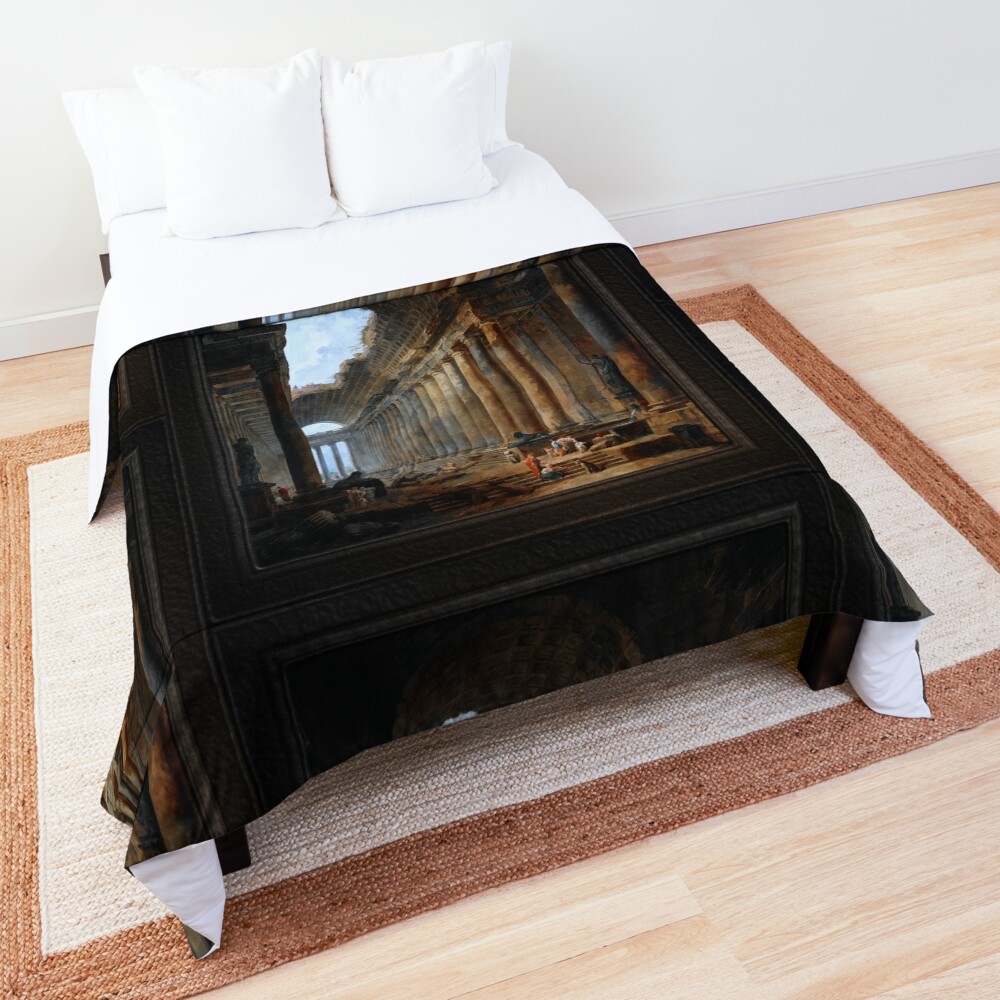
The central focus of the painting is a vast ruin of an ancient temple, its once grandiose architecture now weathered and eroded by centuries of neglect. The temple’s towering columns rise majestically, despite their crumbling state. הארכיטקטורה, though in ruins, retains the classical order of the past, with tall, fluted Corinthian columns and an arching ceiling that hints at the grandeur of a lost civilization.
The viewer’s eye is drawn through the temple’s vast interior, where shafts of light pierce through the dilapidated roof, illuminating the remains of the stone floor. The scene is not devoid of life, למרות זאת; human figures occupy the foreground, some appearing to study the ruins, others engaging in idle conversation, perhaps contemplating the history of the structure they stand within.
The structure’s vastness is amplified by the carefully constructed perspective of the artist, who utilizes the length of the temple’s columns to guide the viewer’s gaze toward the light-filled arch at the far end of the composition. The architectural forms are exaggerated in their scale, evoking a sense of awe and reverence.
The deliberate use of light and shadow also adds to the dramatic mood of the painting, where the natural elements interact with the built environment to create a melancholic yet beautiful effect. The rubble scattered on the ground further emphasizes the ruinous state of the temple, with stone fragments and collapsed structures evoking the passage of time and the inevitable decay of all things.
The Landscape and Terrain
Beyond the temple’s grand interior, the landscape opens up into a wide vista. A faint blue sky, dotted with clouds, serves as a backdrop to the crumbled columns and statues. The contrast between the bright sky and the shadowed ruins highlights the passing of time, as nature continues its cycle, indifferent to the fall of civilizations. Some sparse vegetation, possibly moss or ivy, has begun to grow in the cracks of the stone, suggesting that nature is reclaiming its dominion over the human-made structure. The terrain is rocky and uneven, further suggesting the erosion caused by years of exposure to the elements.
The scene’s open expanse also gives a sense of isolation and abandonment. The figures are placed within the ruins, not as part of a vibrant society, but as passive observers of something long past its prime. Their small scale in relation to the monumental ruins evokes the transient nature of human life compared to the timelessness of the world itself. דרך זה, Robert poignantly suggests that while human creations may fall, the land and the forces of nature endure.
חומרים וטכניקות
Hubert Robert’s meticulous use of oil paints is evident in the fine details and textures within the scene. The artist’s masterful handling of light and shadow enhances the three-dimensionality of the columns and figures, creating depth and a sense of realism. The surface of the stone columns is textured, with visible cracks and worn surfaces that add to the sense of decay. The play of light, particularly as it filters through the broken roof, is rendered with such skill that it appears almost ethereal, casting delicate shadows and highlighting the fine details of the architecture and rubble.
עבודת המכחול, while intricate in the foreground, becomes looser and more fluid as it recedes into the background, particularly in the rendering of the sky. This technique allows the viewer to focus on the foreground while gently leading the eye toward the horizon. The subtle transitions between light and shadow, combined with the precise depiction of architectural elements, showcase Robert’s ability to balance both the human and natural aspects of the scene, blending them into a harmonious whole.
סִגְנוֹן, נוֹשֵׂא, ומצב רוח
מבחינת הסגנון, Robert’s בית המקדש הישן reflects the late 18th-century interest in Romanticism and the Sublime, which often dealt with themes of decay, ruin, and the ephemeral nature of human achievement. This movement emphasized the power of nature and the insignificance of mankind in the face of its vastness. The juxtaposition of human figures within the monumental ruins serves as a reminder of this contrast. While the figures seem to occupy the space, they are overwhelmed by the sheer size and decay of the temple, suggesting that even the greatest human endeavors are transient in the grand scope of history.
The mood of the painting is one of reflection and melancholy. The ruinous state of the temple and the solitary, almost contemplative poses of the figures invoke a sense of nostalgia for a bygone era. במקביל, there is a beauty in the decay, as the natural world begins to reclaim the space, illustrating the cyclical nature of life and death. The peacefulness of the scene, despite the temple’s destruction, suggests a sense of acceptance, as though the passage of time is a natural and inevitable process.
בית המקדש הישן הוא רפרודוקציה של אמנות דיגיטלית מחודשת של אומנות ותיקה של תמונה ברשות הרבים שתוכל להשתמש בה בתור הדפס קנבס מגולגל.
ביו אמן
מידע למטה מ Wikipedia.org
הוברט רוברט נולד בפריז ב 1733. אביו, ניקולס רוברט, היה בשירותו של פרנסואה-ג'וזף דה צ'ויסול, מרקיז דה סטיינוויל דיפלומט מוביל מלוריין. רוברט הצעיר סיים את לימודיו אצל הישועים בקולג 'דה נוואר ב 1751 ונכנס לאטלייה של הפסל מישל-אנגה סלודץ שלימד אותו עיצוב ופרספקטיבה אך עודד אותו לפנות לציור. ב 1754 הוא יצא לרומא ברכבת של אטיין-פרנסואה דה צ'ויסול, בנו של המעסיק של אביו, שנקרא שגריר צרפת ויהיה מזכיר המדינה לענייני חוץ ללואי ה -15 1758.
הוא בילה אחת עשרה שנים ברומא, לאורך זמן מדהים; לאחר שנגמר מגוריו הרשמיים של האמן הצעיר באקדמיה הצרפתית ברומא, הוא תמך בעצמו ביצירות שהפיק לאניני טעם מבקרים כמו אבבה דה סן-נון, שלקח את רוברט לנאפולי באפריל 1760 לבקר בהריסות פומפיי. המרקיז דה מריני, מנהל Bâtiments du Roi התעדכן בהתפתחותו בהתכתבות עם נטואר, מנהל האקדמיה הצרפתית, אשר הפציר בכרטיסי הפנסיה לשרטט בחוץ, מהטבע: רוברט לא היה צריך שום דחיפות; רישומים מספרי הרישומים שלו מתעדים את מסעותיו: וילה ד'אסטה, קפרולה.
הניגוד בין הריסות רומא העתיקה לחיי תקופתו עורר את התעניינותו העזה ביותר. הוא עבד זמן מה בסטודיו של פאניני, שאת ההשפעה שלו אפשר לראות בתצוגה הדמיונית של גלריית הלובר ההרוסה (אִיוּר). רוברט בילה את זמנו בחברת אמנים צעירים בחוג פיראנסי, אשר גבעותיו של חורבות שגדלו באופן רומנטי השפיעו עליו עד כדי כך שזכה לכינוי רוברט דה חורבות.[2] אלבומי הרישומים והרישומים שאסף ברומא סיפקו לו מוטיבים שעיבד לציורים לאורך הקריירה שלו.