

The Old Temple c1788
ユベール・ロバート‘s painting 古い寺院, 周りに作成されます 1788, captures a striking representation of ancient ruins, masterfully blending history with the passage of time. で生まれた 1733 そして亡くなります 1808, Robert was a prominent French painter of the Rococo and early Neoclassical periods, known for his romanticized depictions of ruins and imaginary landscapes.
に 古い寺院, the artist explores the theme of decay and the eternal passage of time, a subject that was central to the intellectual and artistic movements of the late 18th century. The work reflects the fascination of the era with classical antiquity and the sublime, which was often juxtaposed with the concept of destruction and the fragility of human creation.

目次
主題と構成
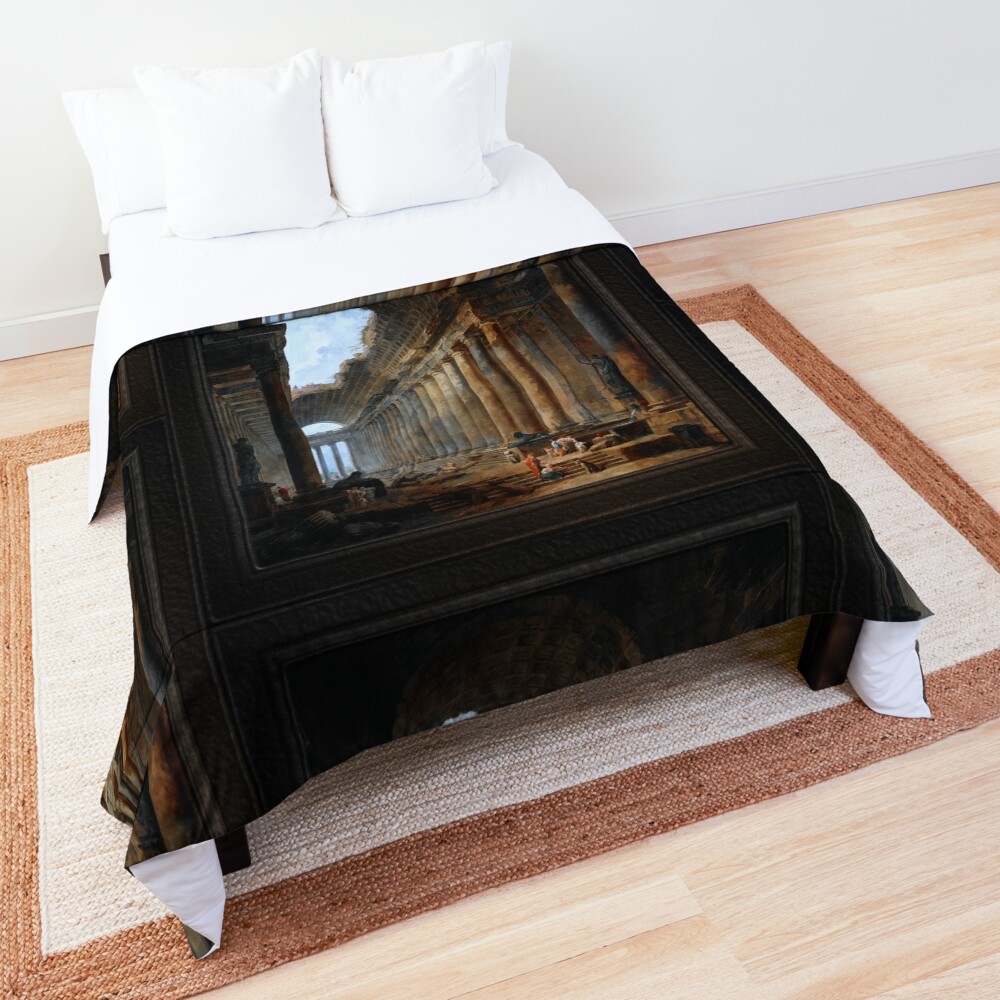
The central focus of the painting is a vast ruin of an ancient temple, its once grandiose architecture now weathered and eroded by centuries of neglect. The temple’s towering columns rise majestically, despite their crumbling state. アーキテクチャ, though in ruins, retains the classical order of the past, with tall, fluted Corinthian columns and an arching ceiling that hints at the grandeur of a lost civilization.
The viewer’s eye is drawn through the temple’s vast interior, where shafts of light pierce through the dilapidated roof, illuminating the remains of the stone floor. The scene is not devoid of life, しかしながら; human figures occupy the foreground, some appearing to study the ruins, others engaging in idle conversation, perhaps contemplating the history of the structure they stand within.
The structure’s vastness is amplified by the carefully constructed perspective of the artist, who utilizes the length of the temple’s columns to guide the viewer’s gaze toward the light-filled arch at the far end of the composition. The architectural forms are exaggerated in their scale, evoking a sense of awe and reverence.
The deliberate use of light and shadow also adds to the dramatic mood of the painting, where the natural elements interact with the built environment to create a melancholic yet beautiful effect. The rubble scattered on the ground further emphasizes the ruinous state of the temple, with stone fragments and collapsed structures evoking the passage of time and the inevitable decay of all things.
風景と地形
Beyond the temple’s grand interior, the landscape opens up into a wide vista. A faint blue sky, dotted with clouds, serves as a backdrop to the crumbled columns and statues. The contrast between the bright sky and the shadowed ruins highlights the passing of time, as nature continues its cycle, indifferent to the fall of civilizations. Some sparse vegetation, possibly moss or ivy, has begun to grow in the cracks of the stone, suggesting that nature is reclaiming its dominion over the human-made structure. The terrain is rocky and uneven, further suggesting the erosion caused by years of exposure to the elements.
The scene’s open expanse also gives a sense of isolation and abandonment. The figures are placed within the ruins, not as part of a vibrant society, but as passive observers of something long past its prime. Their small scale in relation to the monumental ruins evokes the transient nature of human life compared to the timelessness of the world itself. Through this, Robert poignantly suggests that while human creations may fall, the land and the forces of nature endure.
材料とテクニック
Hubert Robert’s meticulous use of oil paints is evident in the fine details and textures within the scene. The artist’s masterful handling of light and shadow enhances the three-dimensionality of the columns and figures, creating depth and a sense of realism. The surface of the stone columns is textured, with visible cracks and worn surfaces that add to the sense of decay. The play of light, particularly as it filters through the broken roof, is rendered with such skill that it appears almost ethereal, casting delicate shadows and highlighting the fine details of the architecture and rubble.
ブラシワーク, while intricate in the foreground, becomes looser and more fluid as it recedes into the background, particularly in the rendering of the sky. This technique allows the viewer to focus on the foreground while gently leading the eye toward the horizon. The subtle transitions between light and shadow, combined with the precise depiction of architectural elements, showcase Robert’s ability to balance both the human and natural aspects of the scene, blending them into a harmonious whole.
スタイル, テーマ, と気分
スタイル的には, Robert’s 古い寺院 reflects the late 18th-century interest in Romanticism and the Sublime, which often dealt with themes of decay, ruin, and the ephemeral nature of human achievement. This movement emphasized the power of nature and the insignificance of mankind in the face of its vastness. The juxtaposition of human figures within the monumental ruins serves as a reminder of this contrast. While the figures seem to occupy the space, they are overwhelmed by the sheer size and decay of the temple, suggesting that even the greatest human endeavors are transient in the grand scope of history.
The mood of the painting is one of reflection and melancholy. The ruinous state of the temple and the solitary, almost contemplative poses of the figures invoke a sense of nostalgia for a bygone era. 同時に, there is a beauty in the decay, as the natural world begins to reclaim the space, illustrating the cyclical nature of life and death. The peacefulness of the scene, despite the temple’s destruction, suggests a sense of acceptance, as though the passage of time is a natural and inevitable process.
オールド テンプルは、パブリック ドメインの画像を修正した古いマスターのデジタル アートです。 ロールドキャンバスプリント.
アーティスト略歴
以下の情報から Wikipedia.org
ユベール・ロバートはパリで生まれました 1733. 彼の父, ニコラス・ロバート, フランソワ・ジョセフ・ド・ショワズールに仕えていました, ロレーヌ出身の主要な外交官、マーキス・ド・ステインビル. 若いロバートは、のナバラ大学でイエズス会で勉強を終えました。 1751 そして彫刻家ミシェル・アンジュ・スロッツのアトリエに入り、彼は彼にデザインと展望を教えましたが、彼に絵画に目を向けるように勧めました. に 1754 彼はエティエンヌ・フランソワ・ド・ショワズールの列車でローマに向けて出発しました, 父親の雇用主の息子, フランス大使に任命され、ルイ15世の外務大臣になる予定だった 1758.
彼は完全に11年間ローマで過ごしました, 驚くべき時間の長さ; ローマのフランスアカデミーでの若い芸術家の公邸がなくなった後, 彼はサンノン修道院のような愛好家を訪問するために彼が制作した作品によって彼自身を支えました, 4月にロバートをナポリに連れて行った人 1760 ポンペイの遺跡を訪問する. マリニー侯爵, BâtimentsduRoiのディレクターは、ナトワールに対応して彼の発展に遅れをとっていませんでした, フランスアカデミーのディレクター, 年金受給者に屋外でスケッチするように促した人, 自然から: ロバートは促す必要はありませんでした; 彼のスケッチブックからの図面は彼の旅行を記録しています: ヴィラデステ, カプラローラ.
古代ローマの遺跡と彼の時代の生活との対比は、彼の鋭い関心を刺激しました. 彼はしばらくの間、パニーニのスタジオで働いていました, その影響は、ルーヴル美術館の廃墟の想像上の眺めで見ることができます (図). ロバートはピラネージのサークルの若いアーティストの会社で彼の時間を過ごしました, ロマンチックに生い茂った廃墟のカプリッチョが彼に大きな影響を与えたため、彼はロバート・デ・ルインズというニックネームを獲得しました。[2] 彼がローマで集めたスケッチやドローイングのアルバムは、彼が彼のキャリアを通して絵画に取り組んだモチーフを彼に提供しました.