

Stara Świątynia ok. 1788 r
Hubert Robertmalarstwo Stara Świątynia, stworzone wokół 1788, oddaje uderzające przedstawienie starożytnych ruin, po mistrzowsku łącząc historię z upływem czasu. Urodzony w 1733 i odejście w 1808, Robert był wybitnym francuskim malarzem epoki rokoka i wczesnego neoklasycyzmu, znany ze swoich romantycznych przedstawień ruin i wyimaginowanych krajobrazów.
W Stara Świątynia, artysta podejmuje temat rozkładu i wiecznego upływu czasu, temat centralny dla ruchów intelektualnych i artystycznych końca XVIII wieku. Praca odzwierciedla fascynację epoki klasyczną starożytnością i wzniosłością, co często było przeciwstawiane koncepcji zagłady i kruchości ludzkiego stworzenia.

Spis treści
Przedmiot i kompozycja
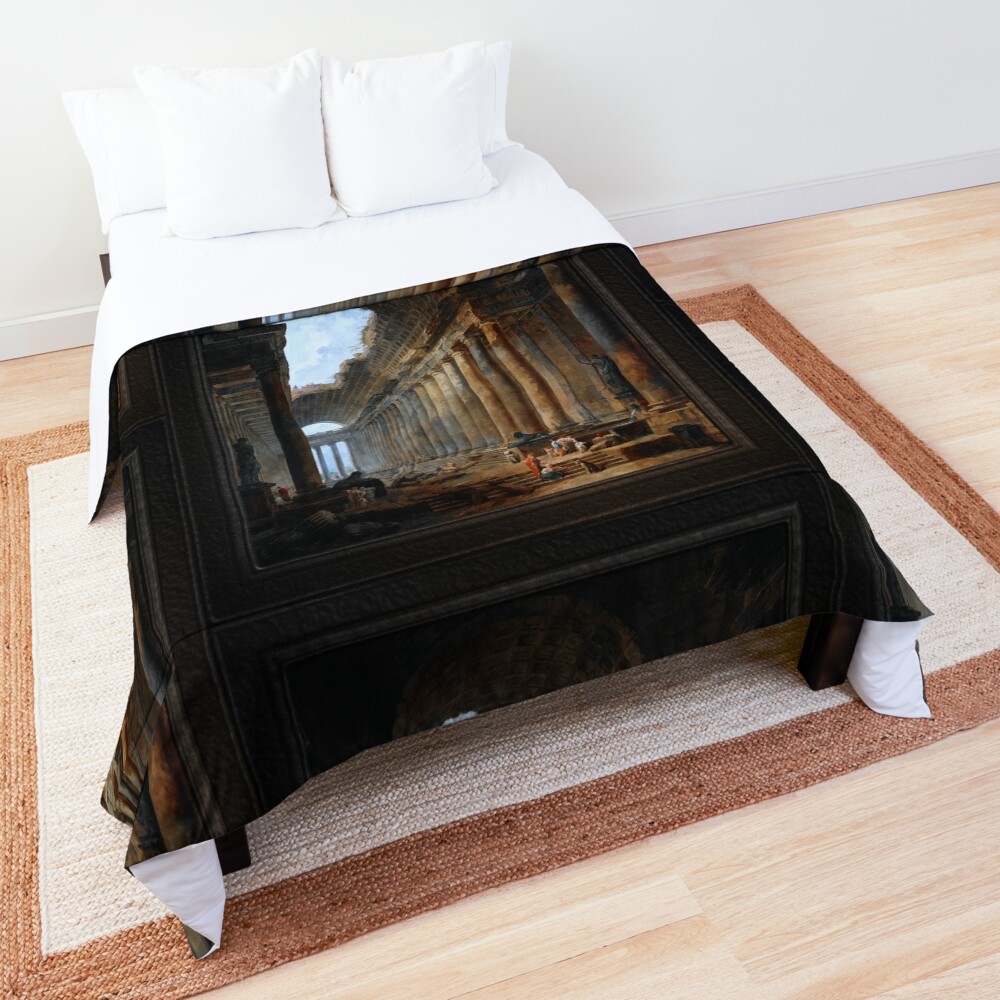
The central focus of the painting is a vast ruin of an ancient temple, its once grandiose architecture now weathered and eroded by centuries of neglect. The temple’s towering columns rise majestically, despite their crumbling state. Architektura, though in ruins, retains the classical order of the past, with tall, fluted Corinthian columns and an arching ceiling that hints at the grandeur of a lost civilization.
The viewer’s eye is drawn through the temple’s vast interior, where shafts of light pierce through the dilapidated roof, illuminating the remains of the stone floor. The scene is not devoid of life, jednak; human figures occupy the foreground, some appearing to study the ruins, others engaging in idle conversation, perhaps contemplating the history of the structure they stand within.
The structure’s vastness is amplified by the carefully constructed perspective of the artist, who utilizes the length of the temple’s columns to guide the viewer’s gaze toward the light-filled arch at the far end of the composition. The architectural forms are exaggerated in their scale, evoking a sense of awe and reverence.
The deliberate use of light and shadow also adds to the dramatic mood of the painting, where the natural elements interact with the built environment to create a melancholic yet beautiful effect. The rubble scattered on the ground further emphasizes the ruinous state of the temple, with stone fragments and collapsed structures evoking the passage of time and the inevitable decay of all things.
Krajobraz i teren
Beyond the temple’s grand interior, the landscape opens up into a wide vista. A faint blue sky, dotted with clouds, serves as a backdrop to the crumbled columns and statues. The contrast between the bright sky and the shadowed ruins highlights the passing of time, as nature continues its cycle, indifferent to the fall of civilizations. Some sparse vegetation, possibly moss or ivy, has begun to grow in the cracks of the stone, suggesting that nature is reclaiming its dominion over the human-made structure. The terrain is rocky and uneven, further suggesting the erosion caused by years of exposure to the elements.
The scene’s open expanse also gives a sense of isolation and abandonment. The figures are placed within the ruins, not as part of a vibrant society, but as passive observers of something long past its prime. Their small scale in relation to the monumental ruins evokes the transient nature of human life compared to the timelessness of the world itself. Through this, Robert poignantly suggests that while human creations may fall, the land and the forces of nature endure.
Materiały i techniki
Hubert Robert’s meticulous use of oil paints is evident in the fine details and textures within the scene. The artist’s masterful handling of light and shadow enhances the three-dimensionality of the columns and figures, creating depth and a sense of realism. The surface of the stone columns is textured, with visible cracks and worn surfaces that add to the sense of decay. The play of light, particularly as it filters through the broken roof, is rendered with such skill that it appears almost ethereal, casting delicate shadows and highlighting the fine details of the architecture and rubble.
Praca pędzla, while intricate in the foreground, becomes looser and more fluid as it recedes into the background, particularly in the rendering of the sky. This technique allows the viewer to focus on the foreground while gently leading the eye toward the horizon. The subtle transitions between light and shadow, combined with the precise depiction of architectural elements, showcase Robert’s ability to balance both the human and natural aspects of the scene, blending them into a harmonious whole.
Styl, Temat, i Nastrój
Pod względem stylu, Robert’s Stara Świątynia reflects the late 18th-century interest in Romanticism and the Sublime, which often dealt with themes of decay, ruin, and the ephemeral nature of human achievement. This movement emphasized the power of nature and the insignificance of mankind in the face of its vastness. The juxtaposition of human figures within the monumental ruins serves as a reminder of this contrast. While the figures seem to occupy the space, they are overwhelmed by the sheer size and decay of the temple, suggesting that even the greatest human endeavors are transient in the grand scope of history.
The mood of the painting is one of reflection and melancholy. The ruinous state of the temple and the solitary, almost contemplative poses of the figures invoke a sense of nostalgia for a bygone era. Naraz, there is a beauty in the decay, as the natural world begins to reclaim the space, illustrating the cyclical nature of life and death. The peacefulness of the scene, despite the temple’s destruction, suggests a sense of acceptance, as though the passage of time is a natural and inevitable process.
The Old Temple is a retouched digital art old masters reproduction of a public domain image that you can by as a zrolowany obraz na płótnie.
Biografia artysty
Informacje poniżej od Wikipedia.org
Hubert Robert urodził się w Paryżu w 1733. Jego ojciec, Nicolas Robert, był w służbie François-Josepha de Choiseul, markiz de Stainville czołowy dyplomata z Lotaryngii. Młody Robert ukończył studia u jezuitów w Collège de Navarre in 1751 i wszedł do atelier rzeźbiarza Michel-Ange Slodtz, który nauczył go projektowania i perspektywy, ale zachęcił go do zwrócenia się do malarstwa. W 1754 wyjechał do Rzymu pociągiem Étienne-François de Choiseul, syn pracodawcy ojca, który został mianowany ambasadorem Francji i został sekretarzem stanu do spraw zagranicznych Ludwika XV w 1758.
W Rzymie spędził całe jedenaście lat, niezwykła długość czasu; po wygaśnięciu oficjalnej rezydencji młodego artysty w Akademii Francuskiej w Rzymie, utrzymywał się z dzieł, które produkował dla odwiedzających go koneserów, takich jak księdza Saint-Non, który zabrał Roberta do Neapolu w kwietniu? 1760 odwiedzić ruiny Pompei. markiz de Marigny, dyrektor Bâtiments du Roi w korespondencji z Natoire . na bieżąco śledził swój rozwój, dyrektor Akademii Francuskiej, który namawiał emerytów do szkicowania w plenerze, z natury: Robert nie potrzebował zachęty; rysunki z jego szkicowników dokumentują jego podróże: Willa d'Este, Caprarola.
Kontrast między ruinami starożytnego Rzymu a życiem w jego czasach wzbudził jego największe zainteresowanie. Pracował przez pewien czas w pracowni Pannini, którego wpływ można zobaczyć w Wyimaginowanym Widoku Galerii Zrujnowanego Luwru (ilustracja). Robert spędzał czas w towarzystwie młodych artystów z kręgu Piranesi, którego kaprysy romantycznie zarośniętych ruin wpłynęły na niego tak bardzo, że zyskał przydomek Robert des ruines.[2] Albumy ze szkicami i rysunkami, które zgromadził w Rzymie, dostarczyły mu motywów, które tworzył w malarstwie przez całą swoją karierę.