

The Russian Brides Attire
The Russian Brides Attire c1889 by Russian Painter Konstantin Makovsky (1839 – 1915); erikoistunut venäläisiin historiallisiin maalauksiin, jotka näyttävät idealisoidun näkemyksen venäläisestä elämästä menneinä vuosisatoina.
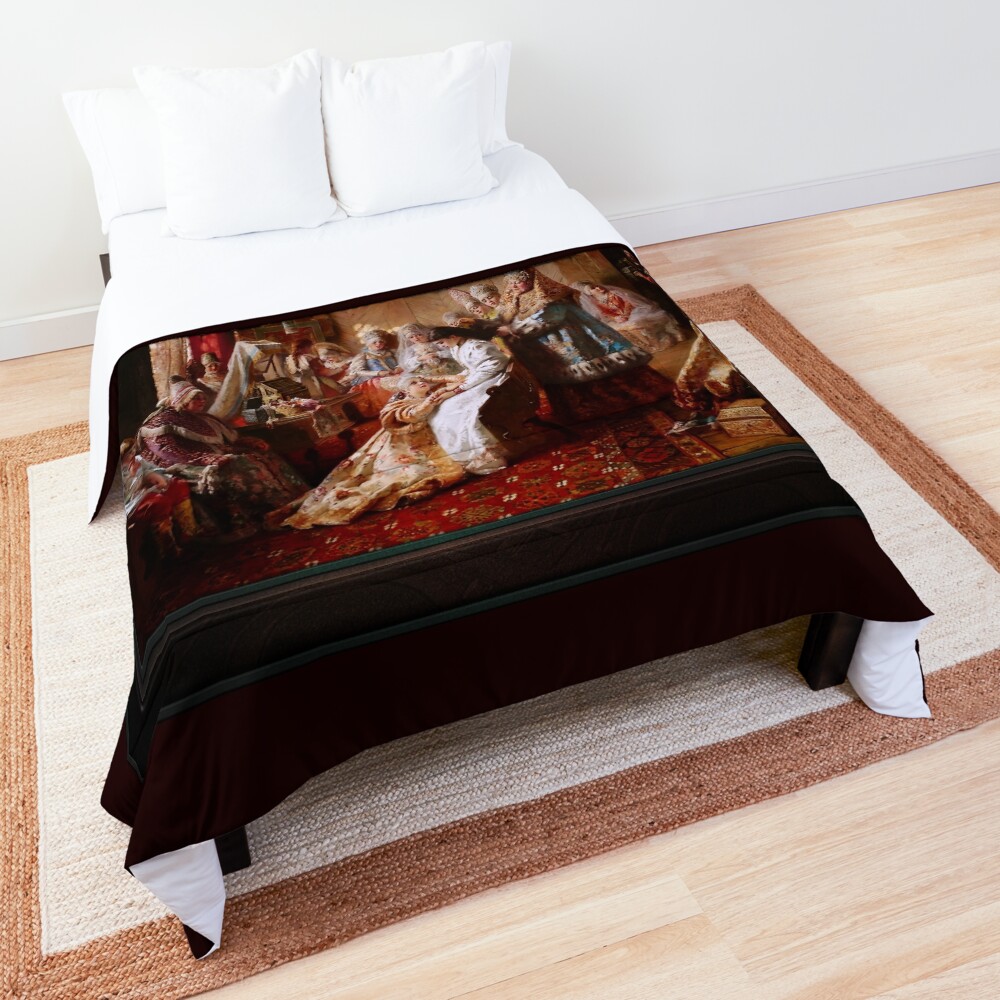
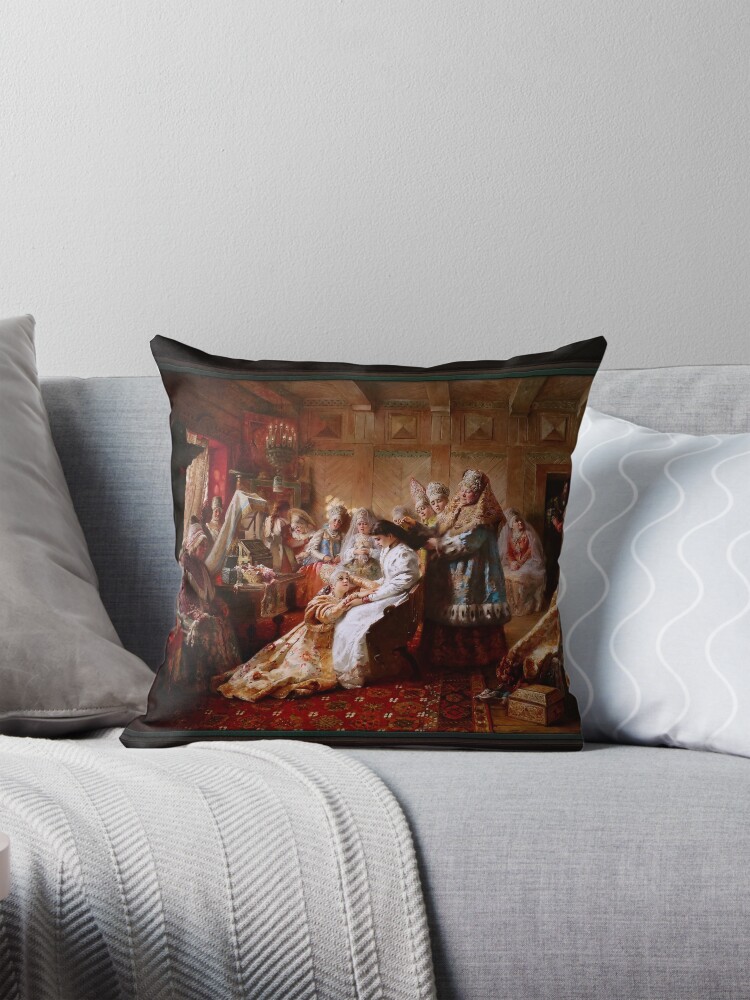
Konstantin Makovsky’s The Russian Brides Attire (1889) presents a captivating glimpse into the ceremonial preparations of a Russian bride in a traditional 19th-century setting. The scene is set within an intimate, richly adorned room where the bride-to-be, poised in anticipation, is surrounded by her closest family and friends. This historical genre painting, rooted deeply in Russian culture, reflects both the bride’s personal moment and the social customs of the time.
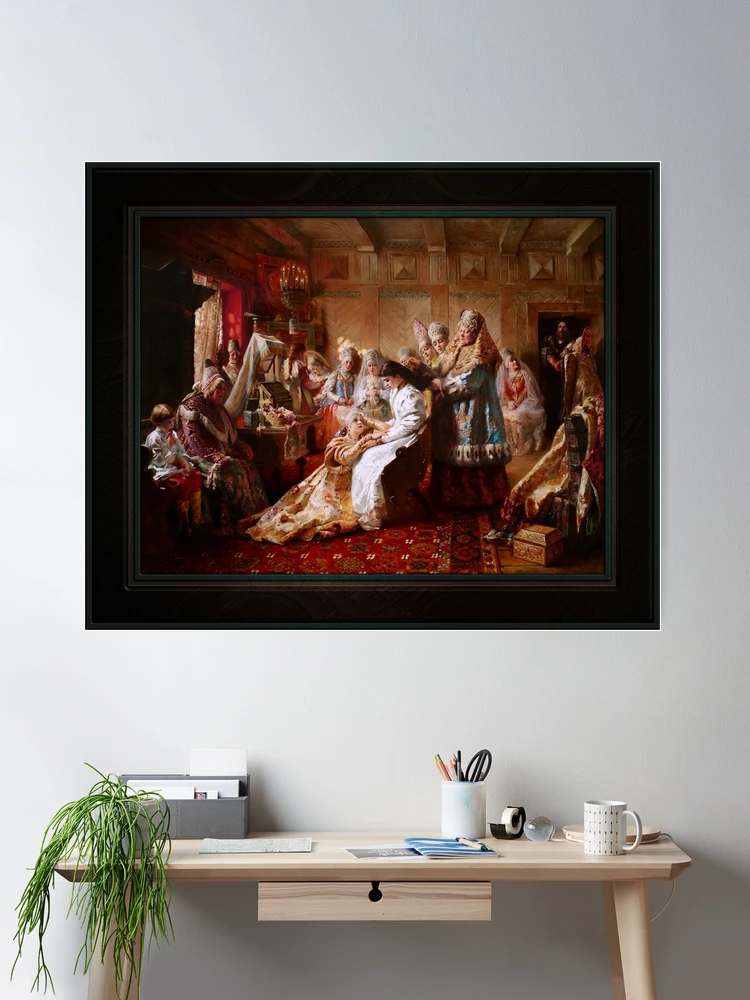
At the heart of the painting sits the young bride, dressed in an opulent, meticulously detailed gown of traditional Russian wedding attire. The intricacies of her attire are striking; every fold and embellishment in her richly embroidered dress echoes the skill and craftsmanship of the period. The gown’s texture, enhanced by the gentle play of light, emphasizes its luxurious fabric, hinting at the bride’s high social standing.
Puku, with its intricate patterns and vibrant colors, combines tradition with beauty, setting her apart as the central figure in the composition. Hänen ilmeensä, serene yet tinged with the anticipation of the upcoming union, contributes to the painting’s overall sense of reverence for this momentous life event.
The surrounding figures enhance the emotional depth of the scene. Bridesmaids, family members, and an attentive mother are present, each contributing to the bride’s preparations. The bridal party’s clothing is also detailed, showcasing the opulence typical of the Russian aristocracy during the era.
These individuals are all engaged in the intimate tasks of finalizing the bride’s appearance, with one figure seated at the bride’s feet, holding her hands tenderly—a subtle gesture of familial connection and support. Verrattuna, a young man, possibly the groom, appears at the threshold of the room, holding a gift box. His presence is restrained, his access to the bride’s space halted by a gentle but firm barrier, as custom would dictate.
The setting further complements the mood of the painting. The room is lavishly decorated, pimeällä, rich tones contrasting against the soft glow of candlelight and the bride’s radiant attire. This use of light symbolizes both the bride’s purity and the solemnity of the occasion.
The opulent, antique furniture and the delicate furnishings suggest an upper-class household, indicative of the wealth and status of the bride’s family. These elements come together to transport the viewer to the Russian nobility’s private spaces, where tradition and social rituals were deeply ingrained.
Makovsky’s approach to the painting reflects his expertise in academic art and historical realism, grounded in his training and experience with the Peredvizhniki (Vaeltajat) liikettä. Known for portraying the everyday lives of Russians, Makovsky’s work in The Russian Bride’s Attire transcends mere documentation, offering an emotional portrait of a pivotal moment in a young woman’s life. His mastery of detail, väri-, and light conveys a sense of reverence for the traditions of Russian weddings, while the gentle interactions between the figures in the scene imbue the work with a sense of warmth and familial love.
The mood of the painting is one of quiet anticipation, ceremonial dignity, and a deep respect for cultural traditions. The bride is presented not just as the central figure in a social ritual, but as a symbol of purity, continuity, and heritage.
The work conveys a mixture of joy and solemnity, emphasizing the gravity of the wedding ceremony while celebrating the familial bonds that are integral to it. The groom, awaiting his bride’s arrival, is a figure of patience and longing, and the space between the bride and groom symbolizes the sacredness and exclusivity of the pre-wedding ritual.
Tyylin suhteen, The Russian Bride’s Attire is a quintessential example of Russian academic realism. Makovsky’s technique, with its sharp focus on the textures of fabrics, the naturalism of facial expressions, and the subtle play of light, creates a vivid, almost tangible atmosphere.
The figures are carefully posed to convey a sense of unity and purpose, while the careful rendering of the bride’s dress and the surrounding details showcases the artist’s skill in depicting texture and material.
Temaattisesti, the work explores the cultural importance of the Russian wedding, which was more than just a personal event—it was a public and familial milestone. Through the artist’s portrayal of the bride’s attire, the familial interaction, and the ceremonial anticipation, the viewer is invited to witness an intimate, yet highly structured moment in Russian society. The painting also highlights the role of tradition in Russian culture, where customs surrounding marriage were highly ritualized and carefully observed.
The Russian Bride’s Attire is not only a visual narrative of a traditional wedding but also an insightful reflection of the values and customs of 19th-century Russian aristocracy. It stands as a testament to Konstantin Makovsky’s ability to blend historical accuracy with emotional depth, offering the viewer a vivid portrayal of Russian cultural heritage at its most beautiful and ceremonial.
Tämä on retusoitu digitaalisen taiteen vanhojen mestareiden kopio julkisesta kuvasta.
Alla olevat tiedot ovat peräisin Wikipedia.org
Konstantin Makovsky oli vaikutusvaltainen venäläinen taidemaalari, sidoksissa “Peredvizhniki (Vaeltajat)”. Monet hänen historiallisista maalauksistaan, kuten Beeath the Crown (1889) tunnetaan myös nimellä The Russian Bride's Attire ja Before the Wedding, osoitti idealisoidun näkemyksen Venäjän aikaisempien vuosisatojen elämästä. Häntä pidetään usein akateemisen taiteen edustajana.
Konstantin Makovsky syntyi Moskovassa. Hänen isänsä oli venäläinen taidehahmo ja amatöörimaalari, Jegor Ivanovich Makovsky. Hänen äitinsä oli säveltäjä, ja hän toivoi, että hänen poikansa jonain päivänä seuraisi hänen jalanjälkiä. Hänen nuoremmat veljensä Vladimir ja Nikolay sekä hänen sisarensa Alexandra ryhtyivät myös maalareiksi.
Sisään 1851 Makovsky tuli Moskovan maalauskouluun, Veistos ja arkkitehtuuri, jossa hänestä tuli paras opiskelija, saada helposti kaikki saatavilla olevat palkinnot. Hänen opettajansa olivat Karl Bryullov ja Vasily Tropinin. Makovskin taipumukset romantiikkaan ja koristeellisuuteen selittyvät Bryullovin vaikutuksella.
Although art was his passion, he also considered what his mother had wanted him to do. He set off to look for composers he could refer to, and first went to France. Before, he had always been a classical music lover, and listened to many pieces. He often wished he could change the tune, or style of some of them to make them more enjoyable. Later in his life it came true.
Sisään 1858 Makovsky tuli Pietarin keisarilliseen taideakatemiaan. Alkaen 1860 hän osallistui Akatemian näyttelyihin maalauksilla, kuten Curing of the Blind (1860) ja Agents of the False Dmitry tappavat Boris Godunovin pojan (1862). Sisään 1863 Makovsky ja 13 muuta opiskelijaa protestoivat Akatemian asettamia aiheita skandinaaviseen mytologiaan kilpailussa Large Gold Medal of Academiasta.; kaikki lähtivät akatemiasta ilman virallista tutkintotodistusta.
Makovsky became a member of a co-operative (artel) of artists led by Ivan Kramskoi, typically producing Wanderers paintings on everyday life (Widow 1865, Herring-seller 1867, etc.). Alkaen 1870 he was a founding member of the Society for Traveling Art Exhibitions and continued to work on paintings devoted to everyday life. He exhibited his works at both the Academia exhibitions and the Traveling Art Exhibitions of the Wanderers.
A significant change in his style occurred after traveling to Egypt and Serbia in the mid-1870s. His interests changed from social and psychological problems to the artistic problems of colors and shape.
In the 1880s he became a fashionable author of portraits and historical paintings. At the World’s Fair of 1889 in Paris he received the Large Gold Medal for his paintings Death of Ivan the Terrible, The Judgement of Paris, and Demon and Tamara. He was one of the most highly appreciated and highly paid Russian artists of the time. Many democratic critics considered him as a renegade of the Wanderers’ ideals, producing (like Henryk Siemiradzki) striking but shallow works,[2] while others see him as a forerunner of Russian Impressionism.
Makovsky tapettiin vuonna 1915 kun hänen hevoskärrynsä törmäsi sähköraitiovaunuun Pietarissa.