

The Russian Brides Attire
The Russian Brides Attire c1889 by Russian Painter Konstantin Makovsky (1839 – 1915); ag speisialú i bpictiúir Stairiúla na Rúise a thaispeánann radharc idéalach ar shaol na Rúise sna céadta bliain a chuaigh thart.
Konstantin Makovsky’s The Russian Brides Attire (1889) presents a captivating glimpse into the ceremonial preparations of a Russian bride in a traditional 19th-century setting. The scene is set within an intimate, richly adorned room where the bride-to-be, poised in anticipation, is surrounded by her closest family and friends. This historical genre painting, rooted deeply in Russian culture, reflects both the bride’s personal moment and the social customs of the time.
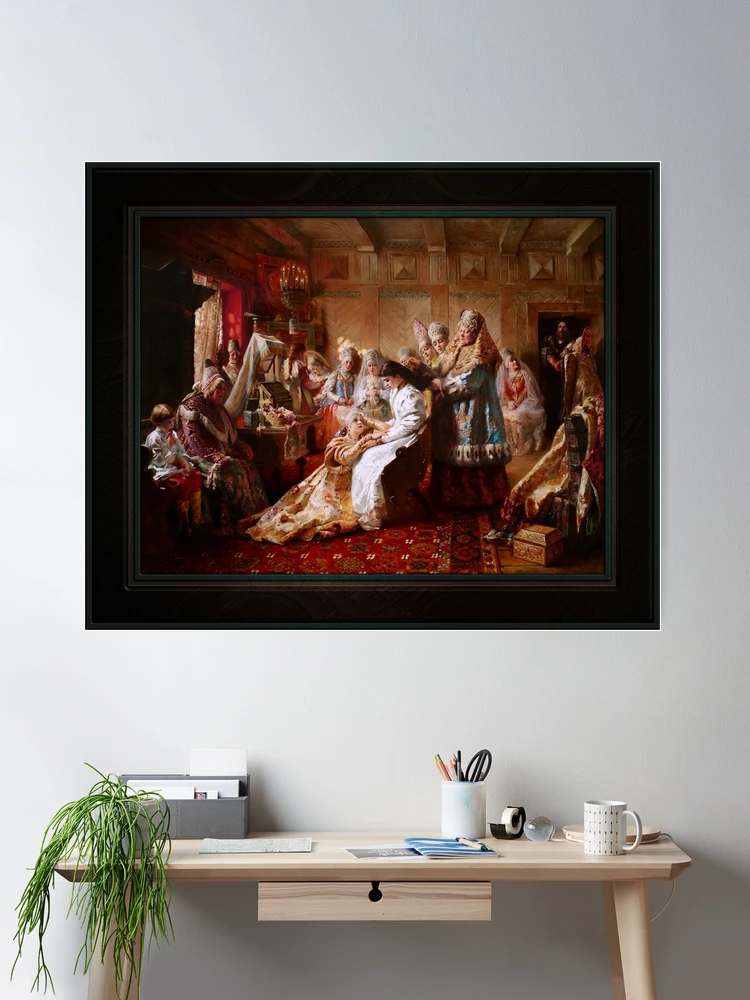
At the heart of the painting sits the young bride, dressed in an opulent, meticulously detailed gown of traditional Russian wedding attire. The intricacies of her attire are striking; every fold and embellishment in her richly embroidered dress echoes the skill and craftsmanship of the period. The gown’s texture, enhanced by the gentle play of light, emphasizes its luxurious fabric, hinting at the bride’s high social standing.
An gúna, with its intricate patterns and vibrant colors, combines tradition with beauty, setting her apart as the central figure in the composition. A léiriú, serene yet tinged with the anticipation of the upcoming union, contributes to the painting’s overall sense of reverence for this momentous life event.
The surrounding figures enhance the emotional depth of the scene. Bridesmaids, family members, and an attentive mother are present, each contributing to the bride’s preparations. The bridal party’s clothing is also detailed, showcasing the opulence typical of the Russian aristocracy during the era.
These individuals are all engaged in the intimate tasks of finalizing the bride’s appearance, with one figure seated at the bride’s feet, holding her hands tenderly—a subtle gesture of familial connection and support. I gcodarsnacht, a young man, possibly the groom, appears at the threshold of the room, holding a gift box. His presence is restrained, his access to the bride’s space halted by a gentle but firm barrier, as custom would dictate.
The setting further complements the mood of the painting. The room is lavishly decorated, with dark, rich tones contrasting against the soft glow of candlelight and the bride’s radiant attire. This use of light symbolizes both the bride’s purity and the solemnity of the occasion.
The opulent, antique furniture and the delicate furnishings suggest an upper-class household, indicative of the wealth and status of the bride’s family. These elements come together to transport the viewer to the Russian nobility’s private spaces, where tradition and social rituals were deeply ingrained.
Makovsky’s approach to the painting reflects his expertise in academic art and historical realism, grounded in his training and experience with the Peredvizhniki (Fánaithe) gluaiseacht. Known for portraying the everyday lives of Russians, Makovsky’s work in The Russian Bride’s Attire transcends mere documentation, offering an emotional portrait of a pivotal moment in a young woman’s life. His mastery of detail, dath, and light conveys a sense of reverence for the traditions of Russian weddings, while the gentle interactions between the figures in the scene imbue the work with a sense of warmth and familial love.
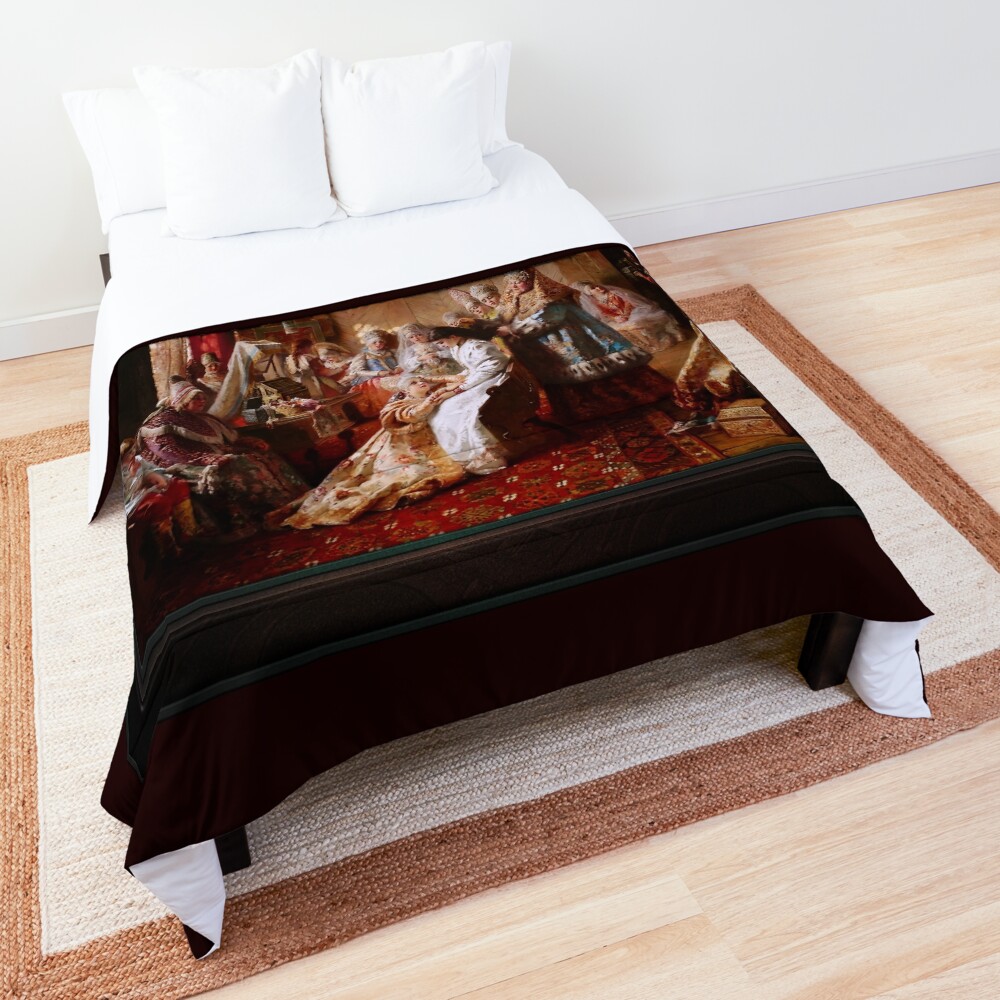
The mood of the painting is one of quiet anticipation, ceremonial dignity, and a deep respect for cultural traditions. The bride is presented not just as the central figure in a social ritual, but as a symbol of purity, continuity, and heritage.
The work conveys a mixture of joy and solemnity, emphasizing the gravity of the wedding ceremony while celebrating the familial bonds that are integral to it. The groom, awaiting his bride’s arrival, is a figure of patience and longing, and the space between the bride and groom symbolizes the sacredness and exclusivity of the pre-wedding ritual.
In terms of style, The Russian Bride’s Attire is a quintessential example of Russian academic realism. Makovsky’s technique, with its sharp focus on the textures of fabrics, the naturalism of facial expressions, and the subtle play of light, creates a vivid, almost tangible atmosphere.
The figures are carefully posed to convey a sense of unity and purpose, while the careful rendering of the bride’s dress and the surrounding details showcases the artist’s skill in depicting texture and material.
Thematically, the work explores the cultural importance of the Russian wedding, which was more than just a personal event—it was a public and familial milestone. Through the artist’s portrayal of the bride’s attire, the familial interaction, and the ceremonial anticipation, the viewer is invited to witness an intimate, yet highly structured moment in Russian society. The painting also highlights the role of tradition in Russian culture, where customs surrounding marriage were highly ritualized and carefully observed.
The Russian Bride’s Attire is not only a visual narrative of a traditional wedding but also an insightful reflection of the values and customs of 19th-century Russian aristocracy. It stands as a testament to Konstantin Makovsky’s ability to blend historical accuracy with emotional depth, offering the viewer a vivid portrayal of Russian cultural heritage at its most beautiful and ceremonial.
Is é atá i gceist leis seo ná sean-mháistrí ealaíne digití atáirgeadh ar íomhá fearainn phoiblí.
Faisnéis Thíos Díorthaithe ó Wikipedia.org
Bhí Konstantin Makovsky ina phéintéir Rúiseach a raibh tionchar aige, cleamhnaithe leis an “Peredvizhniki (Fánaithe)”. Go leor dá phictiúir stairiúla, ar nós Faoi bhun na Corónach (1889) ar a dtugtar freisin The Russian Bride's Attire and Before the Wedding, léirigh radharc idéalach ar shaol na Rúise na gcéadta bliain roimhe sin. Is minic a mheastar é mar ionadaí d’ealaín Acadúil.
Rugadh Konstantin Makovsky i Moscó. Ba é a athair an figiúr ealaíne Rúiseach agus péintéir amaitéarach, Yegor Ivanovich Makovsky. Cumadóir ab ea a mháthair, agus bhí súil aici go leanfadh a mac lá amháin ina cois. Chuaigh a dheartháireacha níos óige Vladimir agus Nikolay agus a dheirfiúr Alexandra ar aghaidh chun bheith ina bpéintéirí freisin.
I 1851 Chuaigh Makovsky isteach i Scoil Péinteála Moscó, Dealbhóireacht agus Ailtireacht áit a raibh sé ar an mac léinn ab fhearr, na dámhachtainí uile atá ar fáil a fháil go héasca. Ba iad a mhúinteoirí Karl Bryullov agus Vasily Tropinin. Is féidir claontaí Makovsky ar an Rómánsachas agus éifeachtaí maisiúla a mhíniú trí thionchar Bryullov.
Cé gurbh í an ealaín a paisean, rinne sé machnamh freisin ar a raibh a mháthair ag iarraidh air a dhéanamh. D'imigh sé ar lorg cumadóirí a bhféadfadh sé tagairt a dhéanamh dóibh, agus chuaigh sé chun na Fraince ar dtús. Roimh, bhí grá riamh aige don cheol clasaiceach, agus d’éist sé le go leor píosaí. Ba mhinic a theastaigh uaidh go bhféadfadh sé an fonn a athrú, nó stíl cuid acu chun iad a dhéanamh níos taitneamhaí. Níos déanaí ina shaol tháinig sé i gcrích.
I 1858 Chuaigh Makovsky isteach san Acadamh Ealaíon Impiriúil i Saint Petersburg. Ó 1860 ghlac sé páirt i dtaispeántais an Acadaimh le pictiúir mar Curing of the Blind (1860) Maraíonn Gníomhairí an False Dmitry mac Boris Godunov (1862). I 1863 Bhí agóid ar siúl ag Makovsky agus trí mhac léinn déag eile in aghaidh shuíomh an Acadaimh d’ábhair ó mhiotaseolaíocht Chríoch Lochlann sa chomórtas do Bhonn Mór Óir an Acadaimh.; d'fhág siad go léir an acadamh gan dioplóma foirmiúil.
Tháinig Makovsky ina bhall de chomharchumann (airteil) ealaíontóirí faoi stiúir Ivan Kramskoi, go tipiciúil ag táirgeadh pictiúir Wanderers ar an saol laethúil (baintreach 1865, Díoltóir Scadán 1867, srl.). Ó 1870 bhí sé ar dhuine de bhunaitheoirí an Chumainn Taispeántais Ealaíne Taistil agus lean sé ag obair ar phictiúir a bhí dírithe ar an saol laethúil.. Thaispeáin sé a shaothair ag taispeántais an Acadaimh agus ag Taispeántais Ealaíne Taistil na nDaoine Wanderers.
Tháinig athrú suntasach ar a stíl tar éis taisteal go dtí an Éigipt agus an tSeirbia i lár na 1870idí. D'athraigh a spéiseanna ó fhadhbanna sóisialta agus síceolaíochta go fadhbanna ealaíne dathanna agus cruth.
Sna 1880idí rinneadh údar faiseanta de phortráidí agus de phictiúir stairiúla de. Ag Aonach an Domhain de 1889 i bPáras fuair sé an Bonn Óir Mór as a phictiúir Death of Ivan the Terrible, Breithiúnas Pháras, agus Demon agus Tamara. Bhí sé ar dhuine de na healaíontóirí Rúiseacha is mó a raibh meas agus ard-íoc air ag an am. Mheas go leor criticeoirí daonlathacha é mar renegade de na Wanderers’ idéalacha, ag táirgeadh (cosúil le Henryk Siemiradzki) oibreacha buailte ach éadomhain,[2] agus feiceann daoine eile é mar réamhtheachtaí de chuid Impriseanachas na Rúise.
Maraíodh Makovsky i 1915 nuair a bhuail tram leictreach a charráiste capall i St Petersburg.