

The Russian Brides Attire
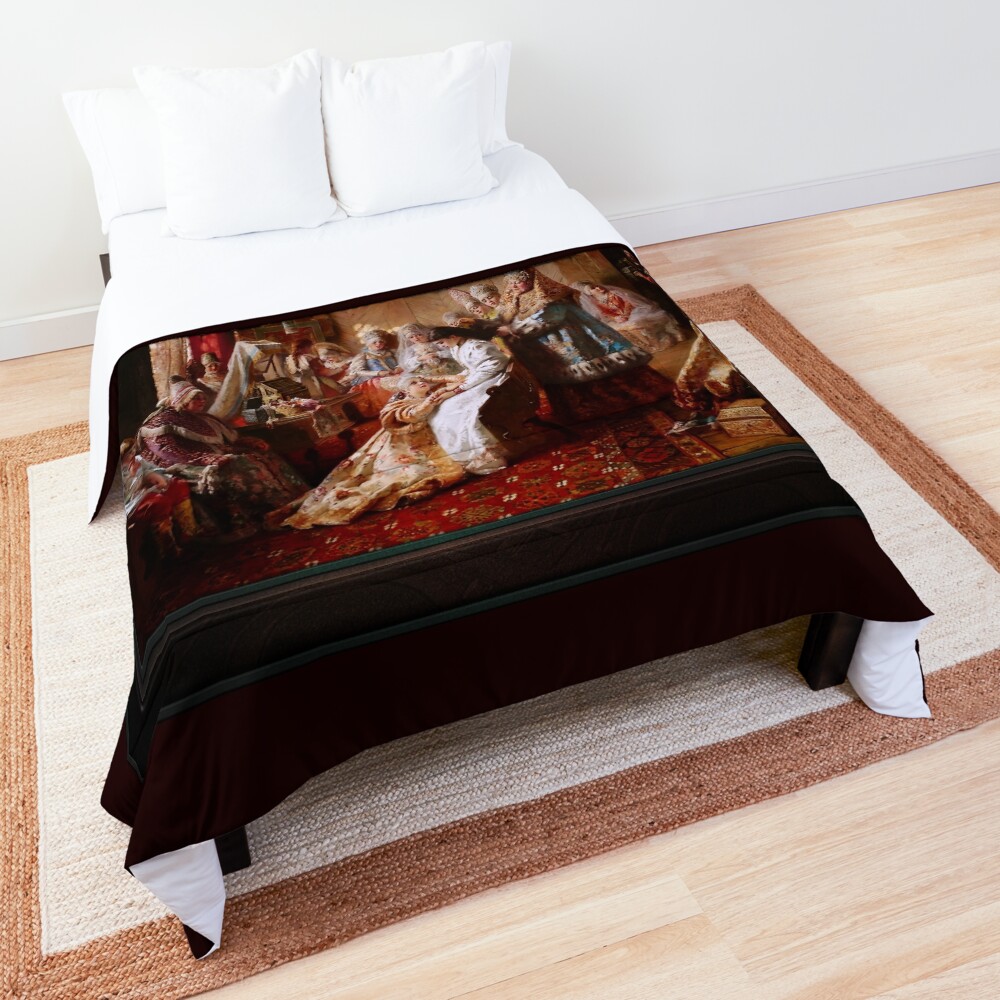
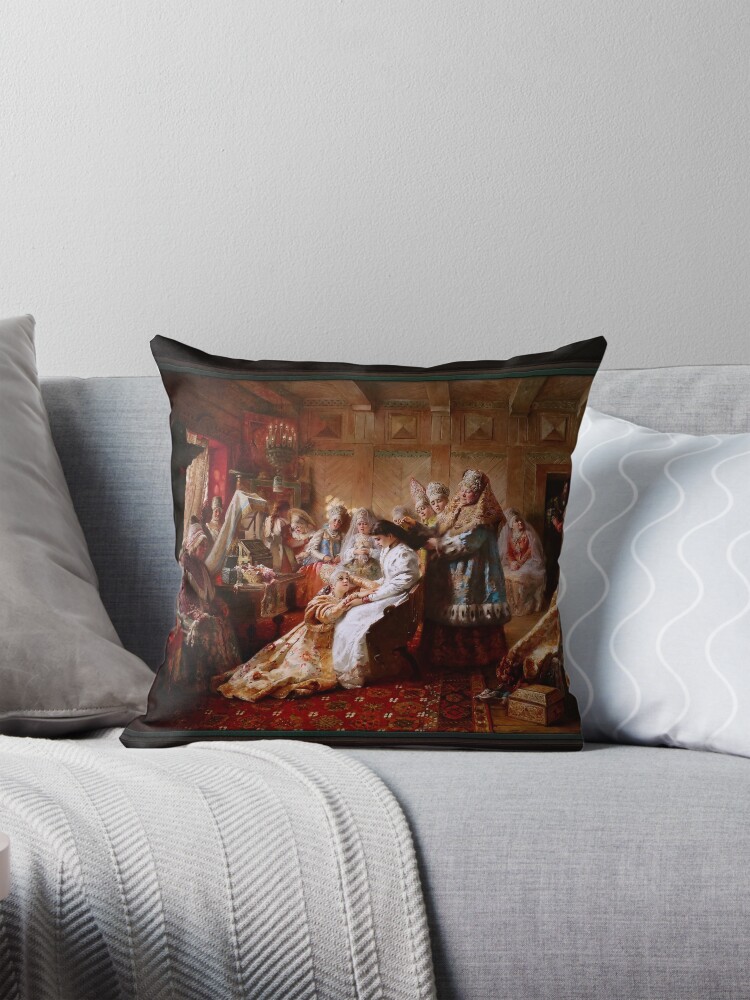
The Russian Brides Attire c1889 by Russian Painter Konstantin Makovsky (1839 – 1915); specializing in Russian Historical paintings showing an idealized view of Russian life in past centuries.
Konstantin Makovsky’s The Russian Brides Attire (1889) presents a captivating glimpse into the ceremonial preparations of a Russian bride in a traditional 19th-century setting. The scene is set within an intimate, richly adorned room where the bride-to-be, poised in anticipation, is surrounded by her closest family and friends. This historical genre painting, rooted deeply in Russian culture, reflects both the bride’s personal moment and the social customs of the time.
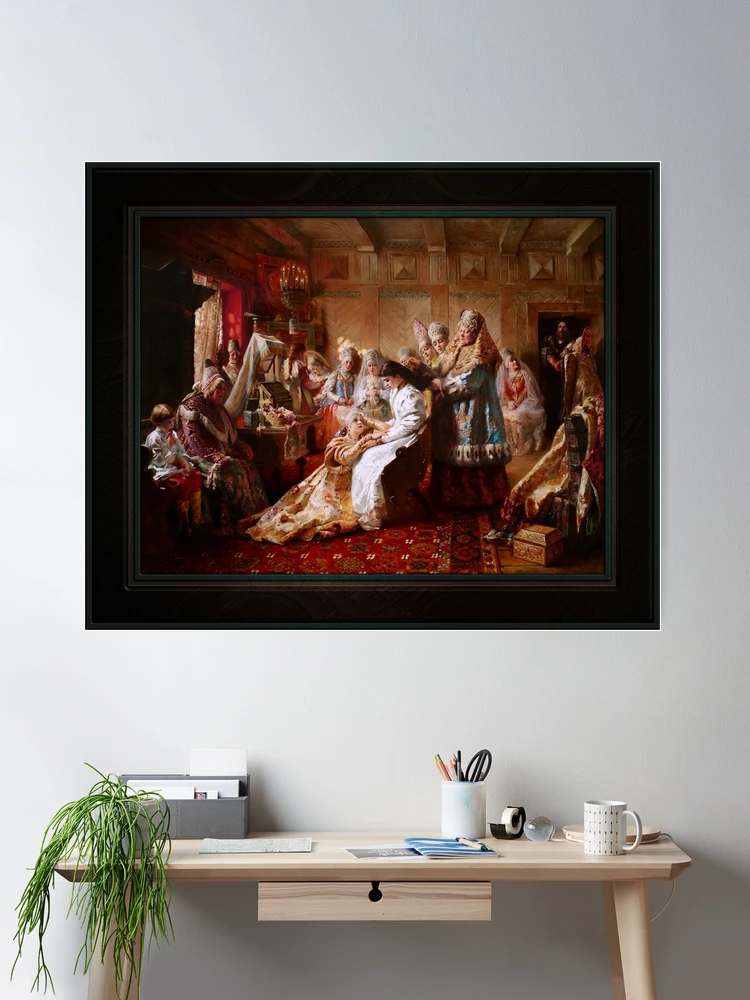
At the heart of the painting sits the young bride, dressed in an opulent, meticulously detailed gown of traditional Russian wedding attire. The intricacies of her attire are striking; every fold and embellishment in her richly embroidered dress echoes the skill and craftsmanship of the period. The gown’s texture, enhanced by the gentle play of light, emphasizes its luxurious fabric, hinting at the bride’s high social standing.
The gown, with its intricate patterns and vibrant colors, combines tradition with beauty, setting her apart as the central figure in the composition. A expressão dela, serene yet tinged with the anticipation of the upcoming union, contributes to the painting’s overall sense of reverence for this momentous life event.
The surrounding figures enhance the emotional depth of the scene. Bridesmaids, family members, and an attentive mother are present, each contributing to the bride’s preparations. The bridal party’s clothing is also detailed, showcasing the opulence typical of the Russian aristocracy during the era.
These individuals are all engaged in the intimate tasks of finalizing the bride’s appearance, with one figure seated at the bride’s feet, holding her hands tenderly—a subtle gesture of familial connection and support. Em contraste, a young man, possibly the groom, appears at the threshold of the room, holding a gift box. His presence is restrained, his access to the bride’s space halted by a gentle but firm barrier, as custom would dictate.
The setting further complements the mood of the painting. The room is lavishly decorated, com escuro, rich tones contrasting against the soft glow of candlelight and the bride’s radiant attire. This use of light symbolizes both the bride’s purity and the solemnity of the occasion.
The opulent, antique furniture and the delicate furnishings suggest an upper-class household, indicative of the wealth and status of the bride’s family. These elements come together to transport the viewer to the Russian nobility’s private spaces, where tradition and social rituals were deeply ingrained.
Makovsky’s approach to the painting reflects his expertise in academic art and historical realism, grounded in his training and experience with the Peredvizhniki (Wanderers) movement. Known for portraying the everyday lives of Russians, Makovsky’s work in The Russian Bride’s Attire transcends mere documentation, offering an emotional portrait of a pivotal moment in a young woman’s life. His mastery of detail, cor, and light conveys a sense of reverence for the traditions of Russian weddings, while the gentle interactions between the figures in the scene imbue the work with a sense of warmth and familial love.
The mood of the painting is one of quiet anticipation, ceremonial dignity, and a deep respect for cultural traditions. The bride is presented not just as the central figure in a social ritual, but as a symbol of purity, continuity, and heritage.
The work conveys a mixture of joy and solemnity, emphasizing the gravity of the wedding ceremony while celebrating the familial bonds that are integral to it. The groom, awaiting his bride’s arrival, is a figure of patience and longing, and the space between the bride and groom symbolizes the sacredness and exclusivity of the pre-wedding ritual.
In terms of style, The Russian Bride’s Attire is a quintessential example of Russian academic realism. Makovsky’s technique, with its sharp focus on the textures of fabrics, the naturalism of facial expressions, and the subtle play of light, creates a vivid, almost tangible atmosphere.
The figures are carefully posed to convey a sense of unity and purpose, while the careful rendering of the bride’s dress and the surrounding details showcases the artist’s skill in depicting texture and material.
Tematicamente, the work explores the cultural importance of the Russian wedding, which was more than just a personal event—it was a public and familial milestone. Through the artist’s portrayal of the bride’s attire, the familial interaction, and the ceremonial anticipation, the viewer is invited to witness an intimate, yet highly structured moment in Russian society. The painting also highlights the role of tradition in Russian culture, where customs surrounding marriage were highly ritualized and carefully observed.
The Russian Bride’s Attire is not only a visual narrative of a traditional wedding but also an insightful reflection of the values and customs of 19th-century Russian aristocracy. It stands as a testament to Konstantin Makovsky’s ability to blend historical accuracy with emotional depth, offering the viewer a vivid portrayal of Russian cultural heritage at its most beautiful and ceremonial.
Esta é uma reprodução retocada de arte digital de antigos mestres de uma imagem de domínio público.
Informações abaixo derivadas de Wikipédia.org
Konstantin Makovsky was an influential Russian painter, affiliated with the “Peredvizhniki (Wanderers)”. Many of his historical paintings, such as Beneath the Crown (1889) also known as The Russian Bride’s Attire and Before the Wedding, showed an idealized view of Russian life of prior centuries. He is often considered a representative of Academic art.
Konstantin Makovsky was born in Moscow. His father was the Russian art figure and amateur painter, Yegor Ivanovich Makovsky. His mother was a composer, and she hoped her son would one day follow in her footsteps. His younger brothers Vladimir and Nikolay and his sister Alexandra also went on to become painters.
Em 1851 Makovsky entered the Moscow School of Painting, Sculpture and Architecture where he became the top student, easily getting all the available awards. His teachers were Karl Bryullov and Vasily Tropinin. Makovsky’s inclinations to Romanticism and decorative effects can be explained by the influence of Bryullov.
Although art was his passion, he also considered what his mother had wanted him to do. He set off to look for composers he could refer to, and first went to France. Before, he had always been a classical music lover, and listened to many pieces. He often wished he could change the tune, or style of some of them to make them more enjoyable. Later in his life it came true.
Em 1858 Makovsky entered the Imperial Academy of Arts in Saint Petersburg. De 1860 he participated in the Academy’s exhibitions with paintings such as Curing of the Blind (1860) and Agents of the False Dmitry kill the son of Boris Godunov (1862). Em 1863 Makovsky e outros treze estudantes protestaram contra a definição de tópicos da mitologia escandinava pela Academia na competição pela Grande Medalha de Ouro da Academia; todos saíram da academia sem diploma formal.
Makovsky became a member of a co-operative (artel) of artists led by Ivan Kramskoi, normalmente produzindo pinturas de Wanderers sobre a vida cotidiana (Viúva 1865, Vendedor de arenque 1867, etc.). De 1870 foi membro fundador da Society for Travelling Art Exhibitions e continuou a trabalhar em pinturas dedicadas à vida quotidiana. Expôs seus trabalhos tanto nas exposições da Academia quanto nas Mostras de Arte Itinerantes dos Andarilhos..
Uma mudança significativa em seu estilo ocorreu depois de viajar para o Egito e a Sérvia em meados da década de 1870.. Seus interesses mudaram dos problemas sociais e psicológicos para os problemas artísticos de cores e formas..
Na década de 1880, ele se tornou um autor da moda de retratos e pinturas históricas.. Na Feira Mundial de 1889 em Paris recebeu a Grande Medalha de Ouro por suas pinturas Morte de Ivan, o Terrível, O Julgamento de Paris, e Demônio e Tamara. He was one of the most highly appreciated and highly paid Russian artists of the time. Many democratic critics considered him as a renegade of the Wanderers’ ideals, producing (like Henryk Siemiradzki) striking but shallow works,[2] while others see him as a forerunner of Russian Impressionism.
Makovsky foi morto em 1915 quando sua carruagem foi atropelada por um bonde elétrico em São Petersburgo.