

The Toilet of Venus
The Enchanting Ritual: Examining François Boucher’s “The Toilet of Venus”
The Toilet of Venus, painted by François Boucher’s (1703 – 1770) around 1746, stands as a quintessential example of Rococo art, embodying its characteristic lightness, sensuality, and decorative elegance. This large-scale canvas, currently housed in the Louvre Museum, transports viewers to an idyllic, dreamlike realm where the goddess Venus is attended by nymphs during her morning toilette. The painting isn’t merely a depiction of bathing; it’s a carefully orchestrated scene designed to evoke pleasure, beauty, and a sense of refined leisure.
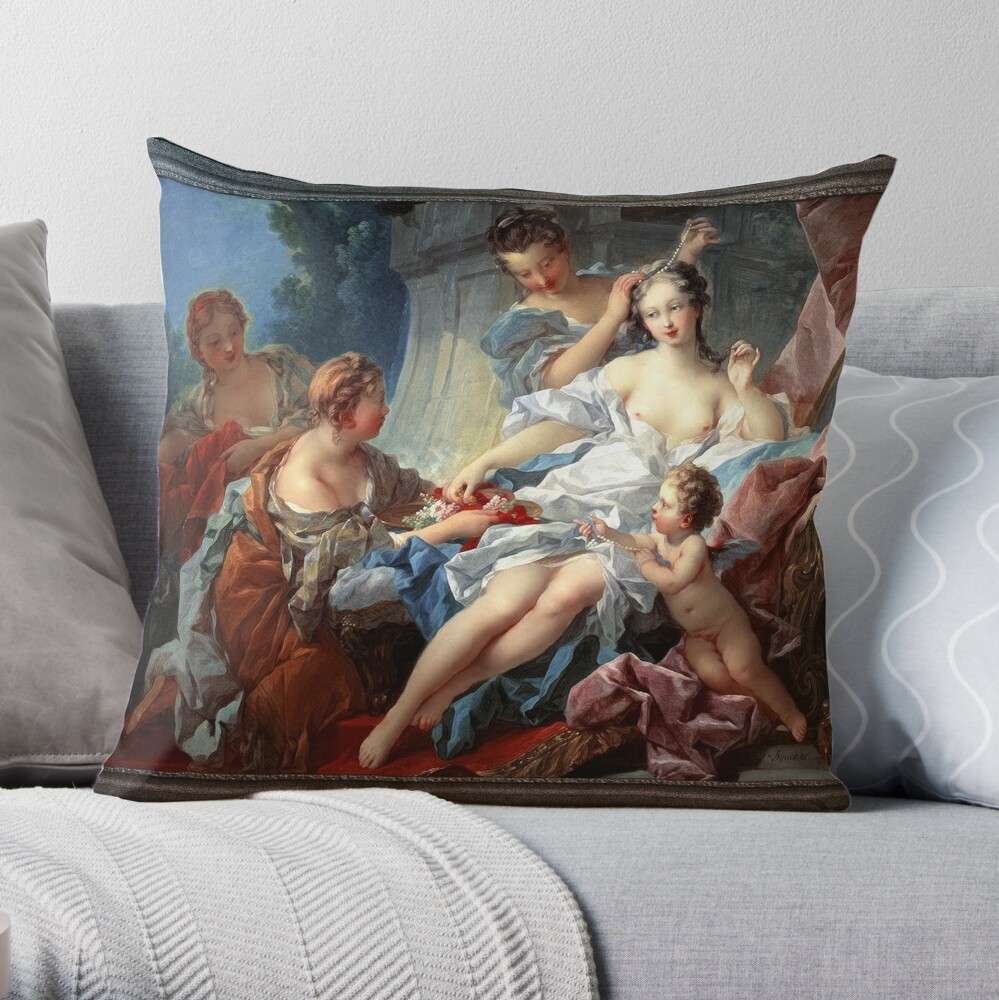
Table of Contents
Compositional Harmony & Setting
The composition unfolds within a shallow, theatrical space defined by classical architectural elements – columns, pilasters, and an arched niche – that frame the central action. These structures are rendered with a soft focus, appearing more as decorative backdrops than structurally significant components. The setting itself is deliberately ambiguous; it’s neither explicitly earthly nor entirely divine, contributing to the painting’s ethereal quality. Lush foliage spills in from the left side of the canvas, further blurring the boundaries between reality and fantasy. A rich red curtain drapes behind Venus, adding a touch of opulent warmth to the scene. The overall effect is one of secluded intimacy within a timeless paradise.
Venus: The Central Figure
Venus, the goddess of love and beauty, occupies the focal point of the painting. She reclines languidly on an ornate chaise lounge, her body partially draped in flowing blue fabric that reveals much more than it conceals. Her pose is relaxed and graceful, conveying a sense of effortless allure. Boucher masterfully captures the softness of her flesh through delicate brushstrokes and subtle gradations of light and shadow. Her expression is serene, almost detached, as she engages with the attendants surrounding her. She isn’t actively participating in the toilette; rather, she seems to be enjoying the attention and the beauty of the moment.
The Attendants: Nymphs & Cupid
Surrounding Venus are several female figures – nymphs – each engaged in a specific task related to her morning ritual. One nymph carefully arranges flowers into a bouquet, while another offers Venus a mirror for inspection. A third gently tends to her hair with a comb and brush. These attendants aren’t portrayed as servants; they appear more like companions or handmaidens, sharing in the goddess’s pleasure and contributing to the overall atmosphere of indulgence. In the lower right corner, Cupid playfully observes the scene, his presence reinforcing the theme of love and desire that permeates the painting. He is depicted with a mischievous grin, adding a touch of lightheartedness to the composition.
Color Palette & Light
Boucher’s use of color is integral to the painting’s aesthetic appeal. The palette is dominated by soft pastels – pinks, blues, greens, and creams – creating a harmonious and visually pleasing effect. These colors are applied with a delicate touch, resulting in a luminous quality that enhances the sense of dreamlike beauty. Light plays a crucial role in shaping the forms and defining the mood. It emanates from an unseen source, softly illuminating Venus and her attendants while leaving portions of the background shrouded in shadow. This chiaroscuro effect accentuates the figures’ sensuality and creates a sense of depth within the shallow space.
Rococo Style & Boucher’s Influence
“The Toilet of Venus” is a prime example of Rococo style, which emerged in France during the 18th century as a reaction against the more formal and grandiose Baroque aesthetic. Rococo art emphasized grace, elegance, and playful sensuality. Boucher was one of the leading exponents of this style, and his paintings were highly sought after by members of the French aristocracy. His work helped to define the Rococo aesthetic, influencing countless artists and shaping the taste of the era. The painting’s focus on pleasure, beauty, and refined leisure reflects the values and aspirations of the French court during the reign of Louis XV.
Technical Mastery & Legacy
Boucher’s technical skill is evident in every detail of “The Toilet of Venus.” His ability to render flesh tones with such subtlety and realism was remarkable for his time. The painting’s composition, color palette, and lighting all contribute to its overall effect of beauty and enchantment. “The Toilet of Venus” remains a celebrated masterpiece of Rococo art, admired for its exquisite beauty, sensual allure, and masterful execution. It continues to inspire artists and captivate viewers with its timeless depiction of feminine grace and idyllic pleasure.
Artist Bio From Wikipedia.org
A native of Paris, Boucher was the son of a lesser known painter Nicolas Boucher, who gave him his first artistic training. At the age of seventeen, a painting by Boucher was admired by the painter François Lemoyne. Lemoyne later appointed Boucher as his apprentice, but after only three months, he went to work for the engraver Jean-François Cars.
In 1720, he won the elite Grand Prix de Rome for painting, but did not take up the consequential opportunity to study in Italy until five years later, due to financial problems at the Académie royale de peinture et de sculpture.[1] On his return from studying in Italy he was admitted to the refounded Académie de peinture et de sculpture on 24 November 1731. His morceau de réception (reception piece) was his Rinaldo and Armida of 1734.
Boucher married Marie-Jeanne Buzeau in 1733. The couple had three children together. Boucher became a faculty member in 1734 and his career accelerated from this point as he was promoted Professor then Rector of the Academy, becoming inspector at the Royal Gobelins Manufactory and finally Premier Peintre du Roi (First Painter of the King) in 1765. Portrait of Marie-Louise O’Murphy c. 1752
Boucher died on 30 May 1770 in his native Paris. His name, along with that of his patron Madame de Pompadour, had become synonymous with the French Rococo style, leading the Goncourt brothers to write: “Boucher is one of those men who represent the taste of a century, who express, personify and embody it.”
Boucher is famous for saying that nature is “trop verte et mal éclairée” (too green and badly lit).
Boucher was associated with the gemstone engraver Jacques Guay, whom he taught to draw. He also mentored the Moravian-Austrian painter Martin Ferdinand Quadal as well as the neoclassical painter Jacques-Louis David in 1767.[4] Later, Boucher made a series of drawings of works by Guay which Madame de Pompadour then engraved and distributed as a handsomely bound volume to favored courtiers
The Toilet of Venus is a retouched digital art reproduction of a public domain image which you can purchase as a rolled canvas print online.