

El inodoro de Venus
The Enchanting Ritual: Examining François Boucher’s “The Toilet of Venus”
El inodoro de Venus, painted by François Boucher’s (1703 – 1770) alrededor 1746, stands as a quintessential example of Rococo art, embodying its characteristic lightness, sensualidad, and decorative elegance. Este lienzo a gran escala, currently housed in the Louvre Museum, transports viewers to an idyllic, dreamlike realm where the goddess Venus is attended by nymphs during her morning toilette. The painting isn’t merely a depiction of bathing; it’s a carefully orchestrated scene designed to evoke pleasure, belleza, and a sense of refined leisure.
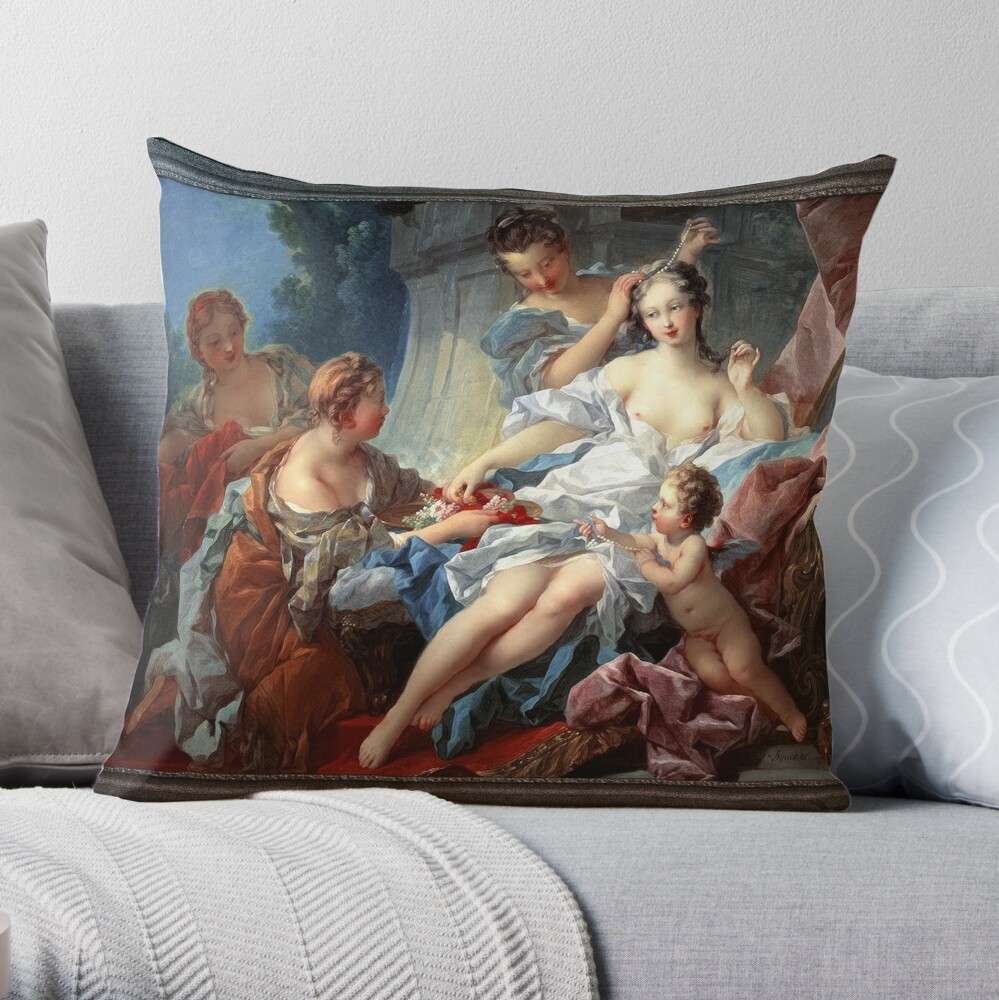
Tabla de contenido
Armonía compositiva & Configuración
The composition unfolds within a shallow, theatrical space defined by classical architectural elements – columns, pilasters, and an arched niche – that frame the central action. These structures are rendered with a soft focus, appearing more as decorative backdrops than structurally significant components. The setting itself is deliberately ambiguous; it’s neither explicitly earthly nor entirely divine, contributing to the painting’s ethereal quality. Lush foliage spills in from the left side of the canvas, further blurring the boundaries between reality and fantasy. A rich red curtain drapes behind Venus, adding a touch of opulent warmth to the scene. The overall effect is one of secluded intimacy within a timeless paradise.
Venus: La figura central
Venus, the goddess of love and beauty, occupies the focal point of the painting. She reclines languidly on an ornate chaise lounge, her body partially draped in flowing blue fabric that reveals much more than it conceals. Her pose is relaxed and graceful, conveying a sense of effortless allure. Boucher masterfully captures the softness of her flesh through delicate brushstrokes and subtle gradations of light and shadow. Su expresión es serena, casi separado, as she engages with the attendants surrounding her. She isn’t actively participating in the toilette; bastante, she seems to be enjoying the attention and the beauty of the moment.
Los asistentes: Ninfas & Cupido
Surrounding Venus are several female figures – nymphs – each engaged in a specific task related to her morning ritual. One nymph carefully arranges flowers into a bouquet, while another offers Venus a mirror for inspection. A third gently tends to her hair with a comb and brush. These attendants aren’t portrayed as servants; they appear more like companions or handmaidens, sharing in the goddess’s pleasure and contributing to the overall atmosphere of indulgence. In the lower right corner, Cupid playfully observes the scene, his presence reinforcing the theme of love and desire that permeates the painting. He is depicted with a mischievous grin, adding a touch of lightheartedness to the composition.
Paleta de colores & Luz
Boucher’s use of color is integral to the painting’s aesthetic appeal. The palette is dominated by soft pastels – pinks, blues, verduras, and creams – creating a harmonious and visually pleasing effect. These colors are applied with a delicate touch, resulting in a luminous quality that enhances the sense of dreamlike beauty. Light plays a crucial role in shaping the forms and defining the mood. It emanates from an unseen source, softly illuminating Venus and her attendants while leaving portions of the background shrouded in shadow. This chiaroscuro effect accentuates the figures’ sensuality and creates a sense of depth within the shallow space.
Rococo Style & Boucher’s Influence
“El inodoro de Venus” is a prime example of Rococo style, which emerged in France during the 18th century as a reaction against the more formal and grandiose Baroque aesthetic. Rococo art emphasized grace, elegancia, y sensualidad juguetona. Boucher was one of the leading exponents of this style, and his paintings were highly sought after by members of the French aristocracy. His work helped to define the Rococo aesthetic, influencing countless artists and shaping the taste of the era. The painting’s focus on pleasure, belleza, and refined leisure reflects the values and aspirations of the French court during the reign of Louis XV.
Dominio técnico & Legado
Boucher’s technical skill is evident in every detail of “The Toilet of Venus.” His ability to render flesh tones with such subtlety and realism was remarkable for his time. The painting’s composition, color palette, and lighting all contribute to its overall effect of beauty and enchantment. “El inodoro de Venus” remains a celebrated masterpiece of Rococo art, admired for its exquisite beauty, sensual allure, y ejecución magistral. It continues to inspire artists and captivate viewers with its timeless depiction of feminine grace and idyllic pleasure.
Biografía del artista de Wikipedia.org
Un nativo de París, Boucher era hijo de un pintor menos conocido, Nicolas Boucher., quien le dio su primera formación artística. A la edad de diecisiete, un cuadro de Boucher fue admirado por el pintor François Lemoyne. Más tarde, Lemoyne nombró a Boucher como su aprendiz., pero despues de solo tres meses, se fue a trabajar para el grabador Jean-François Cars.
En 1720, ganó el Gran Premio de Roma de élite de pintura, pero no aprovechó la consecuente oportunidad de estudiar en Italia hasta cinco años después, por problemas económicos en la Real Academia de Pintura y Escultura.[1] A su regreso de estudiar en Italia fue admitido en la refundada Académie de peinture et de sculpture en 24 noviembre 1731. Su pieza de recepción (pieza de recepción) era su Rinaldo y Armida de 1734.
Boucher se casó con Marie-Jeanne Buzeau en 1733. La pareja tuvo tres hijos juntos.. Boucher se convirtió en miembro de la facultad de 1734 y su carrera se aceleró a partir de este punto cuando fue ascendido a Profesor y luego Rector de la Academia., convirtiéndose en inspector de la Royal Gobelins Manufactory y finalmente en Premier Peintre du Roi (Primer pintor del rey) en 1765. Retrato de Marie-Louise O'Murphy c. 1752
Boucher murió el 30 Mayo 1770 en su París natal. Su nombre, junto con la de su mecenas Madame de Pompadour, se había convertido en sinónimo del estilo rococó francés, llevando a los hermanos Goncourt a escribir: “Boucher es uno de esos hombres que representan el gusto de un siglo, quien expresa, personificarlo y encarnarlo.”
Boucher es famoso por decir que la naturaleza es “demasiado verde y mal iluminado” (demasiado verde y mal iluminado).
Boucher se asoció con el grabador de piedras preciosas Jacques Guay, a quien le enseñó a dibujar. También fue mentor del pintor de Moravia-Austria Martin Ferdinand Quadal, así como del pintor neoclásico Jacques-Louis David en 1767.[4] Mas tarde, Boucher hizo una serie de dibujos de obras de Guay que Madame de Pompadour luego grabó y distribuyó como un volumen bellamente encuadernado a los cortesanos predilectos.
The Toilet of Venus es una reproducción de arte digital retocada de una imagen de dominio público que puede comprar como impresión de lienzo enrollado.