

El inodoro de Venus: El encanto del ocio
El inodoro de Venus, esta versión fue pintada por François Boucher (1703 – 1770) alrededor 1751; y se erige como un ejemplo por excelencia del arte rococó, encarnando su sensualidad característica, elegancia, y representación lúdica de temas mitológicos. Este lienzo a gran escala, Actualmente reside en el Museo del Louvre., transporta a los espectadores a un reino de belleza idílica y placer placentero, mostrando el dominio del color de Boucher, luz, y composición. La pintura no es simplemente una representación de la diosa Venus.; es una exploración de la gracia femenina dentro de un paisaje de fantasía cuidadosamente construido..
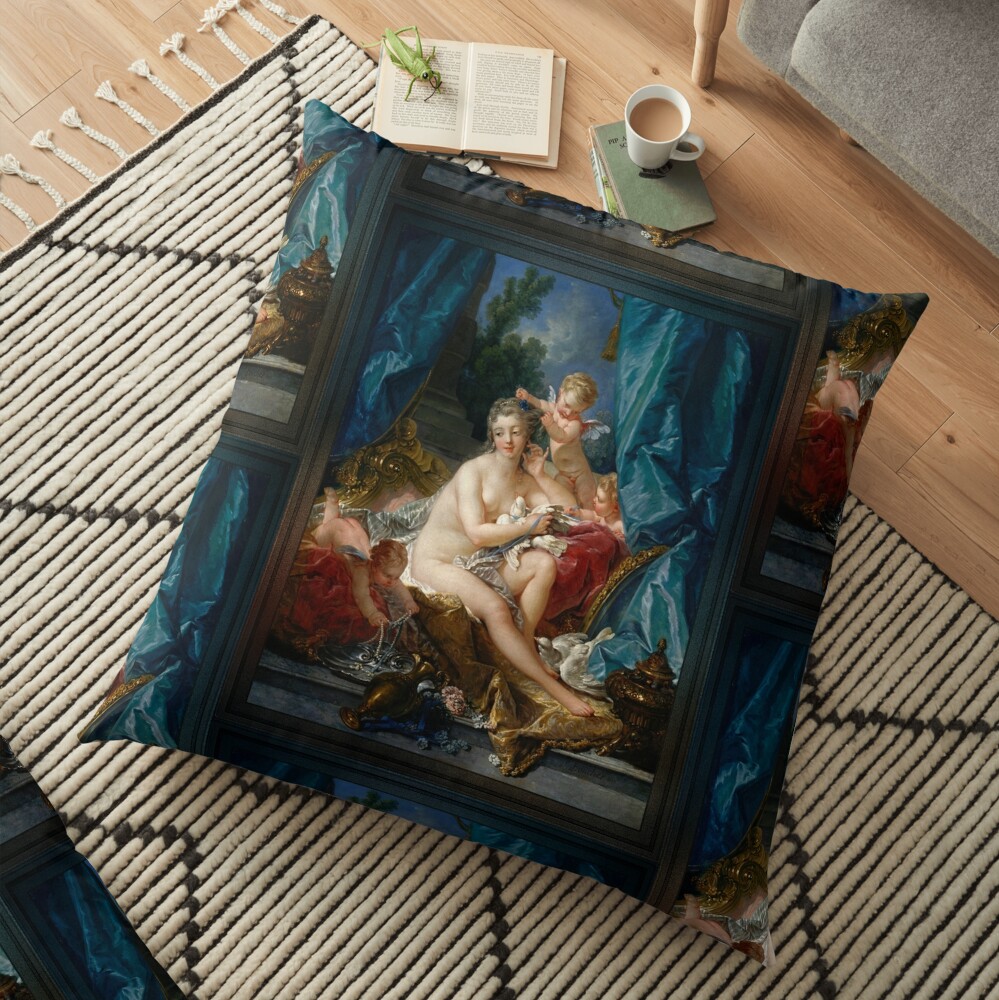
Tabla de contenido
Un escenario de delicados rituales
la figura central, innegablemente venus (Afrodita en la mitología griega), se reclina sobre un diván lujosamente adornado. Ella es representada en mitad de la acción., comprometida en el acto íntimo de peinarse. Su postura es relajada y elegante., Transmitir un aire de serena satisfacción en lugar de cualquier sensación de formalidad o grandeza.. El objetivo del artista no es retratar a Venus como una deidad poderosa sino más bien como una hermosa mujer disfrutando de un momento de cuidado personal..
Ella sostiene un pequeño espejo a un lado., aparentemente admirando su reflejo mientras una criada coloca suavemente cintas en su cabello. Esta escena íntima está muy alejada de las narrativas heroicas a menudo asociadas con la mitología clásica.; en cambio, enfatiza la domesticidad y el placer privado..
Compañeros querúbicos & Detalles decorativos
Alrededor de Venus hay varios querubines., figuras características dentro del arte rococó. Estos espíritus juguetones revolotean, atendiendo las necesidades de la diosa. Un querubín sopla burbujas juguetonamente, mientras otro ofrece un ramo de flores. Su presencia añade un elemento de ligereza y fantasía a la escena., Reforzando la atmósfera general de disfrute sin preocupaciones..
La chaise lounge en sí es una obra maestra de detalles decorativos., con tallas intrincadas y telas lujosas en ricos rojos y dorados. Esparcidos alrededor de Venus hay varios objetos asociados con la belleza y el adorno.: botellas de perfume, rosas esparcidas, joyas, y un pequeño conejo blanco, todo lo cual contribuye a la opulenta estética de la pintura..
Un escenario de opulencia & Naturaleza
El escenario de esta idílica escena es igualmente importante.. Cortinas azules pesadas enmarcan la composición a ambos lados., creando una sensación de teatralidad y cerramiento. Más allá de estas cortinas se vislumbra un exuberante jardín con árboles verdes y arquitectura clásica en la distancia.. Este telón de fondo cuidadosamente construido sugiere un paraíso apartado., mejorando aún más la sensación de privacidad e indulgencia. Destaca especialmente el uso de la luz.; Boucher emplea magistralmente, iluminación difusa para iluminar la figura de Venus, resaltando la luminosidad de su piel y creando una sensación de calidez e intimidad.
Paleta de colores & Técnica artística
La paleta de colores de Boucher en “El retrete de Venus” está dominada por los tonos pastel: los rosas, blues, verduras, y dorados, que son sellos distintivos del estilo rococó. Estos colores suaves contribuyen a la sensación general de ligereza y delicadeza de la pintura.. Su pincelada es suelta y fluida., creando una sensación de movimiento y espontaneidad.. La técnica del artista prioriza capturar la esencia de la belleza y el placer por encima del realismo estricto. Utiliza sutiles gradaciones de color para modelar la forma de Venus., enfatizando sus curvas y contornos manteniendo una calidad etérea.

Contexto & Legado
"El baño de Venus" se creó durante un período en el que el arte rococó floreció en Francia., particularmente bajo el patrocinio de Madame de Pompadour, La influyente amante de Louis XV. Boucher se convirtió en el artista líder de este estilo., conocido por sus pinturas decorativas que atendían los gustos de la aristocracia. La pintura refleja los valores culturales predominantes de la época: un énfasis en el placer., belleza, y ocio refinado.
Es un testimonio de la capacidad de Boucher para crear obras visualmente impresionantes que capturaron el espíritu de la era rococó y continúan cautivando al público con su encanto y elegancia.. La influencia de la obra se puede ver en tendencias artísticas posteriores., particularly in depictions of idealized feminine figures and the use of decorative elements to enhance visual appeal.
Biografía del artista de Wikipedia.org
Un nativo de París, Boucher era hijo de un pintor menos conocido, Nicolas Boucher., quien le dio su primera formación artística. A la edad de diecisiete, un cuadro de Boucher fue admirado por el pintor François Lemoyne. Más tarde, Lemoyne nombró a Boucher como su aprendiz., pero despues de solo tres meses, se fue a trabajar para el grabador Jean-François Cars.
En 1720, ganó el Gran Premio de Roma de élite de pintura, pero no aprovechó la consecuente oportunidad de estudiar en Italia hasta cinco años después, por problemas económicos en la Real Academia de Pintura y Escultura.[1] A su regreso de estudiar en Italia fue admitido en la refundada Académie de peinture et de sculpture en 24 noviembre 1731. Su pieza de recepción (pieza de recepción) era su Rinaldo y Armida de 1734.
Boucher se casó con Marie-Jeanne Buzeau en 1733. La pareja tuvo tres hijos juntos.. Boucher se convirtió en miembro de la facultad de 1734 y su carrera se aceleró a partir de este punto cuando fue ascendido a Profesor y luego Rector de la Academia., convirtiéndose en inspector de la Royal Gobelins Manufactory y finalmente en Premier Peintre du Roi (Primer pintor del rey) en 1765. Retrato de Marie-Louise O'Murphy c. 1752
Boucher murió el 30 Mayo 1770 en su París natal. Su nombre, junto con la de su mecenas Madame de Pompadour, se había convertido en sinónimo del estilo rococó francés, llevando a los hermanos Goncourt a escribir: “Boucher es uno de esos hombres que representan el gusto de un siglo, quien expresa, personificarlo y encarnarlo.”
Boucher es famoso por decir que la naturaleza es “demasiado verde y mal iluminado” (demasiado verde y mal iluminado).
Boucher se asoció con el grabador de piedras preciosas Jacques Guay, a quien le enseñó a dibujar. También fue mentor del pintor de Moravia-Austria Martin Ferdinand Quadal, así como del pintor neoclásico Jacques-Louis David en 1767.[4] Mas tarde, Boucher hizo una serie de dibujos de obras de Guay que Madame de Pompadour luego grabó y distribuyó como un volumen bellamente encuadernado a los cortesanos predilectos.
El inodoro de Venus es una reproducción de arte digital retocada de una imagen de dominio público., que se puede comprar como Esta es una elegante chica de glamour art deco vintage..