

It húske fan Venus
The Enchanting Ritual: Examining François Boucher’s “The Toilet of Venus”
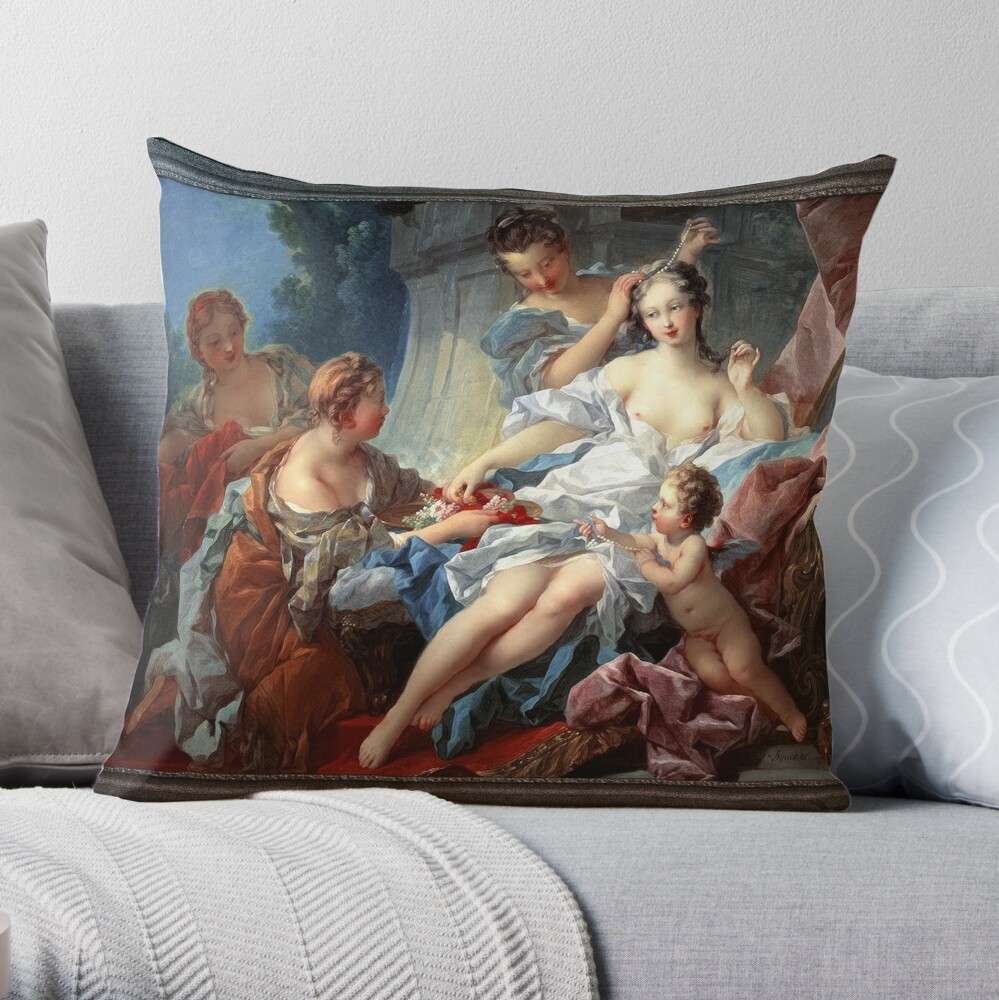
It húske fan Venus, painted by François Boucher’s (1703 – 1770) rûnom 1746, stands as a quintessential example of Rococo art, embodying its characteristic lightness, sensualiteit, and decorative elegance. Dit grutskalige doek, currently housed in the Louvre Museum, transports viewers to an idyllic, dreamlike realm where the goddess Venus is attended by nymphs during her morning toilette. The painting isn’t merely a depiction of bathing; it’s a carefully orchestrated scene designed to evoke pleasure, skientme, and a sense of refined leisure.
Ynhâldsopjefte
Komposysje Harmonie & Setting
The composition unfolds within a shallow, theatrical space defined by classical architectural elements – columns, pilasters, and an arched niche – that frame the central action. These structures are rendered with a soft focus, appearing more as decorative backdrops than structurally significant components. The setting itself is deliberately ambiguous; it’s neither explicitly earthly nor entirely divine, contributing to the painting’s ethereal quality. Lush foliage spills in from the left side of the canvas, further blurring the boundaries between reality and fantasy. A rich red curtain drapes behind Venus, adding a touch of opulent warmth to the scene. The overall effect is one of secluded intimacy within a timeless paradise.
Venus: De sintrale figuer
Venus, the goddess of love and beauty, occupies the focal point of the painting. She reclines languidly on an ornate chaise lounge, her body partially draped in flowing blue fabric that reveals much more than it conceals. Her pose is relaxed and graceful, conveying a sense of effortless allure. Boucher masterfully captures the softness of her flesh through delicate brushstrokes and subtle gradations of light and shadow. Har útdrukking is serene, almost detached, as she engages with the attendants surrounding her. She isn’t actively participating in the toilette; leaver, she seems to be enjoying the attention and the beauty of the moment.
The Attendants: Nymphs & Cupido
Surrounding Venus are several female figures – nymphs – each engaged in a specific task related to her morning ritual. One nymph carefully arranges flowers into a bouquet, while another offers Venus a mirror for inspection. A third gently tends to her hair with a comb and brush. These attendants aren’t portrayed as servants; they appear more like companions or handmaidens, sharing in the goddess’s pleasure and contributing to the overall atmosphere of indulgence. In the lower right corner, Cupid playfully observes the scene, his presence reinforcing the theme of love and desire that permeates the painting. He is depicted with a mischievous grin, adding a touch of lightheartedness to the composition.
Kleurpalet & Ljocht
Boucher’s use of color is integral to the painting’s aesthetic appeal. The palette is dominated by soft pastels – pinks, blues, greens, and creams – creating a harmonious and visually pleasing effect. These colors are applied with a delicate touch, resulting in a luminous quality that enhances the sense of dreamlike beauty. Light plays a crucial role in shaping the forms and defining the mood. It emanates from an unseen source, softly illuminating Venus and her attendants while leaving portions of the background shrouded in shadow. This chiaroscuro effect accentuates the figures’ sensuality and creates a sense of depth within the shallow space.
Rococo Style & Boucher’s Influence
“It húske fan Venus” is a prime example of Rococo style, which emerged in France during the 18th century as a reaction against the more formal and grandiose Baroque aesthetic. Rococo art emphasized grace, sierlikens, and playful sensuality. Boucher was one of the leading exponents of this style, and his paintings were highly sought after by members of the French aristocracy. His work helped to define the Rococo aesthetic, influencing countless artists and shaping the taste of the era. The painting’s focus on pleasure, skientme, and refined leisure reflects the values and aspirations of the French court during the reign of Louis XV.
Technyske behearsking & Legacy
Boucher’s technical skill is evident in every detail of “The Toilet of Venus.” His ability to render flesh tones with such subtlety and realism was remarkable for his time. The painting’s composition, Kleurpalet, and lighting all contribute to its overall effect of beauty and enchantment. “It húske fan Venus” remains a celebrated masterpiece of Rococo art, admired for its exquisite beauty, sensual allure, en masterlike útfiering. It continues to inspire artists and captivate viewers with its timeless depiction of feminine grace and idyllic pleasure.
Artist Bio From Wikipedia.org
In ynwenner fan Parys, Boucher wie de soan fan in minder bekende skilder Nicolas Boucher, dy't him syn earste artistike oplieding joech. Op de leeftyd fan santjin, in skilderij fan Boucher waard bewûndere troch de skilder François Lemoyne. Lemoyne beneamde Boucher letter as syn learling, mar nei mar trije moannen, hy gie oan it wurk by de graveur Jean-François Cars.
Yn 1720, hy wûn de elite Grand Prix de Rome foar skilderjen, mar grypte pas fiif jier letter de dêropfolgjende kâns oan om yn Itaalje te studearjen, fanwege finansjele problemen oan de Royal Academy of Painting and Sculpture.[1] Doe't er werom kaam fan syn stúdzje yn Itaalje, waard er talitten ta de opnij oprjochte Académie de peinture et de sculpture op 24 novimber 1731. Syn resepsjestik (resepsje stik) wie syn Rinaldo en Armida fan 1734.
Boucher troude mei Marie-Jeanne Buzeau yn 1733. It pear krige tegearre trije bern. Boucher waard fakulteitslid yn 1734 en syn karriêre fersnelle fan dit punt ôf doe't hy promovearre waard as professor doe rektor fan 'e Akademy, wurde ynspekteur by de Royal Gobelins Manufactory en úteinlik premier Peintre du Roi (Earste skilder fan 'e kening) yn 1765. Portret fan Marie-Louise O'Murphy c. 1752
Boucher ferstoar op 30 Meie 1770 yn syn bertelân Parys. Syn namme, tegearre mei dy fan syn beskermhear Madame de Pompadour, wie synonym wurden mei de Frânske rokokostyl, liedt de bruorren Goncourt te skriuwen: “Boucher is ien fan dy manlju dy't de smaak fan in ieu fertsjintwurdigje, dy't útdrukke, personifisearje en ferbyldzje it.”
Boucher is ferneamd om te sizzen dat de natuer is “te grien en min ferljochte” (te grien en min ferljochte).
Boucher waard ferbûn mei de edelstiennen graveur Jacques Guay, dy't hy learde te tekenjen. Hy begeliede ek de Moravysk-Eastenrykske skilder Martin Ferdinand Quadal en de neoklassisistyske skilder Jacques-Louis David yn 1767.[4] Letter, Boucher makke in searje tekeningen fan wurken fan Guay dy't Madame de Pompadour doe gravearre en ferspraat as in kreas bûn bondel oan begeunstige hovelingen
The Toilet of Venus is a retouched digital art reproduction of a public domain image which you can purchase as a opgerold canvas print online.