

Venus and Adonis
“Venus and Adonis,” sortua 1729 by French painter François Lemoyne (1688 – 1737), presents a masterful depiction of a mythological scene from Ovid’s “Metamorphoses.” The painting captures an intense and emotional moment between the goddess Venus and her beloved Adonis. The work exemplifies the Rococo style that was flourishing in France at the time, characterized by its delicate forms, fluid brushwork, and light, ethereal color palette. Lemoyne’s expertise in rendering human forms and dramatic emotion is evident in this piece, which conveys a tender yet tragic narrative.
Edukien taula
Gai nagusia eta osaera
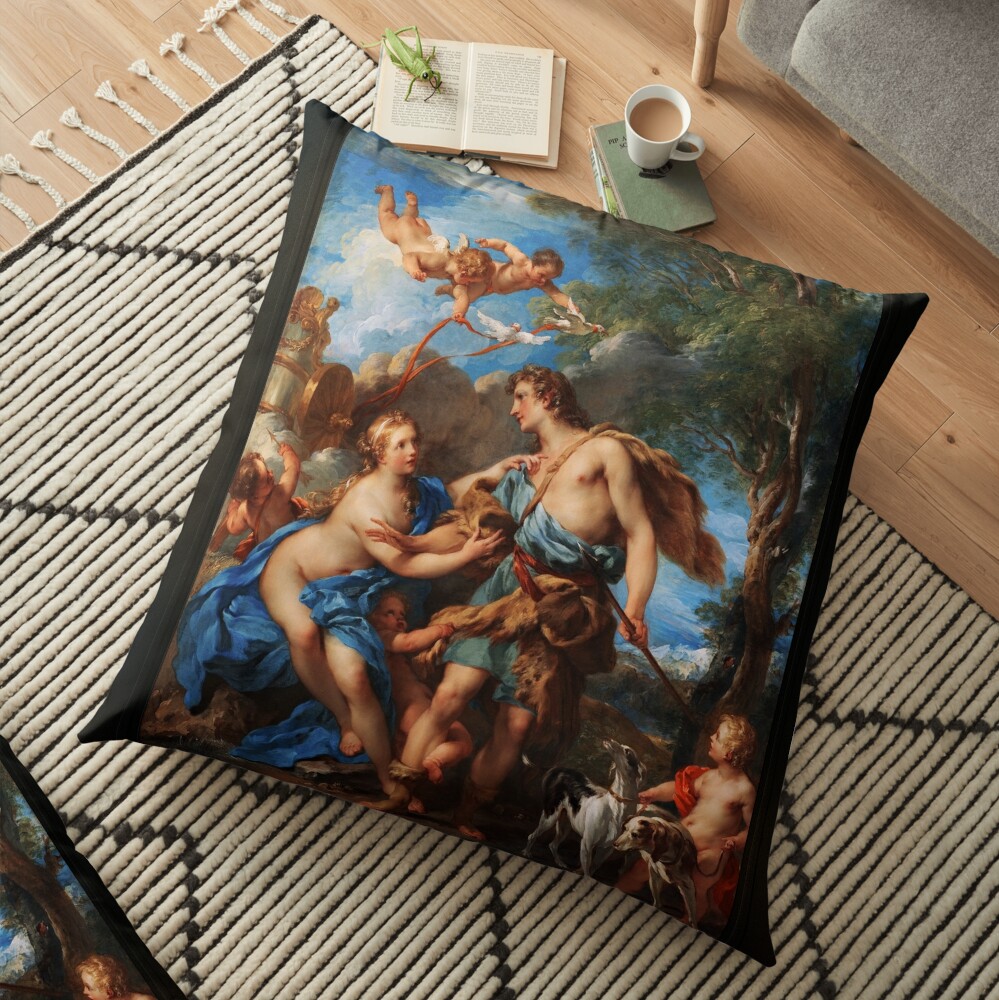
The central figures in “Venus and Adonis” are the goddess Venus and her mortal lover Adonis. Venu, depicted in a state of divine beauty, reaches toward Adonis, her expression filled with sorrow and longing. She is partially unclad, her flowing blue drapery accentuating her sensuous form. Her posture is one of both entreaty and desperation, as she gazes at Adonis, urging him not to go hunting despite the danger that lies ahead. The connection between the two figures is palpable—Venus’s hand rests gently on Adonis’s arm as if trying to keep him from leaving her side.
Adonis, muscular and youthful, stands in contrast to Venus’s softness. His attire is minimal, save for a brief loincloth and a fur mantle, highlighting his athletic form. His posture is firm, resolute, as he is seemingly determined to pursue his love for hunting. His gaze, hala ere, is conflicted, torn between his affection for Venus and his passion for the hunt, which will ultimately lead to his tragic death.
The figures are surrounded by playful cherubs, or putti, who represent the playful and amorous nature of Venus herself. Two cherubs are seen flying overhead, holding ribbons that further emphasize the dynamic and lively atmosphere of the scene. Other cherubs stand or crouch around the couple, some holding a bow, while another gently cradles a goat—perhaps an allusion to the innocent and untamed side of nature that both Venus and Adonis are drawn to.
The Landscape and Setting
The landscape in “Venus and Adonis” is an idealized pastoral scene, lush with greenery and dotted with trees, suggesting a peaceful and fertile world that contrasts with the impending violence of the hunt. Biguna, rolling hills are bathed in a warm light that gives the composition a serene, ia ametsezko kalitatea. This idyllic setting enhances the emotional tension of the narrative, as it serves as a backdrop to the tragic story of love and loss.
The sky in the painting is equally important, painted with a vibrant yet soft blue that leads the viewer’s eye upward toward the cherubs in flight. The clouds are soft and billowy, creating a sense of movement and lightness that contrasts with the heavy emotions depicted below. Konposizio osoa, both terrestrial and celestial, is bathed in golden hues that reflect the Rococo style’s emphasis on lightness and beauty.
Materialak eta Teknikak
Lemoyne’s use of oil paints is exemplary in this work. Pintzelada leuna eta zehatza da, with no visible strokes that might interrupt the soft, almost velvety texture of the scene. The paint is layered with great care to achieve a luminous, distira efektua Venus eta Adonisen azal-tonuetan, haien edertasuna eta bizitasuna nabarmenduz. Artistak xehetasunetarako duen arreta nabaria da ehunen erreprodukzioan, bereziki Artizarraren soineko urdin lehorra, piezari mugimendu sentsazioa gehitzen dioten toles leunekin irudikatzen dena.
Kerubinak bizia ematen dien ukimen arintasunez margotuta daude, haien ezaugarri delikatuak eta gorputz biribilduak Artizarraren eta Adonisen forma helduagoekin kontrastatzen dituzte. Adonisen larru-mantuaren ehundurak eta leunak, Artizarraren larruazal ezak margolanaren ukimen-kalitateari laguntzen dio, ikuslea bere azalaren leuntasuna eta Adonisen janzkeraren zakartasuna imajinatzera gonbidatuz.
Estilo, Gai, eta umorea
“Venus and Adonis” Rococo estiloa gorpuzten du, sentsualitatean duen enfasia du ezaugarri, arintasuna, eta adierazpen emozionala. The color palette of soft pastels and golden tones creates a dreamy atmosphere, while the smoothness of the brushwork enhances the ethereal quality of the scene. The sensuality of the figures and the emotional intensity of their interaction convey the Rococo fascination with love, pasioa, and the fragility of life.
The theme of the painting is grounded in classical mythology, specifically the tragic love story between Venus, maitasunaren jainkosa, and Adonis, the mortal who is beloved by her. This mythological tale speaks to the transience of beauty and life, as Adonis, despite his beauty and youth, is fated to die in a hunting accident, leaving Venus devastated. Lemoyne captures this poignant moment just before Adonis leaves, making the viewer acutely aware of the impending loss.
The mood of the painting is a delicate balance between tenderness and sorrow. The figures of Venus and Adonis are rendered with such emotional depth that the viewer cannot help but feel the weight of their parting. The cherubs, with their playful energy, add a layer of irony to the scene, as they seem unaware of the tragedy that is about to unfold. This combination of innocence and impending doom creates a deeply moving atmosphere.
Bukaera
François Lemoyne’s “Venus and Adonis” is a stunning example of Rococo art that combines mythological narrative, sakontasun emozionala, eta maisutasun teknikoa. Konposizioa, rich with detail and movement, invites the viewer into a world of beauty, maite izan, eta galera. Lemoyne’s use of light, ehundura, and color creates a scene that is both serene and emotionally charged, capturing the moment of love just before its tragic end. Pintura hau, with its emphasis on sensuality, emotional expression, and classical themes, stands as a testament to the elegance and complexity of Rococo art.
Arte digital birmasterizatua da, sarean mihise inprimatu gisa eskuragarri dagoen domeinu publikoko irudi baten erreprodukzioa..