

Venus and Adonis
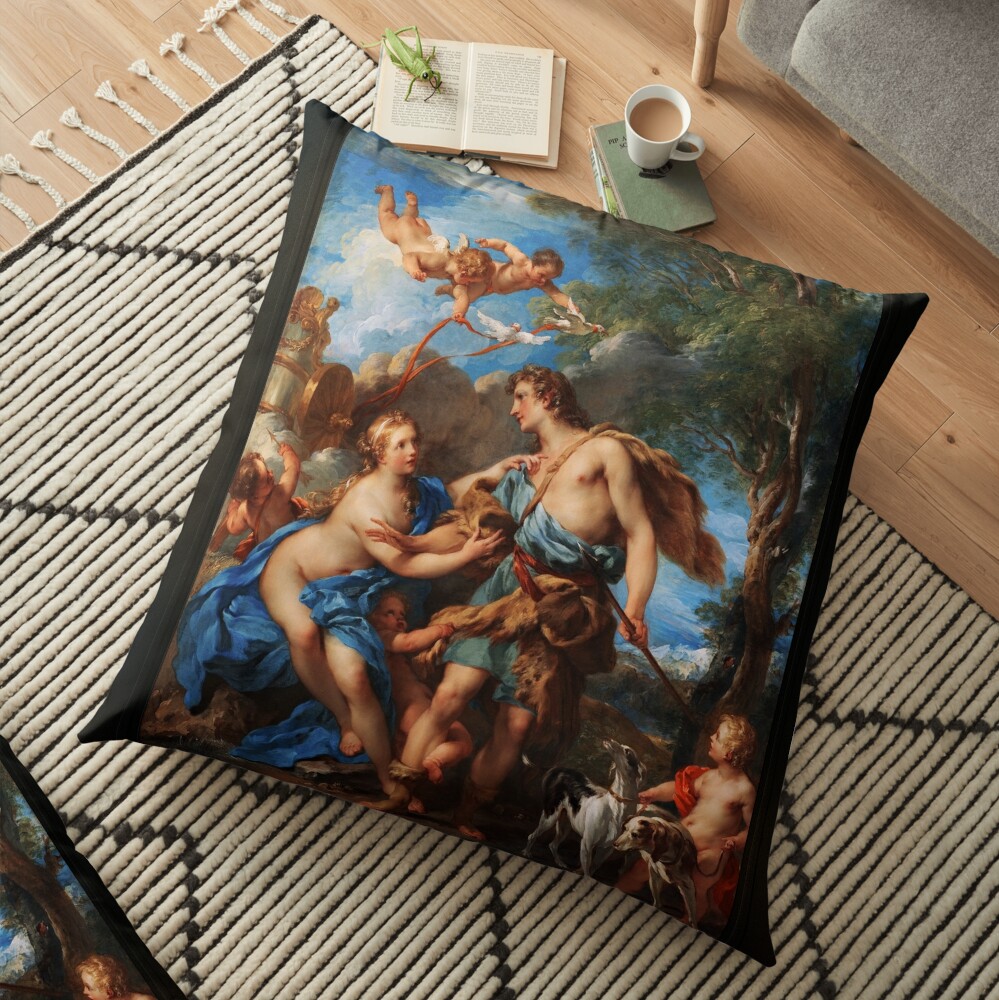
“Venus and Adonis,” erstallt an 1729 vum franséischen Moler François Lemoyne (1688 – 1737), presents a masterful depiction of a mythological scene from Ovid’s “Metamorphoses.” The painting captures an intense and emotional moment between the goddess Venus and her beloved Adonis. The work exemplifies the Rococo style that was flourishing in France at the time, characterized by its delicate forms, fluid brushwork, a Liicht, ethereal color palette. Lemoyne’s expertise in rendering human forms and dramatic emotion is evident in this piece, which conveys a tender yet tragic narrative.
Inhaltsverzeechnes
Den Haaptthema a Kompositioun
The central figures in “Venus and Adonis” are the goddess Venus and her mortal lover Adonis. Venus, depicted in a state of divine beauty, reaches toward Adonis, her expression filled with sorrow and longing. She is partially unclad, her flowing blue drapery accentuating her sensuous form. Her posture is one of both entreaty and desperation, as she gazes at Adonis, urging him not to go hunting despite the danger that lies ahead. The connection between the two figures is palpable—Venus’s hand rests gently on Adonis’s arm as if trying to keep him from leaving her side.
Adonis, muscular and youthful, stands in contrast to Venus’s softness. His attire is minimal, save for a brief loincloth and a fur mantle, highlighting his athletic form. His posture is firm, resolute, as he is seemingly determined to pursue his love for hunting. His gaze, awer, is conflicted, torn between his affection for Venus and his passion for the hunt, wat schlussendlech zu sengem trageschen Doud féiert.
D'Figure si vu spilleresche Cherubs ëmgi, oder putti, déi déi spilleresch an amoréis Natur vun der Venus selwer representéieren. Zwee Cherubs si gesinn iwwer de Kapp fléien, hält Bännercher déi déi dynamesch a lieweg Atmosphär vun der Zeen weider ënnersträichen. Aner Cherubs stinn oder krouchen ronderëm d'Koppel, e puer hält e Bou, während eng aner sanft eng Geess wéckelt - vläicht eng Allusioun op déi onschëlleg an ongetämt Säit vun der Natur, op déi d'Venus an d'Adonis ugezunn sinn.
The Landscape and Setting
Landschaft an “Venus and Adonis” ass eng idealiséiert Pastoralzeen, üppig mat Gréngs a mat Beem gestippelt, suggeréiert eng friddlech a fruchtbar Welt déi kontrastéiert mat der bevirsteet Gewalt vun der Juegd. Der mëller, Rolling Hiwwele ginn an engem waarme Liicht gebad, wat d'Kompositioun e roueg gëtt, bal dreemen Qualitéit. This idyllic setting enhances the emotional tension of the narrative, as it serves as a backdrop to the tragic story of love and loss.
The sky in the painting is equally important, painted with a vibrant yet soft blue that leads the viewer’s eye upward toward the cherubs in flight. The clouds are soft and billowy, creating a sense of movement and lightness that contrasts with the heavy emotions depicted below. The entire composition, both terrestrial and celestial, is bathed in golden hues that reflect the Rococo style’s emphasis on lightness and beauty.
Materialien an Techniken
Lemoyne’s use of oil paints is exemplary in this work. D'Brushwork ass glat a präzis, with no visible strokes that might interrupt the soft, almost velvety texture of the scene. The paint is layered with great care to achieve a luminous, glowing effect on the skin tones of Venus and Adonis, highlighting their beauty and vitality. The artist’s attention to detail is evident in the rendering of fabrics, particularly Venus’s flowing blue gown, which is depicted with soft folds that add a sense of movement to the piece.
The cherubs are painted with a lightness of touch that brings them to life, their delicate features and rounded bodies contrasting with the more mature forms of Venus and Adonis. The textures of the fur mantle on Adonis and the smooth, unblemished skin of Venus further contribute to the tactile quality of the painting, inviting the viewer to imagine the softness of their skin and the roughness of Adonis’s attire.
Stil, Thema, a Stëmmung
“Venus and Adonis” embodies the Rococo style, characterized by its emphasis on sensuality, Léifen, an emotional Ausdrock. The color palette of soft pastels and golden tones creates a dreamy atmosphere, while the smoothness of the brushwork enhances the ethereal quality of the scene. The sensuality of the figures and the emotional intensity of their interaction convey the Rococo fascination with love, Leidenschaft, and the fragility of life.
The theme of the painting is grounded in classical mythology, specifically the tragic love story between Venus, d'Gëttin vun der Léift, and Adonis, the mortal who is beloved by her. This mythological tale speaks to the transience of beauty and life, as Adonis, despite his beauty and youth, is fated to die in a hunting accident, leaving Venus devastated. Lemoyne captures this poignant moment just before Adonis leaves, making the viewer acutely aware of the impending loss.
The mood of the painting is a delicate balance between tenderness and sorrow. The figures of Venus and Adonis are rendered with such emotional depth that the viewer cannot help but feel the weight of their parting. The cherubs, with their playful energy, add a layer of irony to the scene, as they seem unaware of the tragedy that is about to unfold. This combination of innocence and impending doom creates a deeply moving atmosphere.
Conclusioun
François Lemoyne’s “Venus and Adonis” is a stunning example of Rococo art that combines mythological narrative, emotional Déift, an technesch Maîtrise. D'Kompositioun, rich with detail and movement, invites the viewer into a world of beauty, Léift, a Verloscht. Lemoyne’s use of light, Texture, and color creates a scene that is both serene and emotionally charged, capturing the moment of love just before its tragic end. Dëst Bild, with its emphasis on sensuality, emotional Ausdrock, and classical themes, stands as a testament to the elegance and complexity of Rococo art.
Dëst ass eng remastered digital Konscht al Master Reproduktioun vun engem Public Domain Bild dat als Canvas Print online verfügbar ass.