

Venus On The Waves
Venus On The Waves: A Rococo Dreamscape
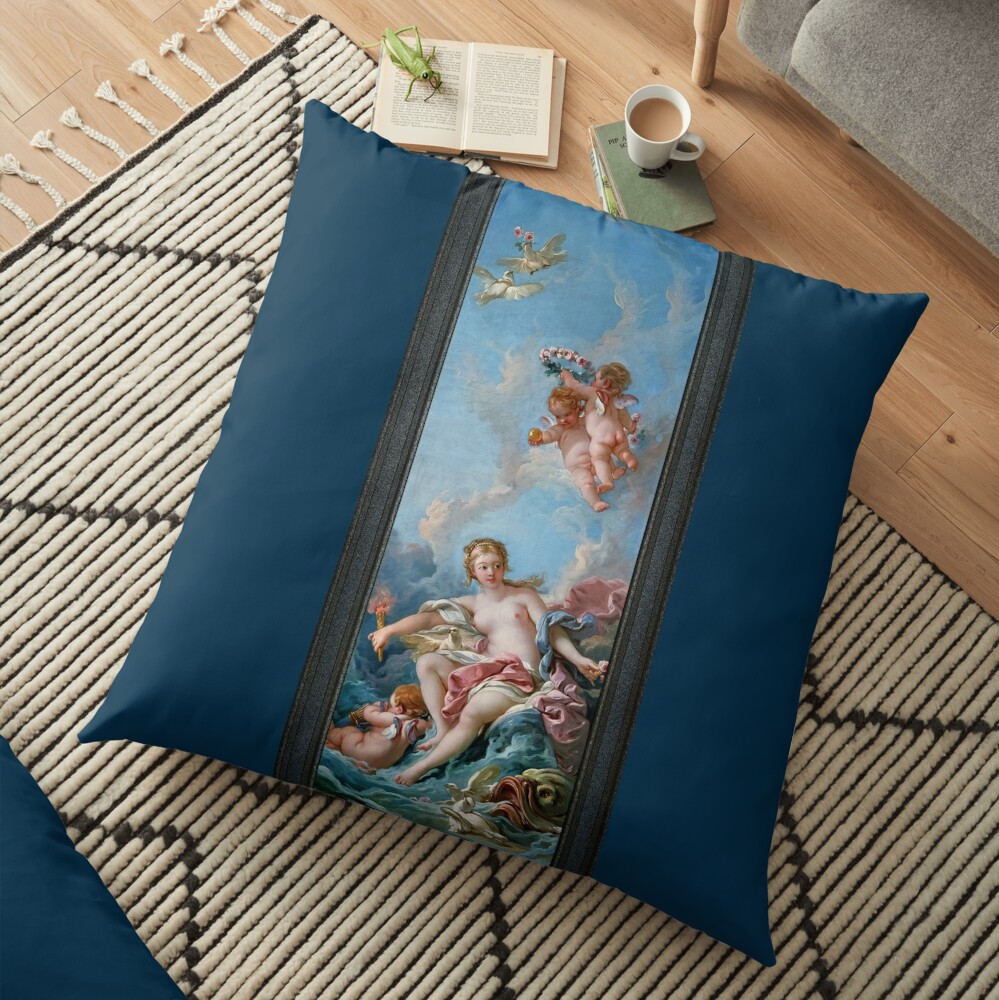
Francois Boucher’s (1703 – 1770) “Venus on the Waves,” paentio o gwmpas 1769, exemplifies the quintessential Rococo style that flourished in France during the mid-18th century. This vertical format painting, a testament to Boucher’s mastery of color and composition, depicts the Roman goddess Venus, or Aphrodite as she is known in Greek mythology, emerging from the sea amidst a swirling panorama of clouds, ceriwbiaid, and marine motifs. The work was commissioned by Madame de Pompadour, Louis XV’s influential mistress, reflecting the era’s taste for mythological subjects rendered with elegance and sensuality.
Tabl Cynnwys
Elfennau Cyfansoddiadol & Narrative Absence
The composition is vertically oriented, drawing the viewer’s eye upwards from the turbulent sea towards the celestial realm above. Venus occupies a central position, seated upon a shell-like structure that rises from the waves. She appears serene and composed, her gaze directed slightly downwards, as if acknowledging the surrounding spectacle but not actively participating in it. The lower portion of the painting is dominated by the churning ocean, rendered with a palette of blues and greens, punctuated by whitecaps suggesting movement and energy. Above Venus, a swirling sky filled with clouds provides a backdrop for several cherubic figures engaged in playful activities.
Cherubs & Symbolic Details
Several cherubs populate the scene, each contributing to the overall atmosphere of lightness and grace. One cherub floats above Venus, scattering rose petals – a traditional symbol of love and beauty associated with the goddess. Another group of cherubs is depicted weaving a garland, adding a touch of pastoral charm to the composition. A winged putto flies overhead carrying a bouquet of flowers, further reinforcing the theme of affection and celebration. The shell upon which Venus sits isn’t merely decorative; it’s a symbolic representation of her birth from the sea foam – a foundational myth in classical mythology.
Boucher’s Rococo Style: Lliw & Techneg
Boucher’s artistic style is immediately recognizable through his use of soft, pastel colors and delicate brushstrokes. The painting lacks sharp lines or dramatic contrasts; yn lle, it relies on subtle gradations of color to create a sense of ethereal beauty. His technique emphasizes fluidity and movement, particularly evident in the depiction of the waves and clouds. Boucher’s mastery of light is also apparent – Venus appears bathed in a soft, diffused glow that enhances her luminous quality. The overall effect is one of dreamy tranquility, characteristic of Rococo art’s pursuit of pleasure and escapism.
Cyd-destun & Historical Significance
“Venus on the Waves” was created during a period when mythological subjects were highly fashionable among the French aristocracy. Boucher’s interpretation of Venus departs from earlier depictions that emphasized her power or authority; yn lle, he presents her as an embodiment of beauty, harddaf, and sensuality – qualities prized by the court of Louis XV. The painting reflects the Rococo era’s shift away from the grandeur of the Baroque towards a more intimate and decorative style. It served not only as a work of art but also as a symbol of refined taste and aristocratic patronage.
Examination of Venus’s Pose & Mynegiant
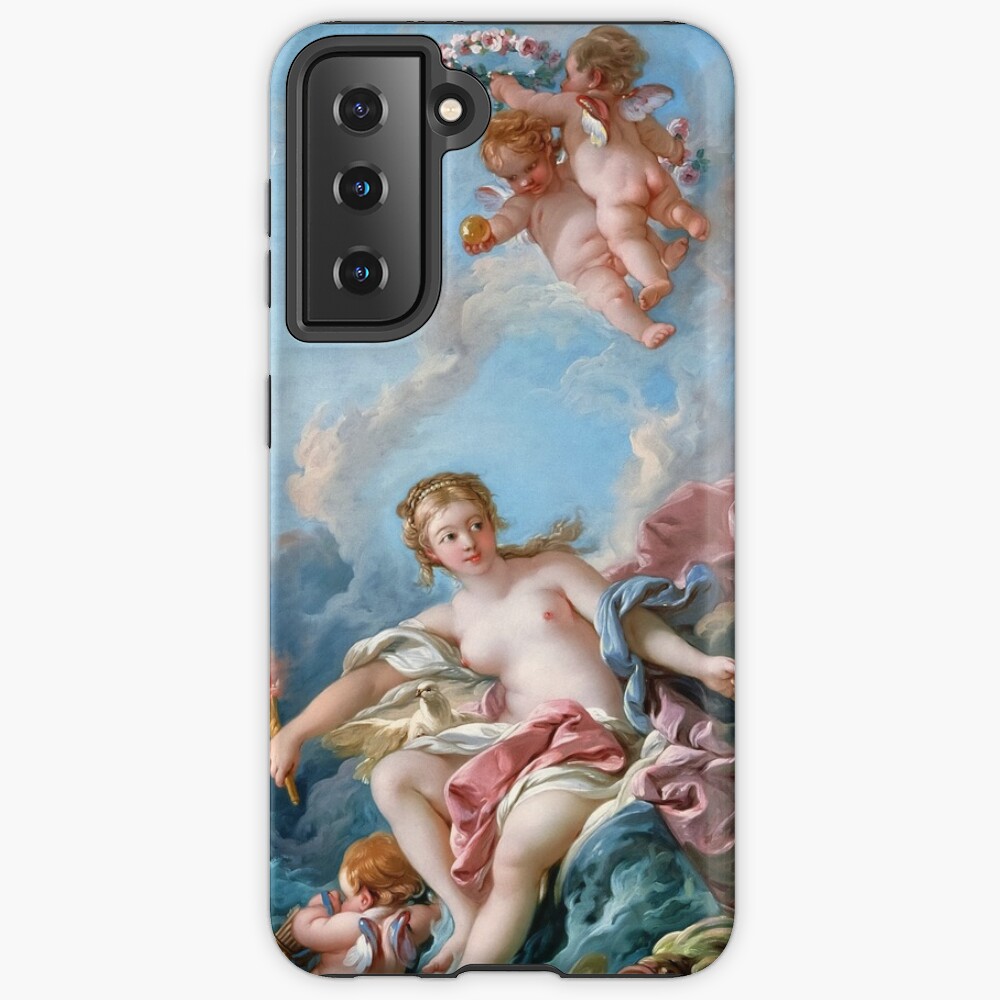
Venus is depicted in a relaxed, almost languid pose. Her body curves gently, suggesting both softness and vitality. She holds a single torch aloft, its flame casting a warm glow on her face and hands. The torch itself carries symbolic weight; it represents the divine spark of love and beauty that Venus embodies. Mae ei mynegiant yn dawel ac yn fyfyriol, conveying a sense of inner peace and detachment from the surrounding activity. This lack of overt emotion contributes to the painting’s overall atmosphere of tranquility and grace.
Palet Lliw & Effeithiau atmosfferig
The color palette in “Venus on the Waves” is dominated by soft blues, pinciau, gwyrddion, ac aur. These colors contribute to the painting’s ethereal quality and evoke a sense of warmth and light. Boucher skillfully uses atmospheric perspective – rendering distant objects with less detail and paler colors – to create a sense of depth and space within the composition. The swirling clouds and turbulent waves add dynamism to the scene, while the soft lighting enhances the overall feeling of dreamlike beauty.
Dylanwadau Artistig & Etifeddiaeth
Boucher’s work was influenced by earlier masters such as Peter Paul Rubens and Jean-Antoine Watteau, both renowned for their depictions of mythological subjects and their mastery of color and composition. Fodd bynnag, Boucher developed his own unique style that became synonymous with the Rococo movement. “Venus on the Waves” is considered one of his most iconic works and has had a lasting impact on Western art, inspiring countless artists to emulate its elegance and sensuality. The painting remains an important example of Rococo aesthetics and a testament to Boucher’s artistic genius.
Bio artist yn deillio o Wikipedia.org
Brodor o Baris, Roedd Boucher yn fab i arlunydd llai adnabyddus Nicolas Boucher, a roddodd ei hyfforddiant artistig cyntaf iddo. Yn ddwy ar bymtheg oed, edmygwyd paentiad gan Boucher gan yr arlunydd François Lemoyne. Yn ddiweddarach, penododd Lemoyne Boucher yn brentis iddo, ond ar ôl dim ond tri mis, aeth i weithio i'r engrafwr Jean-François Cars.
Yn 1720, enillodd y Grand Prix de Rome elitaidd am baentio, ond ni fanteisiodd ar y cyfle canlyniadol i astudio yn yr Eidal tan bum mlynedd yn ddiweddarach, oherwydd problemau ariannol yn yr Academi Frenhinol Peintio a Cherflunio.[1] Ar ôl dychwelyd o astudio yn yr Eidal derbyniwyd ef i'r cerflun Académie de peinture et de newydd ei addurno 24 Tachwedd 1731. Ei ddarn derbyn (darn derbynfa) oedd ei Rinaldo ac Armida o 1734.
Priododd Boucher â Marie-Jeanne Buzeau yn 1733. Roedd gan y cwpl dri o blant gyda'i gilydd. Daeth Boucher yn aelod cyfadran yn 1734 a chyflymodd ei yrfa o'r pwynt hwn wrth iddo gael ei ddyrchafu'n Athro ar y pryd yn Rheithor yr Academi, dod yn arolygydd yn y Royal Gobelins Manufactory ac yn olaf Premier Peintre du Roi (Peintiwr Cyntaf y Brenin) yn 1765. Portread o Marie-Louise O’Murphy c. 1752
Bu farw Boucher ymlaen 30 Mai 1770 yn ei wlad enedigol Paris. Ei enw, ynghyd â rhywun ei noddwr Madame de Pompadour, wedi dod yn gyfystyr ag arddull Rococo Ffrainc, arwain y brodyr Goncourt i ysgrifennu: “Mae Boucher yn un o'r dynion hynny sy'n cynrychioli blas canrif, sy'n mynegi, personoli a'i ymgorffori.”
Mae Boucher yn enwog am ddweud bod natur yn “rhy wyrdd a goleuo'n wael” (rhy wyrdd a goleuo'n wael).
Roedd Boucher yn gysylltiedig â'r engrafwr gemstone Jacques Guay, y dysgodd ei dynnu. Bu hefyd yn mentora'r arlunydd Morafaidd-Awstria Martin Ferdinand Quadal yn ogystal â'r arlunydd neoglasurol Jacques-Louis David yn 1767.[4] Yn ddiweddarach, Gwnaeth Boucher gyfres o luniau o weithiau gan Guay y gwnaeth Madame de Pompadour eu hysgythru a'u dosbarthu fel cyfrol wedi'i rhwymo'n golygus i lyswyr a ffefrir
Venus On The Waves is a retouched digital art reproduction of a public domain image that is available as a print rholio ar-lein.