

Veronica Veronese c1872
“Veronica Veronese,” created in 1872 by Italian-British painter Dante Gabriel Rossetti, is a striking example of Victorian art that showcases Rossetti’s hallmark style, an approach that merged Pre-Raphaelite principles with the personal elements of symbolism and romanticism. The painting features a young woman, Veronica, depicted with intense, almost ethereal beauty, illustrating the artist’s mastery in portraying both physical and emotional depth in his subjects. Rossetti’s ability to infuse life and narrative into the subject matter is evident in the subtle interplay of light, texture, and symbolism within the composition.
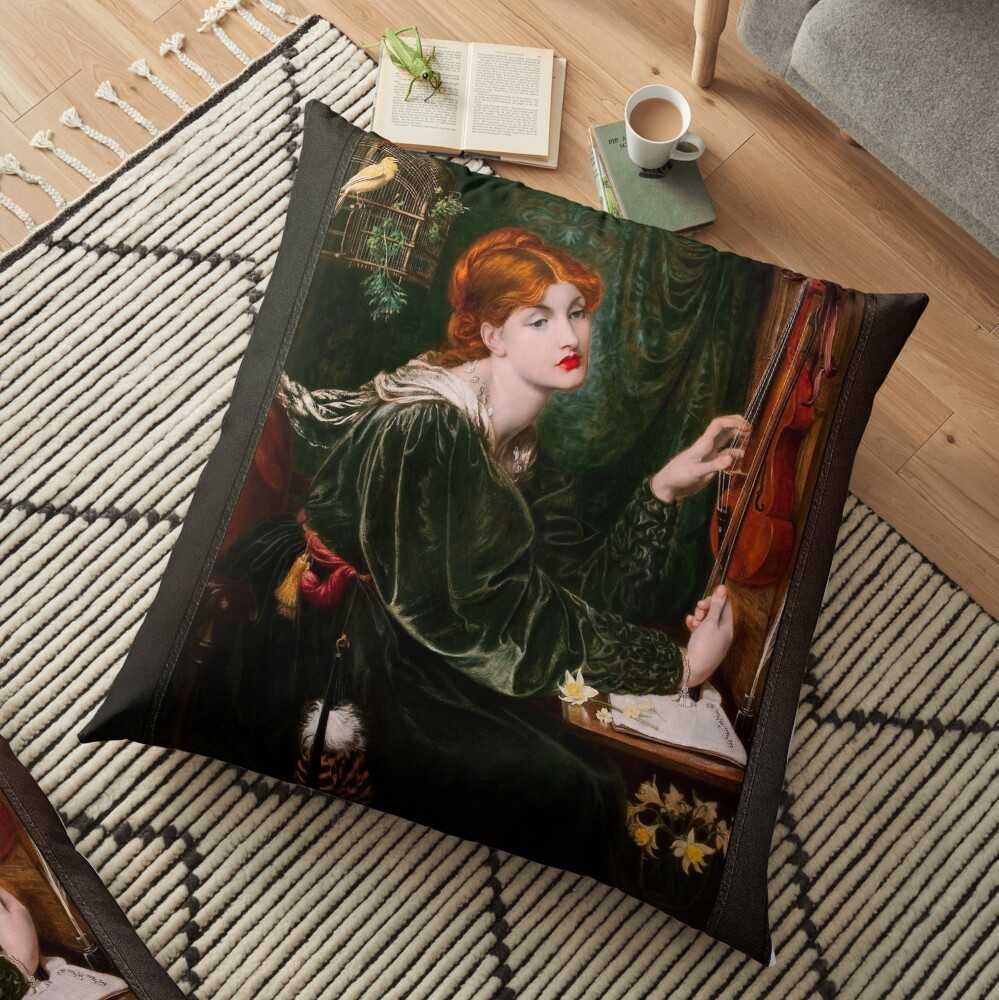
Table of Contents
Subject of the Artwork: Veronica Veronese
At the center of this artwork is the figure of Veronica Veronese, a woman of aristocratic bearing, dressed in sumptuous, dark green velvet. The style of her gown, along with the intricacies of the fabric’s folds, reveals Rossetti’s skill in portraying rich, luxurious textures. The deep green of her attire stands in contrast to her porcelain-like skin, which, combined with her delicate facial features, gives her a statuesque, yet graceful quality. The soft curls of her auburn hair frame her face, and her expressive gaze adds to the mood of wistfulness and contemplation that pervades the scene.
The posture of Veronica suggests both elegance and restraint, as she sits poised with one hand lightly resting on a violin. The violin, like many other objects in the piece, serves as a symbol of culture and refinement, connecting the viewer to the intellectual and emotional world of the subject. The inclusion of a small yellow bird in a cage—resting on the left side of the painting—introduces an additional layer of symbolic meaning. Birds, often depicted in Rossetti’s works, can represent themes of freedom, fragility, or a connection to the natural world. In this context, it likely emphasizes the tension between the subject’s quiet, controlled presence and the potential for release or escape.
Objects and Materials
In the foreground, several subtle elements complement the figure of Veronica and contribute to the overall mood of the piece. Near the bottom of the frame, a small pot of daffodils rests delicately on a wooden surface, their bright yellow petals stark against the darker background. Daffodils are often associated with themes of rebirth and the fleeting nature of life, further reinforcing the melancholic yet optimistic undercurrent of the painting. These flowers are painted with meticulous detail, highlighting Rossetti’s commitment to the depiction of natural beauty and his characteristic attention to the symbolic language of flowers.
A few other objects populate the space, such as a violin stand and musical sheets, which are placed on a nearby table. The sheet music is an important symbol of Veronica’s cultivated nature and her connection to the arts. The act of playing music or creating art was often imbued with notions of intellectual and emotional refinement during the Victorian era, and Rossetti emphasizes these traits through the objects that surround his subject.
Landscape and Setting
The background of “Veronica Veronese” consists of lush, dark green drapery, which frames the figure in an intimate yet enclosed space. This dark, rich backdrop contrasts with the vividness of the subject’s skin and the colorful elements of the still life in the foreground. The dense, velvety fabric of the curtains wraps around the figure, lending the setting a sense of privacy and introspection, as though the viewer is peering into a quiet, personal moment in time. The dark green of the curtains also reinforces the feeling of a hidden or secretive space, amplifying the tone of isolation and quiet contemplation.
The lushness of the drapery, with its deep folds and detailed textures, also highlights Rossetti’s skill in capturing the opulent aspects of the Victorian world. The use of this fabric echoes the richness of the subject’s attire, linking the two and underscoring the idea of a noble, refined lifestyle. The scene is composed so that there is a clear distinction between the subject’s personal space and the objects that serve as symbols of her character and status.
Artistic Style and Techniques
“Veronica Veronese” is a prime example of Rossetti’s refined Pre-Raphaelite style, characterized by vivid colors, attention to detail, and an almost dreamlike quality. His use of color—particularly the rich greens, deep reds, and delicate skin tones—creates an ethereal effect that gives the figure of Veronica a sense of otherworldliness. The smoothness of her skin contrasts with the fine detail of the fabric and the surrounding objects, emphasizing the idealized and somewhat unattainable beauty of the subject.
Rossetti’s brushwork in this painting is precise and deliberate, yet it retains a softness that allows the subject to appear almost life-like. The textures in the fabric of the gown, the natural elements such as the flowers, and the delicate rendering of the violin show Rossetti’s mastery in blending realism with the symbolic and emotional undercurrents of the work.
The mood of the painting can be described as one of quiet introspection, with Veronica caught in a moment of solitude. The melancholic atmosphere is heightened by her slightly averted gaze, which gives the impression of someone lost in thought, perhaps contemplating the complexities of love, art, or life itself. Her pale face, framed by the richness of the fabric and the soft lighting, gives her an almost ethereal presence. The bird in the cage can be seen as a metaphor for the artist’s own ideas of female captivity, both in terms of societal expectations and emotional restraint.
Themes and Mood
The predominant theme of the painting revolves around the notion of femininity and the inner life of the woman depicted. Rossetti’s works often explored the intersection of beauty, virtue, and sorrow, and in “Veronica Veronese,” these elements are intertwined with the theme of solitude and quiet contemplation. The subject is isolated from the external world, yet her poised, delicate nature evokes a sense of grace and dignity that suggests she is in control of her own fate.
There is also an undercurrent of longing in the mood of the piece, with the subtle symbolism of the bird and flowers suggesting both a sense of yearning for freedom and an awareness of the transience of life. Rossetti’s treatment of his subject in this painting exemplifies his interest in depicting women who are at once idealized and deeply human, revealing both strength and vulnerability.
Conclusion
Dante Gabriel Rossetti’s “Veronica Veronese” captures the essence of Victorian elegance, while also delving into the psychological and symbolic layers that characterize much of his work. The painting is a rich tapestry of color, texture, and meaning, revealing not only the artist’s technical mastery but also his deep understanding of the complex inner lives of women. Through Veronica’s serene beauty, the painting invites the viewer into a world of refinement and introspection, where the external grace of the subject contrasts with the quiet emotional depth that lies beneath.
Artwork Backstory
Veronica Veronese c1872 by Italian-British Painter Dante Gabriel Rossetti (1828 – 1882); poet, illustrator, translator and co-founder of the Pre-Raphaelite Brotherhood.
This is a companion painting to Lady Lilith that features one of Rossetti’s favorite model Alexa Wilding as Veronica Veronese that was sold to the shipping magnate Frederick Richards Leyland.
According to Wikipedia, the painting is suppose to represent the artistic soul in the act of creation”. This theme is expounded by the fictitious quote inscribed on the frame of the painting. Though the quote is attributed on the frame to “The Letters of Girolamo Ridolfi,” critics believe that Algernon Charles Swinburne (1837 – 1909) or Rossetti actually wrote it.
Suddenly leaning forward, the Lady Veronica rapidly wrote the first notes on the virgin page. Then she took the bow of her violin to make her dream reality; but before commencing to play the instrument hanging from her hand, she remained quiet a few moments, listening to the inspiring bird, while her left hand strayed over the strings searching for the supreme melody, still elusive. It was the marriage of the voices of nature and the soul – the dawn of a mystic creation.
Translation from the French by Rowland Elzea.
The symbolism in the painting includes the un-caged bird, which may represent “the marriage of the voices of nature and the soul” and overt flower symbolism. The camomile in the bird cage may represent “energy in adversity”, the primroses youth, and the daffodils reflection.
Jane Morris (1839 – 1914) lent the green dress in the picture. The violin was part of Rossetti’s collection of musical instruments, and the fan also appeared in Monna Vanna. The few bars of musical composition on the manuscript may have been borrowed from George Boyce (1826 – 1897).
This is a remastered digital art old masters reproduction of a public domain image that is available as a canvas print online.
Info below derived from Wikipedia.org
Dante was born Gabriel Charles Dante Rossetti and was the son of émigré Italian scholar Gabriele Pasquale Giuseppe Rossetti and Frances Mary Lavinia Polidori.
Dante had three siblings who were poet Christina Rossetti, critic William Michael Rossetti, and author Maria Francesca Rossetti.
As a child Dante was home schooled and when he became old enough he then attended King’s College School near the Strand in London.
Though during his college years he aspired to be a poet; he also wanted to be a painter, demonstrating great interest in Medieval Italian Art.
From 1841 to 1845 he studied at the Henry Sass Drawing Academy; he was also enrolled in the Antique School of the Royal Academy until 1848.
After leaving the Royal Academy he studied under British Painter Ford Madox Brown (1821 – 1893).
Some tie later he would meet William Holman Hunt (1827 – 1910), after his exhibition of the painting The Eve of St.Agnes, which illustrated a poem by British Poet John Keats (1795 – 1821).
Much the same as Rossetti’s painting The Blessed Damozel was an imitation of Keats; believing that Hunt might share some of his artistic and literary ideals.
Together Rossetti and Hunt would develop the philosophy of the Pre-Raphaelite Brotherhood which they founded along with John Everett Millais.