

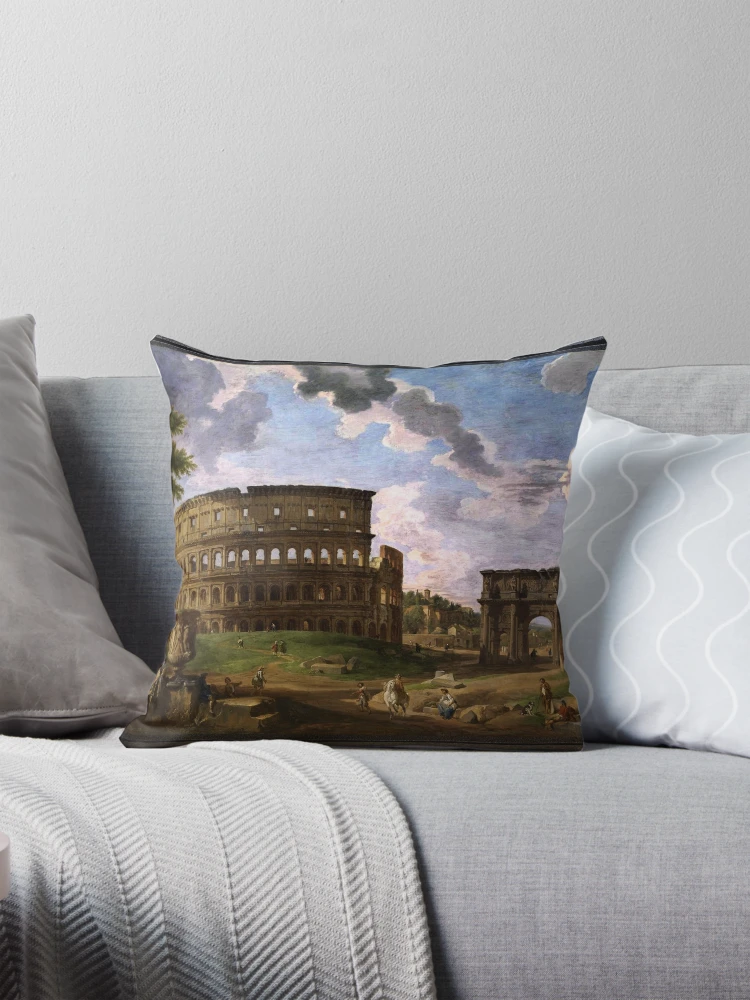
“View of the Colosseum c1747” is an artwork by Italian artist Giovanni Paolo Pannini (1691 – 1765), created during the 18th century. Pannini, a renowned artist celebrated for his works in the genre of vedute (ビュー), brings the grandeur of Rome’s monumental ruins to life through his exquisite rendition. This painting serves as both an architectural study and an evocative narrative of Rome’s ancient glory, capturing the vastness of the コロッセオ and its surrounding environment in exceptional detail.
目次
作品の主題: The Colosseum and Its Surroundings
The main subject of this artwork is the magnificent Colosseum, also known as the Flavian Amphitheatre, which stands as a symbol of Rome’s imperial past. Pannini paints the amphitheater from a slightly elevated vantage point, revealing its impressive structure from the ground level. The Colosseum is depicted in its historical ruinous state, though still retaining an air of grandeur. アーチ, 列, and the exposed skeleton of the building, battered by time and weather, dominate the canvas.
Flanking the Colosseum is an archway that appears to be a representation of the Arch of Constantine, a famous triumphal arch located nearby. This feature not only enhances the composition but also provides historical context, as both structures were significant landmarks in ancient Rome, symbolizing its power and opulence. The arch’s inclusion demonstrates Pannini’s expertise in architectural perspectives, providing a sense of scale and drawing attention to the juxtaposition of ancient civilization with the modern world of the 18th century.
The Terrain and the Landscape
The terrain surrounding the Colosseum is depicted with meticulous attention to detail. The foreground is populated with a variety of human figures, some casually strolling or gathered in groups, while others are engaged in playful activities. These figures provide a sense of scale and animation to the painting, making the ancient ruins feel more integrated with contemporary life. A few children can be seen in the lower left corner, symbolizing the passage of time and perhaps the continuity of the legacy of ancient Rome through generations.
The middle ground features the Colosseum itself, surrounded by expansive green lawns and rocky remnants. The stark contrast between the lush greenery and the crumbling stone adds to the narrative of nature’s reclamation of human creations, a theme often found in depictions of ruins. 右の方へ, the distant hills and additional architectural fragments suggest that there is more to the area beyond the immediate view, hinting at the vastness of the ancient Roman city that once thrived in this space.
The sky is a radiant blend of soft blues, 白人, and swirling clouds that stretch across the entire expanse above the scene. The lighting is carefully balanced, with sunlight illuminating the Colosseum’s structure and casting long shadows across the terrain, emphasizing its grandeur. The painter’s use of light and shadow enhances the depth and drama of the scene, highlighting the ruins’ timeless beauty and the surrounding landscape.
素材と技法
Pannini employs oil paint on canvas, a common medium during the Baroque and Rococo periods, to create this vivid representation. His mastery of perspective is evident in the way he captures the architectural details of the Colosseum and the arch. The subtle use of light, combined with intricate detailing of the stonework, enhances the realism and solidity of the structures, even as the buildings have suffered the ravages of time. His technique highlights the texture of the stone, the delicacy of the clouds, and the vividness of the figures’ clothing.
The human figures, though relatively small in comparison to the colossal architecture, are rendered with a great deal of attention to their movement and interaction. Their clothing is depicted in fine detail, showcasing the fashion of the 18th century, which serves as a subtle reminder that while the painting is about ancient Rome, it is also an observation of the modern world of Pannini’s time. This fusion of the old and new is a hallmark of Pannini’s style, where historical sites are placed in the context of contemporary life, creating a dialogue between past and present.
気分とテーマ
The overall mood of the painting is one of serenity and contemplation. Despite the ruins that dominate the composition, there is a certain peacefulness to the scene. The gentle blending of light and the pastoral setting create a sense of harmony between nature and history. The figures in the foreground, relaxed and enjoying the space around them, evoke a sense of everyday life that contrasts with the monumental scale of the Colosseum and the Arch of Constantine. This juxtaposition of human scale with the vastness of the ruins invites the viewer to reflect on the passage of time, the impermanence of civilizations, and the endurance of art and architecture.
The theme of ruin and the passage of time is prominent throughout the piece. Pannini does not simply depict the Colosseum as a static monument; he places it within a living landscape, reminding the viewer of the continual evolution of human civilization. Through the meticulous detail in his portrayal of the ruins, Pannini both celebrates the history of Rome and reflects on its eventual decay. The presence of people in the scene, interacting with the ruins, 過去と現在の対話を示唆する, 歴史が忘れられることなく、生活に影響を与え続ける場所.
結論
“View of the Colosseum c1747” ジョバンニ・パオロ・パニーニによる歴史間の相互作用を強力に視覚的に探求した作品です。, 自然, そして現代性. 壮大な建築と日常生活を融合させるパニーニの能力は、時代を超越し、描かれた 18 世紀の背景を反映した物語を生み出します。. この作品を通して, パニーニは鑑賞者に、古代ローマの遺跡を過ぎ去った時代の遺物としてだけでなく、この都市の不滅の影響力の継続的な象徴として熟考するよう促します。.
コロッセオの眺めは、パブリック ドメインの画像をデジタル アートで複製したものです。.
アーティスト略歴の由来 Wikipedia.org
ジョバンニパオロパニーニまたはジョバンニパオロパニーニは、ローマで働いていた画家兼建築家であり、主にヴェドゥータの1人として知られています (“画家を見る”).
画家として, パニーニはローマの彼の景色で最もよく知られています, 彼は街の古代遺跡に特に興味を持っていました.
彼の最も有名な作品の中には、パンテオンの内部の彼の見方があります (フランチェスコ・アルガロッティに代わって 1712 – 1764 – ベネチアン博学者), ローマの景色を含む写真ギャラリーの彼のヴェドゥータ絵画.
彼の作品のほとんど, 特に廃墟のもの, カプリッチョのテーマに特徴的な空想的で非現実的な装飾があります. この点で、彼らはイタリアの画家で印刷メーカーのマルコ・リッチのカプリッチに似ています (1676 – 1730).
パニーニも肖像画を描いた, 教皇ベネディクトゥス14世の1人を含む (生まれたプロスペロロレンツォランベルティーニ 1675 – 1758 – からカトリック教会の頭 1740 – 1758).
ローマで, パニーニは宮殿の装飾者として名を馳せました. 彼の作品のいくつかには、Villa Patrizi c1719/25が含まれていました, パラッツォデカロリスc1720, とローマ神学校c1721/22).
に 1719, パニーニはVirtuosialPantheonの会衆に入院しました. 彼はローマのアカデミアディサンルカとアカデミアデフランスで教えました, 彼がジャン・オノレ・フラゴナールに影響を与えたと言われている場所. に 1754, 彼は王子を務めました (監督) アカデミアディサンルカ.