

White Silk
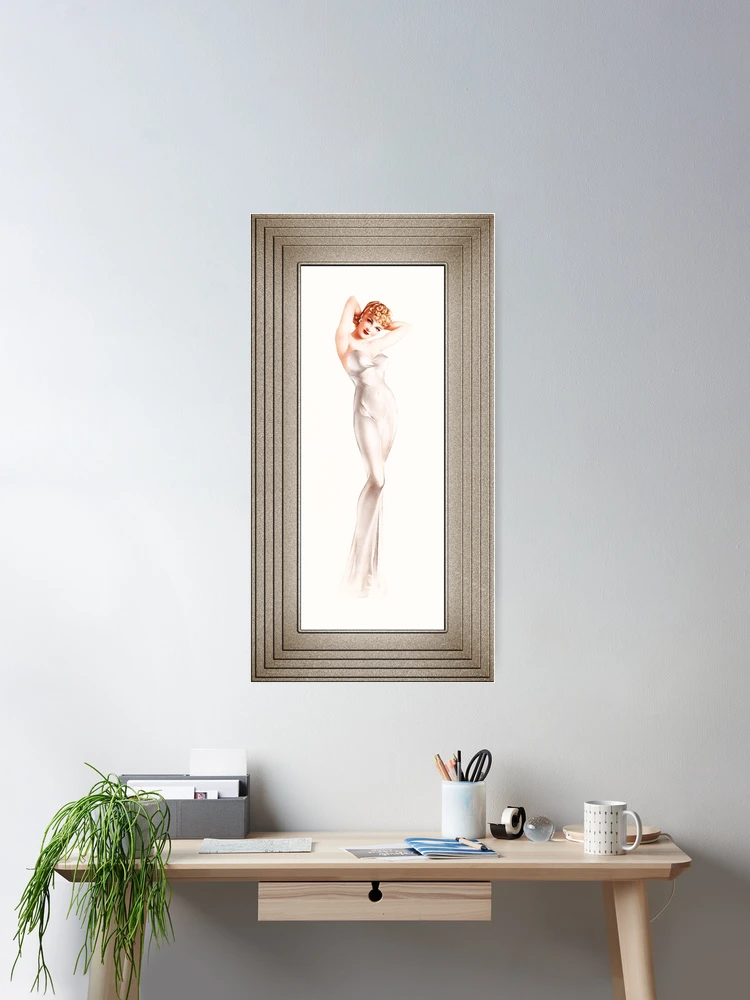
“White Silk” is a striking artwork created by Peruvian artist Alberto Vargas yn 'e midden fan' e 20e ieu, capturing the beauty of femininity through a vintage lens. Alberto Vargas, berne yn 1896 en yngean 1982, was known for his remarkable talent in the realm of pin-up art, bringing sensual elegance to life through his illustrations. Dit bysûndere stik, “White Silk,” embodies his distinctive style, marrying sophistication with allure. The piece stands as a testament to Vargas’ mastery in blending the glamour of Hollywood with classical art techniques, showcasing a timeless and evocative portrayal of a woman’s elegance.
Ynhâldsopjefte
Haadûnderwerp en komposysje
Yn it hert fan “White Silk” is a stunning female figure, depicted with soft, graceful lines and an air of effortless allure. The subject is a woman draped in a flowing, form-fitting white silk gown, which clings to her curves, evoking a sense of elegance and sensuality. Har postuer is ûntspannen noch selsbetrouwen, with her arms raised above her head, suggesting a moment of grace as she adjusts her coiffed, vintage-styled hair. Har blik is wat fan 'e kant ôf, adding an element of mystery and intrigue to the image.
The figure’s delicate features, such as her flawless skin, molke lippen, and expressive eyes, are highlighted by the soft lighting that bathes her face and body. The soft folds of the gown create a beautiful contrast against the smoothness of her skin, and the fabric’s subtle sheen adds a sense of luxuriousness to the overall composition. Har hier, a cascade of curls, complements the sophistication of her look, highlighting Vargas’ skill in creating volume and texture.
Ynstelling en Objekten
De eftergrûn fan “White Silk” is simple yet deliberate, providing a neutral, almost ethereal space that directs the viewer’s attention entirely to the subject. The lack of extraneous objects allows the viewer to focus on the form and beauty of the woman without distraction. This minimalist approach, common in Vargas’ work, enhances the mood of elegance and glamour while maintaining an uncluttered and refined aesthetic.
The absence of a detailed background is not a mere omission but rather a calculated decision by Vargas to create a timeless, universal atmosphere. The focus on the subject’s beauty and the luxurious fabric of her gown is emphasized by the stark simplicity of the space surrounding her, evoking the glamour of the early to mid-20th century when pin-up art reached its peak popularity.
Styl, Technyk, en Materialen
Alberto Vargas is known for his iconic pin-up art, often blending realistic portraiture with a soft, romanticized approach to his subjects. Yn “White Silk,” he employs a meticulous technique, using the soft blending of colors and detailed shading to achieve a lifelike appearance. The smooth transitions of light and shadow enhance the sensuality of the subject, especially in the way the gown hugs the curves of her body.
Vargas’ use of color is another noteworthy aspect of this piece. De sêfte, almost ethereal white of the silk gown contrasts with the warm tones of the subject’s skin, creating a delicate yet vibrant composition. The gleaming white of the gown stands out in contrast with the subtle skin tones, allowing the viewer’s eyes to be drawn to the fluidity of the figure. This is balanced by the soft background, which remains neutral and unobtrusive, allowing the figure to take center stage in the composition.
Vargas’ ability to capture the texture of materials is another hallmark of his style, en yn “White Silk,” this is evident in the realistic rendering of the gown’s fabric. The way light plays on the silk, creating subtle reflections and shadows, demonstrates his technical expertise in portraying textures with depth and precision.
Tema en stimming
De stimming fan “White Silk” can be described as one of timeless elegance and understated sensuality. It ûnderwerp, with her perfect posture and quiet confidence, exudes a sense of grace that transcends any specific time period, giving the artwork a universal appeal. There is an air of mystery about the subject, with her gaze turned away, suggesting a private world that is not fully accessible to the viewer.
This theme of quiet confidence and unattainable beauty was characteristic of Vargas’ work, which often portrayed women in a manner that celebrated their sensuality while maintaining a sense of dignity and allure. De sêfte, flowing nature of the white silk gown adds to the dreamlike quality of the image, giving it a sense of ethereal beauty that is both captivating and enigmatic. The subject’s graceful posture, combined with the luxurious gown, creates an atmosphere of refined beauty and timeless allure.
Legacy and Influence
“White Silk” is not just a work of art but also a reflection of the cultural and artistic climate of the time. The image of the idealized woman portrayed in this piece was emblematic of the mid-20th century’s fascination with glamour, sierlikens, and the Hollywood starlet. Wee’ contributions to the world of pin-up art have had a lasting impact on both commercial illustration and fine art, influencing not only other artists but also the way women were portrayed in popular media. His ability to combine beauty with realism made his work stand out and contributed to the enduring popularity of the pin-up genre.
Op in protte manieren, “White Silk” captures the spirit of an era when femininity, skientme, and elegance were celebrated in a way that was both bold and sophisticated. It brûken fan ljocht, weefselstruktuer, and form in this piece highlights Vargas’ skill as a painter and his ability to capture the essence of a moment in time, making this work an iconic representation of his artistic legacy.
Dit is in retouchearre reproduksje fan âlde masters fan digitale keunst fan in ôfbylding yn it iepenbier domein.
Artist Bio
Info hjirûnder Fan Wikipedia.org
Berne yn Arequipa, Perû, hy wie de soan fan de ferneamde Peruaanske fotograaf Max T. Wee. Alberto Vargas ferhuze nei de Feriene Steaten yn 1916 nei in stúdzje keunst yn Europa, Zurich, en Genève foar de Earste Wrâldkriich. Wylst er yn Jeropa wie, kaam er it Frânske tydskrift La Vie Parisienne yn 'e kunde, mei in omslach fan Raphael Kirchner, dy't neffens him in grutte ynfloed wie op syn wurk.
Syn iere karriêre yn New York omfette wurk as artyst foar de Ziegfeld Follies en foar in protte Hollywood-studio's. Ziegfeld hong syn skilderij fan Olive Thomas yn it teater, en se waard tocht as ien fan 'e ierste Vargas Girls. Wee’ meast ferneamde stik film wurk wie foar de poster fan de 1933 film The Sin of Nora Moran, dy't in hast neakene Zita Johann toant yn in pose fan wanhoop. De poster wurdt faak neamd as ien fan 'e grutste filmposters dy't ea makke binne.
Hy waard rûnom bekend makke yn 'e 1940's as de makker fan byldbepalende pin-ups út 'e Twadde Wrâldoarloch foar it tydskrift Esquire bekend as “Vargas Girls.” Tusken 1940 en 1946 Vargas produsearre 180 skilderijen foar it tydskrift. De noaskeunst fan in protte Amerikaanske en Alliearde fleantugen fan 'e Twadde Wrâldoarloch waard ynspireare en oanpast fan dizze Esquire pin-ups, lykas dy fan George Petty, en oare keunstners.