

Junges Mädchen beim Wassersammeln am Brunnen
“Young Girl Gathering Water at the Fountain” is a captivating painting created by American artist Elizabeth Jane Gardner Bouguereau in the late 19th century. Gardner, geboren in 1837 und vergeht in 1922, was a prominent figure in academic realism, and this piece reflects her mastery of the human form, natürliches Licht, and delicate expression. Set in an idyllic outdoor environment, this artwork captures the moment of a young girl interacting with a fountain, a common subject in 19th-century art that evokes themes of youth, Unschuld, und Natur.
Inhaltsverzeichnis
Subjekt und Komposition
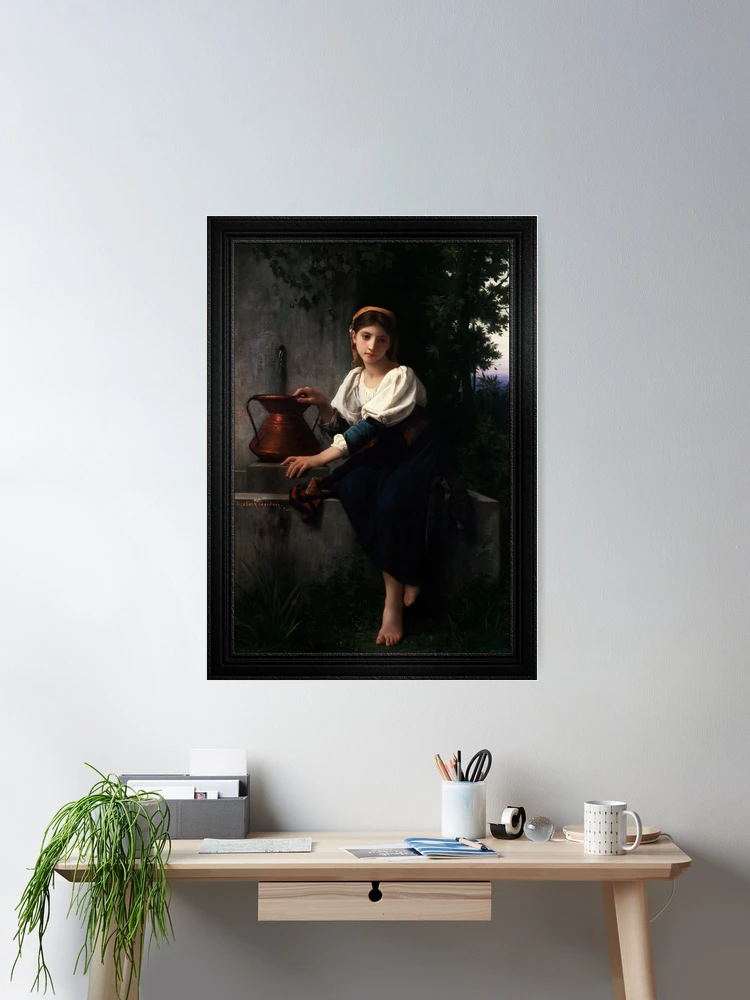
The central subject of this painting is a junges Mädchen seated next to a fountain. She is delicately positioned on the edge of a stone basin, with one hand resting on the surface of the fountain while the other gently holds a copper water jug. Ihre Haltung ist entspannt, yet purposeful, as if she is caught in the moment between tasks. The girl’s face is tender and serene, conveying an expression of quiet contemplation as she gazes off into the distance. The viewer is drawn to her gentle beauty, which is enhanced by her delicate features, including soft, smooth skin and deep, reflective eyes.
Her attire is typical of the period, featuring a loose white blouse with billowing sleeves, paired with a rich blue skirt. This simple but elegant outfit contrasts with the more intricate details of her accessories. A reddish-brown sash is tied around her waist, and a headscarf, worn in a loose knot, frames her face and adds a touch of rustic charm to her appearance. The fabric of her clothing is painted with exquisite attention to detail, capturing the soft texture of linen and wool. The artist’s precision in rendering the clothing emphasizes her technical skill, a hallmark of Gardner’s realist approach.
The girl’s bare feet are casually positioned on the stone surface, further emphasizing the natural setting and the simplicity of rural life. This focus on unadorned, natural beauty is consistent with Bouguereau’s style, which often celebrated the purity and grace of youth in rural settings.
Objekte und Symbolik
The objects within the scene play an important role in reinforcing the themes of domestic life, Natur, and labor. The fountain itself is a key element of the composition, and its presence suggests the cycle of everyday tasks that the young girl partakes in. Water, an essential resource in rural life, symbolizes life itself. The copper jug she holds is another significant object in the painting. Copper was a common material used for domestic utensils during the time, and the reflection of light on its surface adds depth to the artwork. The jug acts as a subtle metaphor for the girl’s role in the home, as well as her connection to nature and the land.
The fountain is a simple stone structure, with water flowing gently from the spout. The sound of water cascading into the basin could almost be heard from the stillness of the painting. The use of flowing water adds an element of movement to the otherwise peaceful scene. The surrounding environment features lush greenery, with ivy climbing the stone backdrop. The foliage and the light, dappled through the trees, lend the setting a serene and natural feel. The artist’s careful rendering of the plant life in the background conveys a sense of harmony between the young girl and the landscape.
Gelände und Hintergrund
Das Gelände in “Young Girl Gathering Water at the Fountain” is a picturesque and tranquil rural setting. The backdrop features a stone wall with trailing ivy that suggests a weathered, natural environment. The foliage surrounding the fountain includes rich greens and subtle earth tones, with the detailed rendering of each leaf and vine enhancing the depth of the scene.
In der Ferne, the landscape fades into a soft horizon where the sky meets a distant body of water or a continuation of lush countryside, creating a sense of vastness beyond the scene. The artist uses soft gradients of color in the background to evoke the warmth of sunlight filtering through the trees, casting a gentle glow across the girl’s face and surroundings.
Gardner Bouguereau’s choice of landscape highlights a sense of peace and simplicity, reflecting a rural life untouched by the noise of urban society. Die Ruhe, natural setting reinforces the mood of tranquility and timelessness, making the scene feel both intimate and universal. The detailed texture of the stone and the foliage contrasts beautifully with the smoothness of the girl’s skin and the flowing nature of her attire, creating a balance of solidity and fluidity within the painting.
Künstlerischer Stil und Technik
As with many of her works, Elizabeth Jane Gardner Bouguereau employed a highly refined and meticulous style in “Young Girl Gathering Water at the Fountain.” Her use of light and shadow is particularly noteworthy, as it serves to model the forms of the figures and create a sense of depth within the composition. The gentle diffusion of light across the girl’s face and clothing enhances the realism of the scene and brings an almost photographic quality to the work.
Gardner Bouguereau was influenced by the academic tradition of French realism, which emphasized the accurate and detailed portrayal of human figures, particularly in outdoor settings. Her mastery of flesh tones and the representation of the human form is on full display in this painting. The careful attention to anatomical detail, such as the subtle play of light across the girl’s face and body, reveals the artist’s technical prowess. Her ability to capture the texture of fabrics and the reflective quality of light on surfaces is one of the defining aspects of her work, and it is especially evident in this painting.
Stimmung und Thema
The mood of the painting is one of peaceful contemplation, with an undercurrent of nostalgia for a simpler time. The scene evokes a sense of harmony between the figure and the natural world, reinforcing the connection between youth, Unschuld, und Natur. The girl, seated at the fountain, represents an archetype of rural life, embodying the purity and grace that were highly regarded in academic realism. The simplicity of her task – gathering water – reflects the importance of domestic chores and the relationship between humans and the land.
The overall theme of the painting is one of timelessness. The young girl and her actions transcend any specific era or place, representing universal values of youth, Einfachheit, and the connection to nature. The painting invites the viewer to reflect on the past and on the enduring beauty of rural life.
Abschluss
“Young Girl Gathering Water at the Fountain” by Elizabeth Jane Gardner Bouguereau is a masterful example of 19th-century academic realism. Through her technical expertise and her delicate portrayal of the human form, Gardner Bouguereau captures a serene moment in the life of a young girl. Die Liebe zum Detail, the balance of light and shadow, and the harmonious composition all contribute to the timeless beauty of this piece. It serves as both a celebration of youth and nature, as well as a poignant reminder of the simplicity and grace that can be found in the everyday tasks of life.
Dies ist eine retuschierte Reproduktion eines gemeinfreien Bildes durch digitale Meister alter Meister.
Künstler Bio abgeleitet von Wikipedia.org
Elizabeth Gardner wurde in Exeter geboren, New Hampshire, und besuchte die Young Ladies Female Academy in Exeter; und besuchte später das Lasell Female Seminary in Auburndale, Massachusetts; Studium der Kunst und Sprachen mit Schwerpunkt Englisch, Französisch, Italienisch und Deutsch.
Im 1856 sie absolvierte das Lasell Female Seminary und verbrachte die nächsten Jahre damit, Französisch an einer neu eröffneten Schule in Worcester zu unterrichten, Massachusetts.
Sie unterrichtete auch Kunst am Lasell Female Seminary, und in 1864 zusammen mit ihrer Freundin und Kollegin Imogene Robinson (1828 – 1908); ein amerikanischer Porträt- und Historienmaler ging nach Frankreich, das in den kommenden Jahren ihr neues Zuhause werden sollte.
Während ihrer frühen Jahre in Frankreich studierte sie bei dem figurativen Maler Hugues Merle (1823 – 1881), Salonmaler Jules Joseph Lefebvre (1836 – 1911) und William-Adolphe Bouguereau (1825 – 1905); in wen sie später heiraten würde 1896.
Um über die Runden zu kommen und ihre Miete zu bezahlen, verbrachte sie in dieser Zeit einen Großteil ihrer Zeit damit, Gemälde zeitgenössischer Künstler und die Kunstwerke alter Meister in verschiedenen renommierten Galerien zu kopieren.
Später im Herbst von 1864 Elizabeth beschloss, sich an der Ecole des Beaus-Art zu bewerben; Ihr Antrag wurde jedoch abgelehnt, da die Schulen zu diesem Zeitpunkt nur von Männern besetzt waren und das Verbot der Einschreibung von Frauen erst aufgehoben werden würde 1897.
Dies schreckte Elizabeth jedoch nicht ab und sie fuhr fort, in Privatunterricht einzuschulen, Verlangsamung des Aufbaus eines herausragenden Portfolios ihrer Arbeit.
Gardners bekanntestes Werk ist The Shepherd David Triumphant c1895, das zeigt den jungen Hirten mit dem Lamm, das er gerettet hat.
Unter ihren anderen Werken waren Cinderella, Cornelia und ihre Juwelen, Corinne, Wahrsager, Maud Müller, Daphne und Chloe, Ruth und Noomi, Die Tochter des Bauern, Die bretonische Hochzeit, und einige Portraits.