

Boireannach òg le Hydrangeas
Boireannach òg le Hydrangeas (Boireannach òg le Hydrangeas) leis a ’pheantair Frangach Élisabeth Sonrel (1874 – 1953); agus dealbhaiche de stoidhle Art Nouveau; bha an obair aige a ’toirt a-steach cuspairean allegorical, ana-cainnt agus samhlachas, dealbhan agus cruthan-tìre.
The painting Young Woman with Hydrangeas (c. 1900) by the French artist Elisabeth Sonrel presents a delicate and contemplative scene, one that radiates the essence of late 19th-century European sensibilities and aesthetic charm. Through her thoughtful use of soft, natural tones, solais socair, agus cuspairean clasaigeach, Sonrel offers a portrayal of beauty that captures the spirit of the Belle Époque era, a period marked by its appreciation for nature, boireannachd, and delicate elegance.
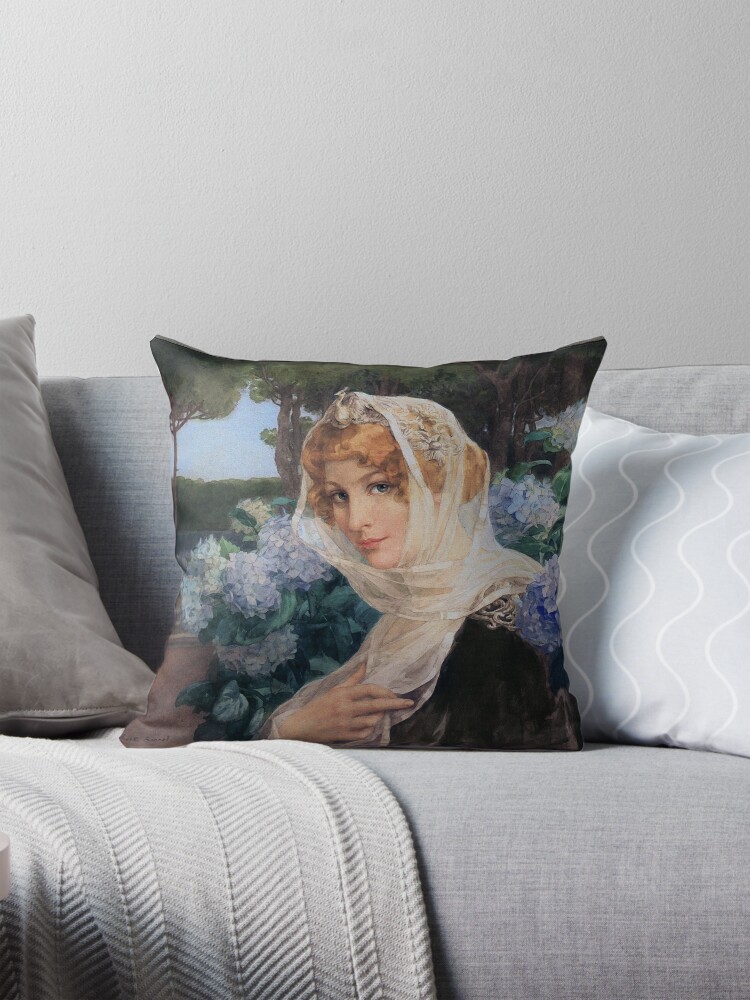
At the heart of this artwork is a boireannach òg, poised with grace and serenity. She occupies the foreground of the composition, the viewer’s gaze immediately drawn to her as the central figure. The woman’s face is framed by soft, wavy hair that spills gently down her shoulders, with subtle hints of warmth in the light brown and auburn hues.
A h-gòrach aice, though not directed outward, carries an air of introspection, as if she is lost in a private, peaceful reverie. Her eyes are soft and her expression serene, conveying a deep sense of tranquility. This sense of calm is enhanced by her posture; she is seated with one hand delicately holding a cluster of hydrangeas, their intricate, multi-toned petals painted with precision and grace.
The hydrangeas, a symbol of beauty, gràs, and abundance, are not merely decorative in this piece but rather serve as a reflection of the subject’s character and the mood of the composition. They are rendered with exquisite detail, each flower appearing to bloom under a soft, solas àrainneachd.
The colors range from rich, deep purples to soft pinks and blues, creating a vivid contrast with the more muted tones of the young woman’s attire. These flowers seem to breathe life into the portrait, making them an essential component in conveying the overall theme of natural beauty and the fleeting, ephemeral nature of youth and femininity.
The woman’s clothing also plays a key role in the narrative of the painting. An gùn aice, adorned with subtle lace and floral patterns, evokes the restrained elegance typical of the late 19th century. The soft hues of her dress—pale creams and whites—complement the colors of the hydrangeas, creating a harmonious relationship between the figure and her floral surroundings. The fabric of her gown is portrayed with remarkable texture, conveying its delicacy and fine quality.
The drapery falls in soft folds around her body, further enhancing the sense of grace that pervades the entire composition. A h-aodach, with its refined cut and high collar, suggests a degree of modesty, in keeping with the values of the time, yet the soft detailing allows for an undercurrent of sensuality and softness to emerge.
Air cùlaibh a' chuspair, the background provides a serene, natural landscape that enhances the intimate, peaceful mood of the painting. The artist has opted for a slightly blurred and ethereal rendering of the surrounding foliage, with the soft light filtering through the trees and casting a warm, diffused glow over the figure.
The background is not overpowering but serves to frame the young woman in a gentle embrace of nature, suggesting a deep connection between the subject and her environment. The interplay of light and shadow on the leaves and flowers subtly echoes the light touch and serenity that pervades the figure, creating a seamless balance between subject and surroundings.
The artist’s choice to depict the woman against this natural backdrop also suggests a celebration of the harmony between human life and nature. The quietude of the landscape complements the figure’s pensive demeanor, evoking themes of renewal, fàs, and cyclical beauty. Am bog, muted greens of the foliage, together with the delicate tones of the hydrangeas, contribute to the painting’s overall sense of stillness and calm.
The palette used in Young Woman with Hydrangeas is another important feature of the artwork. Sonrel’s use of light, pastel tones—pale blues, pincain, greens, and soft yellows—creates an atmosphere of ethereal elegance, lending the scene a dreamlike quality. The composition is bathed in a soft, almost golden light, lending a sense of timelessness to the scene.
The colors are not bold or jarring but rather gentle and soothing, contributing to a sense of peace and refinement. These soft hues are paired with more subdued, dathan nàdarra, creating a perfect balance between warmth and coolness, Solas agus dubhar.
A thaobh stoidhle, Sonrel’s painting reflects the highly refined academic tradition that was popular in France during the late 19th century. Her work demonstrates technical mastery, especially in the detailed rendering of the hydrangeas and the folds of the woman’s gown. Am bog, almost luminous quality of the work, achieved through the artist’s nuanced application of paint, demonstrates an intimate knowledge of how to capture light and texture.
There is an emphasis on fine detail, particularly in the treatment of the flowers and the fabric of the woman’s dress, which invites the viewer to appreciate the careful craftsmanship behind the scene. Aig an aon àm, the soft blending of colors and the gentle modeling of light create an almost impressionistic atmosphere, with an emphasis on mood rather than strict realism.
The theme of the painting is one of natural beauty, neo-chiontach, agus introspection. The hydrangeas, symbolizing both abundance and the transience of life, are paired with the figure of the young woman, who seems to embody the fleeting nature of youth and beauty. Am bog, glowing light and gentle colors emphasize the theme of fragility, reminding the viewer of the ephemeral nature of time and the beauty it bestows. The mood of the painting is calm and contemplative, suggesting a moment of stillness in which the subject is lost in thought or quietly appreciating the beauty of her surroundings.
Ann an co-dhùnadh, Young Woman with Hydrangeas by Elisabeth Sonrel is a work that captures the delicate interplay between beauty, nàdur, agus siubhal ùine. Through her meticulous attention to detail, the artist has created a piece that speaks to the viewer on both an emotional and aesthetic level, evoking a sense of serenity and timelessness that transcends the boundaries of the canvas.
Tha Young Woman le Hydrangeas na seann mhaighstirean ealain didseatach ath-dhealbhaichte de ìomhaigh àrainn phoblach.
Fiosrachadh gu h-ìosal bho Wikipedia.org
Ealasaid Sonrel (1874 Tursan - 1953 Ròin) na pheantair agus dealbhadair Frangach ann an stoidhle Art Nouveau. Am measg na rinn i bha cuspairean allegorical, ana-cainnt agus samhlachas, dealbhan agus cruthan-tìre.
Bha i na nighean aig Nicolas Stéphane Sonrel, peantair bho Tours, agus fhuair i an trèanadh tràth bhuaithe. Airson tuilleadh ionnsachaidh chaidh i air adhart gu Paris mar oileanach aig Jules Lefebvre aig an Ecole des Beaux-Arts.
Ann an 1892 pheant i an obair dioplòma aice, ‘Pax et Làbarach’, obair ri fhaicinn aig na Musée des Beaux-Arts de Tours. Bhon uairsin bha i a ’taisbeanadh aig an Salon des Artistes Français eadar 1893 agus 1941, na pìosan ainm-sgrìobhte aice le dathan uisge mòr ann an dòigh Ro-Raphaelite, a ghabh i ris às deidh turas gu Florence agus an Ròimh, faighinn a-mach peantairean an Ath-bheothachadh – cuid den obair aice le overtones soilleir de Botticelli. Bha na dealbhan aice gu tric air am brosnachadh le romansa Artair, Comadaidh Diadhaidh Dante Alighieri’ agus 'Am Beatha Ùr', cuspairean a ’Bhìobaill, agus uirsgeulan meadhan-aoiseil. Am measg nan obraichean dìomhair aice tha ‘Ames errantes’ (Salon de 1894) agus ‘spioradan an Abyss’ (Salon de 1899) agus "Boireannach òg leis a’ ghrèis-bhrat ".
Aig an Exposition Universelle de 1900, b ’e Art Nouveau am prìomh chuspair, rithe 1895 a ’peantadh‘ Cadal na Maighdinn’ (Cadal na Maighdinn), fhuair e bonn umha, agus duais Henri Lehmann de 3000 francs le Acadamaidh nan Ealan Fine.[3] Bho 1900 air adhart chuir i an dealbh aice ri dealbhan, seallaidhean-tìre breagha sa Bhreatainn Bhig, agus corra sgrùdadh fhlùraichean.
Bhiodh i a ’dèanamh tursan peantaidh cunbhalach don Bhreatainn Bhig, air a bhrosnachadh le coille Brocéliande, agus bho 1910 gu diofar àiteachan air an oirthir leithid Concarneau, Plougastel, Pont-l'Abbé agus Loctudy, glè thric a ’fuireach aig taighean-seinnse agus còmhla ri oileanach no dhà. Pheant i grunn obraichean ann an Le Faouët mus do thog i baile ann an La Baule anns na 1930an. Ag obair mar as trice ann an dathan uisge agus gouache, fhuair i a-mach solar deiseil de mhodalan am measg nigheanan òga san sgìre, agus fhuair iad Bretons càirdeil san fharsaingeachd, onarach agus fèin-mhisneachail.
Bha an taisbeanadh mu dheireadh aice aig an Salon a-staigh 1941 aig aois 67. Tha clàr ann cuideachd gun do rinn i taisbeanadh ann an Liverpool. Nuair a bha i òg, rinn Sonrel postairean, cairtean-puist agus dealbhan, ann an stoidhle Art Nouveau.