

A Summer Rose
Francois Martin-Kavel (1861 – 1931), a prominent French painter, captured the essence of elegance and romance in his exquisite portrait titled A Summer Rose. Completed during the height of his career, this painting is a captivating testament to the delicate beauty of women, as well as a perfect embodiment of late 19th-century artistic ideals.
Through this composition, Martin-Kavel invites the viewer into a world where beauty, izadi, and innocence intertwine, all while adhering to the principles of classical portraiture. Margolanaren gaia, emakume gazte bat, exudes a gentle, yet strong, liraintasun, with her soft expression and elegant attire framing her delicate features.
Edukien taula
Gai nagusia
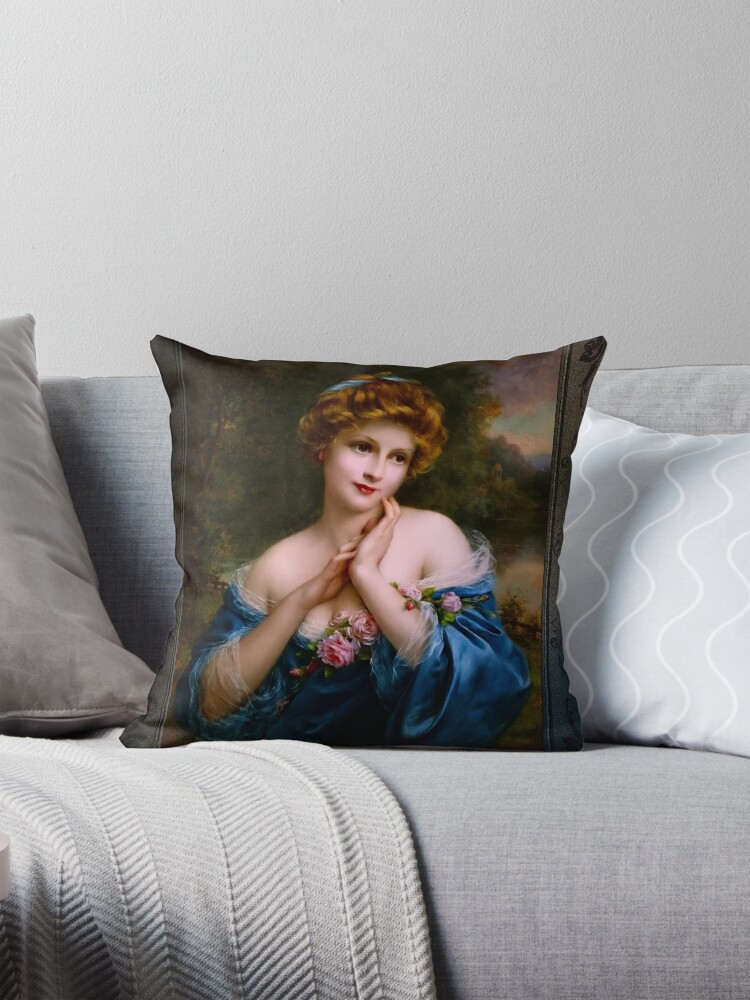
Erdiko irudia A Summer Rose is a woman of youthful innocence, portrayed with an almost ethereal quality. Bere biguna, rosy complexion and delicate expression immediately draw attention. Bere aurpegia bigunez markatuta dago, wavy hair in a rich golden hue, with the strands gently flowing around her forehead and down her neck.
A soft blue ribbon, tied in her hair, adds a charming touch, gently contrasting with the warm tones of her hair and skin. Bere begiak, although not directly meeting the viewer’s gaze, suggest a quiet contemplation or introspection. The slight tilt of her head and the subtle yet confident pose of her hands convey a sense of poise and grace, as though she is caught in a serene moment of reflection.
Her attire is intricately designed, combining both opulence and softness. She is draped in a gown of soft blue and white, with the fabric billowing out from her shoulders in soft, transparent layers, which are adorned with gentle touches of floral elements. The gown’s flow and structure seem to merge seamlessly with the delicate pink roses that encircle her form.
These roses, which appear to be both a natural extension of her attire and symbolic of the subject’s grace, further enhance the painting’s overall theme of youthful femininity and beauty. The roses seem to blossom from the fabric, as though they were a part of her very being, lending a dreamlike quality to the entire composition.
The Objects and Details
The background of the painting is rich with natural beauty, complementing the delicate nature of the subject. Biguna, atmospheric landscape behind the young woman features a muted, yet vibrant, combination of green foliage and distant hills. A faint, almost ethereal light filters through the trees, casting a soft glow across the scene.
The sky above is bathed in warm hues, suggesting the late afternoon or early evening hours, a time when nature itself seems to pause in reverence. Biguna, almost indistinct quality of the landscape in the distance contrasts beautifully with the finely detailed foreground, where the woman is placed.
The roses that frame the figure, along with the faint hint of a flowering vine on the gown, further suggest the passage of time and the season of summer. These symbols of nature, fragile, yet vibrant, act as metaphors for the subject’s own youth and beauty.
They seem to speak of fleeting moments, encapsulating the ephemeral nature of life and love. Modu askotan, the roses and the soft landscape work together to underscore the subject’s delicate beauty, while the painting as a whole evokes the theme of an idealized, timeless feminine form.
Estiloa eta Teknika
Martin-Kavel’s technique in A Summer Rose showcases his mastery of light, kolorea, eta ehundura. The soft transitions of light and shadow on the subject’s face are rendered with meticulous attention to detail, creating a sense of depth and three-dimensionality. Artistak kolorearen erabilera trebea, particularly the contrasts between the pale skin of the subject, the soft blue of her gown, and the rich greenery of the background, is a hallmark of the late 19th-century French academic style.
Each element of the painting is rendered with a high level of realism, from the texture of the fabric to the subtle play of light on the woman’s face. The result is a work that feels both natural and timeless, a frozen moment in a world of beauty and grace.
The brushwork is refined, with smooth transitions between the various elements of the painting. Martin-Kavel’s handling of the fabric, with its delicate folds and shimmering textures, demonstrates his thorough understanding of materiality and movement.
Arrosak, ere bai, are delicately painted, with the soft petals appearing almost tangible. The texture of the leaves, the stems, and the blossoms are rendered in such a way that they seem to come alive within the context of the piece. The attention to detail in these elements enhances the sense of realism, while the overall composition remains harmonious and carefully balanced.
Gaia eta Aldartea
Gaia A Summer Rose is undeniably romantic, capturing the essence of youthful beauty, lañotasun, and the transient nature of time. Biguna, muted tones of the painting evoke a sense of serenity and calm, while the figure of the woman embodies an idealized vision of femininity. Loreak, particularly the roses, serve as symbols of both beauty and fragility, edertasun hori iradokiz, like nature, is both fleeting and precious. The artist’s choice to portray the subject in an almost dreamlike atmosphere, surrounded by the ethereal glow of the landscape and the delicate roses, speaks to the artist’s desire to preserve a moment of grace and purity.
Margolanaren aldartea kontenplazio lasaiarena da. The subject’s gentle expression, combined with the soft glow of the surrounding environment, suggests a calm, peaceful world where beauty is celebrated in its most natural and unhurried form. The viewer is invited to pause and reflect, to appreciate the delicate, timeless beauty of the moment captured on the canvas.
Bukaera
A Summer Rose by Francois Martin-Kavel is a masterpiece that encapsulates the beauty and grace of its subject, as well as the fleeting nature of youth and beauty. Through his use of color, argia, eta ehundura, the artist creates a world where nature, emakumea, and symbolism are seamlessly intertwined. The portrait stands as both a celebration of feminine beauty and a meditation on the passage of time, inviting the viewer to pause and appreciate the delicate moments that make up life’s most cherished memories.
This old masters reproduction of a public domain image, Xzendor7 webgunean aurki daitezkeen artelan guztiak bezala sarean erosteko eskuragarri dago hainbat material formatutan, mihise inprimatuak barne., estanpatu akrilikoak, metal estanpatuak, egur estanpatuak, marko estanpatuak, kartelak, eta gisa ijetzitako mihise inprimatuak hainbat tamainatan 12 zentimetroetara 72 hazbeteko artelanaren eta artea erosteko aukeratzen duzun eskaeraren arabera inprimatzeko dendaren tamainaren arabera.
Erabili esteka hau erosteko Ornament Assets used to create the frame in this piece; the bundle includes 400 elements of beautifully designed ornaments.
Artistaren biografia
Informazioa Behean Deribatua Artnet.com
François Martin-Kavel genero margolari frantsesa izan zen, emakume gazte ederren erretratu idealizatuengatik ezaguna dena, maiz jantzi exotikoekin edo biluzteko egoera ziligarrietan irudikatzen zuena.
Martin-Kavelek sarritan margotu zituen emakumezkoen erretratuak ehun hondo ilunez inguratutako konposizio zentratuetan., eta antzerkian argiztatuta fokuak maketa distiratsuak balira bezala.
Nahiz eta François ezaguna izan bere emakumezkoen erretratu ezagunengatik, bere bodegoietako lore artelanengatik eta paisaia margoengatik ere ezaguna zen; eta ohiko erakusketari izan zen Salon des Artistes Français-en.
Apaindegiko kide gisa, urtean egindako ekarpen artistikoengatik domina bat eman zioten 1881.